
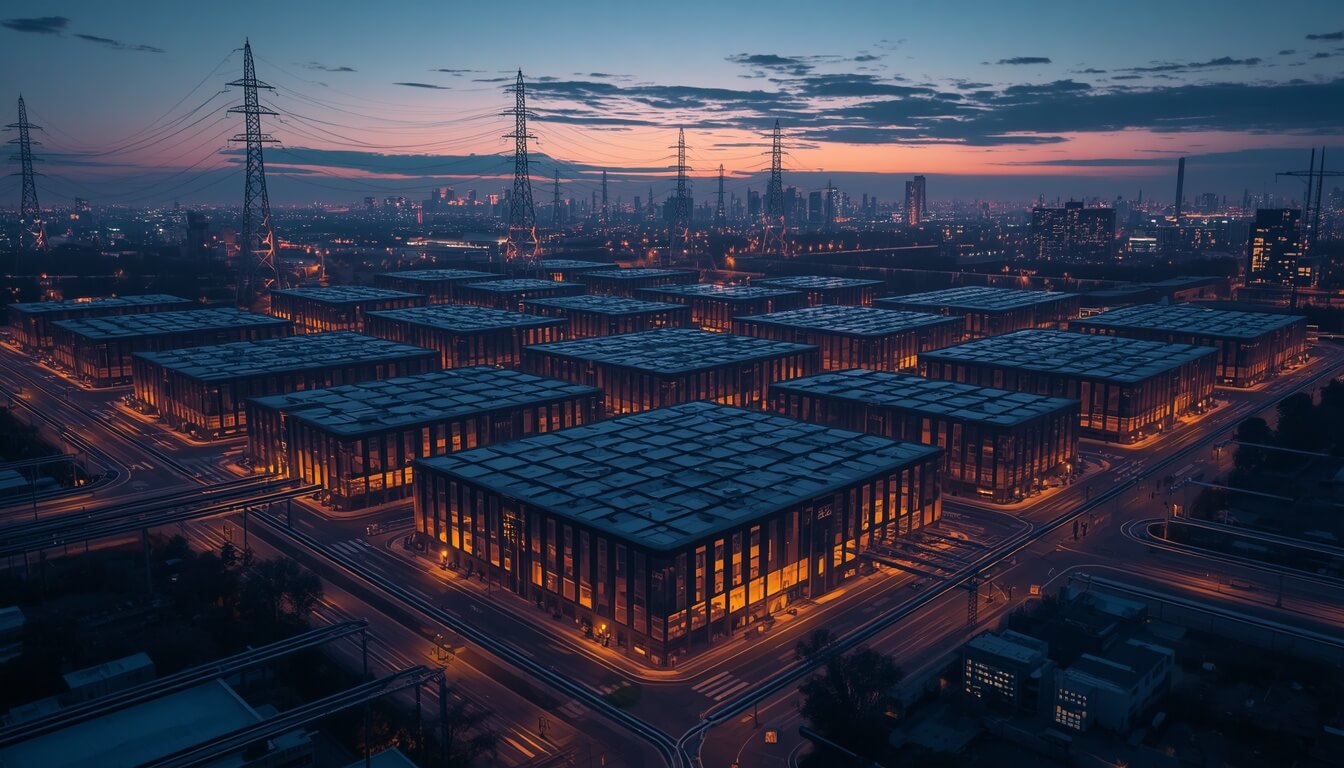
AI data centers are specialized facilities that provide the computing power needed to train artificial intelligence models and run AI applications. They contain powerful processors, servers, networking equipment, cooling systems and electrical infrastructure.
Every time someone uses an AI chatbot, generates an image or accesses an AI-powered application, computers inside a data center may process that request.
For investors, AI data centers matter because their expansion creates demand for semiconductors, electricity, cooling equipment, construction and other infrastructure. The opportunity extends beyond AI software companies, although growing demand does not guarantee profits for every business involved.
What exactly does an AI data center do?
An AI data center provides the computing resources needed to develop and operate artificial intelligence.
Traditional data centers support websites, streaming, cloud services and business applications. AI workloads often require more specialized processors, faster connections between machines and greater electrical capacity.
AI data centers perform two main tasks:
- Training: Developing or improving AI models by processing large datasets, sometimes using thousands of specialized processors working together.
- Inference: Running trained models to answer questions, generate content or complete tasks requested by users.
Training large models can require enormous computing resources. Inference creates ongoing demand as millions of people and businesses use AI applications every day.
Both activities help explain why companies are expanding their computing infrastructure.
What is inside an AI data center?
An AI data center depends on several interconnected systems:
- AI processors: Specialized chips, including graphics processing units (GPUs), that perform calculations for AI models. Nvidia is a major supplier of these processors.
- Servers and storage: Equipment that runs applications and manages large amounts of data.
- Networking: High-speed connections that allow thousands of processors to exchange information efficiently.
- Cooling: Systems that prevent powerful computing equipment from overheating.
- Electrical infrastructure: Transformers, power distribution equipment and backup systems that keep facilities operating reliably.
These components must work together. A facility equipped with expensive AI processors cannot operate at full capacity without sufficient electricity, cooling and network connectivity.
Electricity is particularly important. Lawrence Berkeley National Laboratory estimated that data centers consumed approximately 4.4% of U.S. electricity in 2023. Its projections suggest that share could reach 6.7% to 12% by 2028, depending on future growth.
These figures cover data centers broadly, not AI facilities alone, but they illustrate why computing infrastructure is increasingly connected to utilities and electricity-grid investment.
Why is AI creating so many new data centers?
Demand is growing because businesses are adding AI capabilities to their products while consumers increasingly use chatbots, image generators and other AI services.
Microsoft, Amazon and Alphabet are investing heavily in computing infrastructure to support their own AI products and provide cloud services to customers.
The International Energy Agency projected that global data center electricity consumption could more than double between 2024 and 2030, reaching approximately 945 terawatt-hours annually in its base-case scenario.
Meeting that demand requires more than building facilities. Companies must secure processors, servers, networking equipment, construction services and reliable electricity supplies.
For example, Nvidia supplies AI processors, while companies such as Vertiv provide power and cooling infrastructure. These businesses participate in different parts of the same investment cycle.
However, rising infrastructure spending does not guarantee attractive profits. Competition, production costs and customer demand determine how much value each supplier captures.
For a closer look at the companies involved, see Who Builds AI Data Centers and Who Profits From Them.
Who is paying for all this infrastructure?
Technology companies, cloud providers and specialized data center operators finance much of the construction and computing equipment. They expect to recover those investments through cloud services, AI subscriptions and payments from business customers.
However, large facilities may also require new substations, transmission lines and additional electricity generation.
That raises an important financial question: who should pay for the electrical infrastructure needed to support new data centers?
Some costs may be covered directly by developers through connection charges or negotiated agreements. Others may become part of broader utility investment plans, depending on local regulations.
For investors, these decisions affect project economics, utility spending and potentially electricity prices for other customers.
Who Pays for AI Data Centers and How They Affect Utility Bills examines these financial consequences in more detail.
Why do AI data centers need so much electricity?
AI processors perform intensive calculations, often with thousands of chips operating simultaneously. This consumes electricity and generates heat that cooling systems must remove.
Networking, storage and supporting equipment require additional power.
The challenge is not simply how much electricity a facility uses. It is whether enough reliable power is available at the location where developers want to build.
Computing equipment can sometimes be installed faster than utilities can expand transmission lines, substations and grid connections. These infrastructure projects may take years.
As a result, insufficient electrical capacity can delay a data center even when its financing and computing equipment are ready.
Water use is another consideration. Some cooling technologies consume substantial amounts of water, while others rely on air cooling or closed-loop systems. Actual consumption varies by location, climate and facility design.
The broader environmental and infrastructure implications are explored in How Much Energy and Water AI Data Centers Use.
Why are some communities opposing new data centers?
Data centers can generate construction activity, property tax revenue and demand for local services. However, their development can also create concerns for nearby communities.
Residents may worry about electricity prices, water consumption, noise, land use and the cost of expanding public infrastructure.
Employment is another consideration. Construction can create substantial temporary employment, but completed data centers generally require relatively small permanent operating teams compared with many labor-intensive industrial facilities.
Communities must therefore weigh potential economic benefits against infrastructure costs and environmental concerns.
For investors, opposition matters because permitting disputes, additional requirements and legal challenges can increase development costs or delay projects.
The main sources of local resistance are examined in Why Some Communities Oppose AI Data Centers.
Where are AI data centers being built?
Developers select locations based on several practical requirements:
- Reliable electricity and available grid capacity.
- High-speed fiber-optic connectivity.
- Suitable land and construction conditions.
- Access to cooling resources.
- Permitting requirements, taxes and infrastructure costs.
Northern Virginia is one of the largest established U.S. data center markets, supported by extensive fiber networks and an established technology ecosystem.
However, growing electricity demand and grid constraints are encouraging developers to consider additional regions, including parts of Texas and other markets with available land and potential access to substantial power supplies.
Location directly affects project economics. A facility with secured electricity capacity and existing infrastructure may begin operating sooner than one waiting for major grid upgrades.
For a closer look at regional development, see Where AI Data Centers Are Being Built in the US.
Could something eventually replace traditional data centers?
AI infrastructure will evolve, but centralized data centers are unlikely to disappear simply because alternative computing technologies emerge.
One approach is edge computing, which processes certain tasks closer to users or connected devices rather than sending everything to distant facilities. This can reduce delays and network traffic.
Other developments include more efficient processors, advanced cooling systems and facilities located near dedicated electricity supplies.
Underwater data centers and unconventional designs have also been explored, although their commercial adoption remains limited.
For investors, the key question is whether these technologies can materially reduce computing costs or change demand for traditional infrastructure.
What Could Replace Traditional AI Data Centers explores these alternatives and their potential impact.
Why AI data centers matter for investors
AI data centers create investment exposure across several industries, not just companies developing artificial intelligence software.
Potential beneficiaries include semiconductor manufacturers, server suppliers, networking specialists, cooling equipment producers, electrical equipment manufacturers, utilities and construction businesses.
This is sometimes called the "picks and shovels" approach: investing in companies supplying essential equipment and services rather than trying to predict which AI application will become the market leader.
For example, Nvidia sells AI processors, while electrical infrastructure suppliers can benefit from the need to power increasingly demanding computing facilities. Their products are different, but both support the expansion of AI computing capacity.
However, investors must distinguish between growing sales and attractive investment returns.
Data center operators face substantial upfront costs and must generate enough customer revenue to justify their investments. Suppliers can benefit from construction activity but still face competition, changing technology and pressure on profit margins.
An example of the capital required is Nvidia-backed Lambda's effort to raise up to $4 billion ahead of a planned 2027 IPO, reflecting the financing needs of companies expanding AI cloud infrastructure.
Investors should therefore examine not only which companies are exposed to AI data center growth, but also whether their profits and cash flows justify their valuations.
The biggest risks investors should watch
Several risks could affect the financial performance of AI data center investments:
- Overbuilding: Companies may construct more computing capacity than customers are willing to pay for at profitable prices.
- Electricity shortages: Limited grid capacity can delay projects or increase costs.
- Local opposition: Permitting disputes and community concerns can slow or prevent construction.
- Technology changes: More efficient chips and models could reduce computing needs per task, although lower costs could also encourage greater AI usage.
- Financial pressure: Heavy borrowing, high construction costs and disappointing customer demand can weaken investment returns.
These risks affect companies differently. A chip supplier, utility and data center operator may all benefit from AI expansion while facing very different financial challenges.
What should investors watch next?
Investors can monitor several indicators to assess whether AI infrastructure expansion is supported by sustainable demand.
- Capital spending: Investment plans from Microsoft, Amazon, Alphabet and other cloud providers show how aggressively companies are expanding computing capacity.
- AI revenue: Growth in cloud and AI-related sales helps indicate whether customer demand is translating into actual business revenue.
- Power availability: Electricity supply agreements, utility investment plans and grid connection delays reveal potential construction bottlenecks.
- Data center utilization: The proportion of available computing capacity being used by paying customers can help identify excess supply or strong demand.
- Profitability and cash flow: Operating margins, cash generation and returns on invested capital help determine whether infrastructure spending is creating financial value.
The most important relationship is between AI demand, infrastructure spending and financial returns.
If paying customer demand grows alongside computing capacity, continued investment may be justified. If spending repeatedly exceeds the economic value generated, operators may eventually reduce expansion plans.
AI data centers are becoming part of the broader economy
Artificial intelligence may appear entirely digital, but its growth depends on physical infrastructure: processors, buildings, electricity, cooling and communication networks.
That connects AI development to industries ranging from semiconductor manufacturing to utilities and construction.
For investors, understanding who builds AI data centers, who finances them and what limits their expansion helps identify where money is flowing across the AI economy.
The long-term opportunity depends not simply on how many facilities are built, but on which companies can turn growing demand into sustainable profits and attractive returns on invested capital.
This article is for informational purposes only and does not constitute investment advice. Investing involves risk, including the possible loss of principal.