
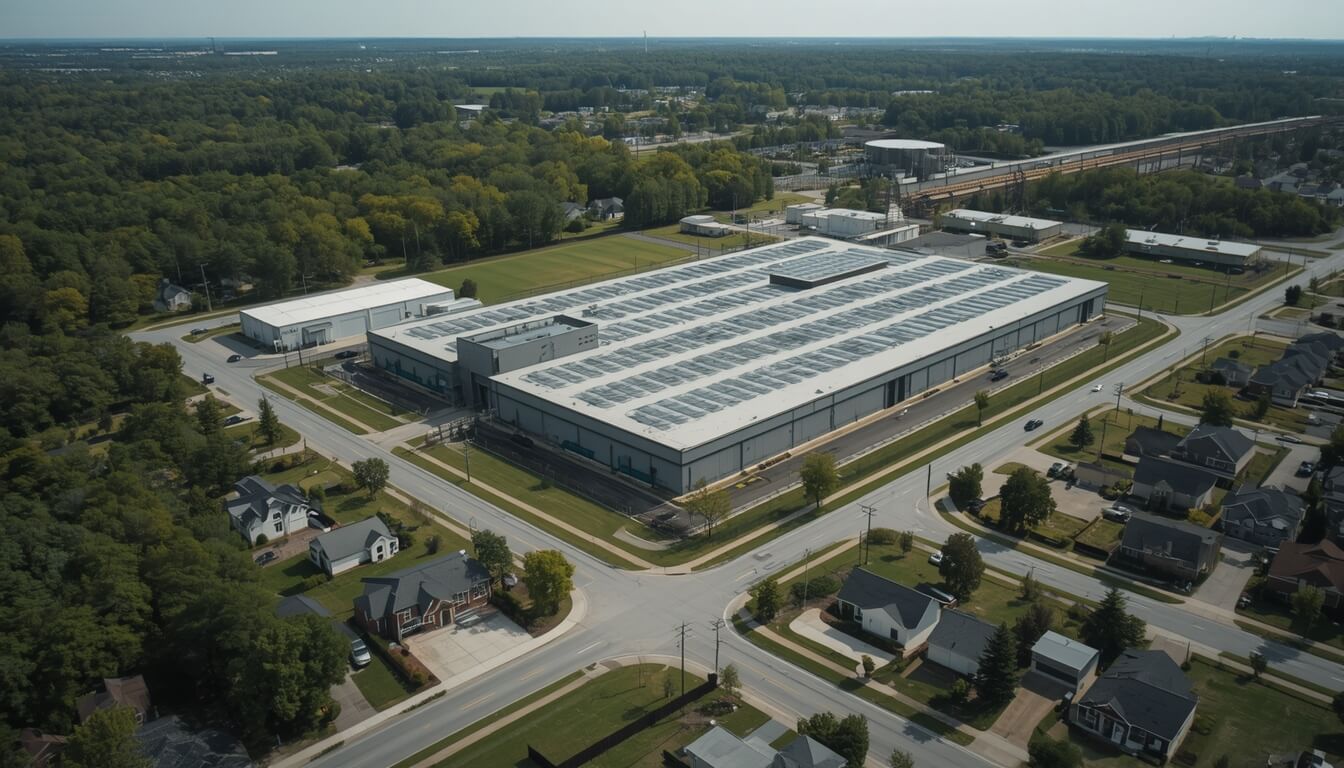
Some communities oppose AI data centers because they consume large amounts of electricity, may require significant water for cooling, create noise and construction traffic, and change how local land is used. Residents also question whether the promised jobs and tax revenue justify these costs.
A central concern is who pays for the infrastructure. A data center may bring billions of dollars in private investment, but households want assurance that their electricity bills and local resources will not bear an unfair share of the burden.
Not every community is opposed. Many welcome the investment and tax revenue. The debate is about balancing economic benefits with the impact on nearby residents.
For investors, the consequences are significant: local opposition can delay, restrict or prevent data center projects, increasing costs and slowing the expansion of AI infrastructure.
Why are people against data centers?
Opposition usually involves several concerns:
- Electricity: Large facilities may require expensive upgrades to local power infrastructure.
- Water: Some cooling systems consume substantial amounts of water, especially concerning in drought-prone regions.
- Noise and traffic: Cooling equipment, backup generators and construction activity can affect nearby neighborhoods.
- Land use: Large campuses can replace agricultural land, undeveloped areas or sites intended for other purposes.
- Employment: Construction creates jobs, but permanent staffing may be relatively limited.
- Transparency: Residents want clear information about resource consumption, tax incentives and long-term impacts.
These concerns have become more visible as AI development has increased the scale of proposed facilities.
In October 2026, Amazon Web Services announced a $1 billion, five-year investment in U.S. communities hosting its data centers, including initiatives related to energy affordability, education, workforce training and resource preservation.
The initiative illustrates how community acceptance is becoming an important consideration for major technology companies.
Electricity demand and utility bills are major concerns
AI data centers require substantial electricity to operate servers and cooling equipment. A large campus may also need new substations, transmission lines, transformers and additional power generation.
For residents, the question is simple: Will my electricity bill increase because a data center is built nearby?
The answer depends on how infrastructure is financed and how utility regulators allocate costs.
Data centers pay for the electricity they consume, and utilities can require large customers to cover infrastructure built specifically for them. However, when new transmission lines or generation capacity serve multiple customers, dividing the costs can become controversial.
Consumer advocates worry that households could contribute to expensive upgrades primarily driven by industrial electricity demand.
With U.S. electricity consumption expected to reach new records in 2026 and 2027, partly because of data center expansion, these questions are increasingly important.
Who Pays for AI Data Centers and How They Affect Utility Bills explains how these costs can be distributed between technology companies, utilities and consumers.
Why is water consumption controversial?
Data centers generate substantial heat, making cooling essential. Some cooling systems consume significant amounts of water, although usage varies by technology, climate and facility design.
Location makes a major difference. A facility in a region with abundant water may raise relatively little concern, while a similar project in an area experiencing drought or groundwater shortages can face strong opposition.
Virginia illustrates the challenge. The state hosts one of America's largest concentrations of data centers, while concerns about groundwater availability in parts of eastern Virginia highlight the importance of evaluating industrial demand alongside population growth and other water needs.
That does not mean every Virginia data center threatens water supplies. Each project must be evaluated against local resource availability.
The important question is not simply how much water a data center uses, but whether that consumption is sustainable for the community hosting it.
For a closer look at resource requirements, see How Much Energy and Water AI Data Centers Use.
How do noise and construction affect nearby residents?
Data centers may resemble ordinary industrial buildings, but much of their equipment operates continuously.
Large fans, cooling systems, pumps, transformers and backup generators can produce persistent noise. The impact depends on equipment design, sound insulation and distance from homes.
Construction adds disruption. Large campuses may take years to complete, involving heavy machinery, delivery trucks and extensive building activity.
For residents several miles away, these effects may be limited. For someone living next to a proposed facility, they can become a serious quality-of-life concern.
That is why zoning rules, noise limits and the distance between data centers and residential areas can influence local approval decisions.
Do data centers create enough jobs to justify their costs?
Data centers create employment, but construction jobs and permanent positions are very different.
During construction, large projects can employ electricians, engineers, equipment installers and other workers. Once operational, facilities generally need smaller permanent teams for maintenance, security and technical operations.
A multibillion-dollar data center may therefore employ fewer permanent workers than a manufacturing facility representing a comparable investment.
However, employment is only part of the economic equation.
Data centers can generate property and other tax revenue, support local contractors and attract infrastructure investment. In 2026, San Jose officials estimated that a proposed data center could generate as much as $6 million annually in city tax revenue.
The question is whether those benefits compensate the community for electricity demand, water consumption, land use and infrastructure requirements.
Some communities may find the trade-off attractive, especially when a project expands the tax base without requiring extensive public spending. Others may prefer development that creates more permanent jobs or makes better use of local resources.
Why do land use and zoning create conflicts?
Modern AI data center campuses can occupy extensive areas containing multiple buildings, substations, backup power equipment and supporting infrastructure.
Local governments must decide whether that land should be used for data centers instead of housing, agriculture, manufacturing or other commercial development.
Projects near residential neighborhoods can raise concerns about property values, views, traffic and changes to the surrounding landscape.
Even when a developer has financing, customers and access to electricity, it may still need planning permission, environmental approvals or zoning changes before construction begins.
These requirements can become major obstacles when residents oppose the proposed location.
Why does transparency matter to local communities?
Residents are more likely to question a project when important decisions appear to be made without sufficient public information.
Before approving a large data center, communities often want answers to practical questions:
- Who is developing and operating the facility?
- How much electricity and water will it require?
- Will new power infrastructure be necessary, and who will pay?
- What tax incentives or exemptions will the developer receive?
- How many permanent jobs will be created?
- Could the campus expand significantly in the future?
When these details remain unclear, even residents who support economic development may become skeptical.
In October 2026, Amazon announced that AWS would stop using nondisclosure agreements with government agencies when developing data center projects and would increase community engagement.
The decision highlights an industry challenge: developers need to explain how projects will affect nearby residents, not simply emphasize the financial benefits.
Are communities actually blocking new data centers?
Yes. Some U.S. communities have introduced temporary moratoriums, zoning restrictions or additional approval requirements for new data center developments.
A moratorium is a temporary pause on development or approvals, not necessarily a permanent ban. It can give local authorities time to review electricity demand, water availability, land use and infrastructure policies.
In Washington state, Seattle and Spokane introduced data center moratoriums in 2026, while Skagit and Snohomish counties also adopted temporary restrictions.
Other jurisdictions have considered tighter rules involving water consumption, tax incentives and project locations.
By October 2026, reports indicated that more than 100 data center moratoriums were under consideration nationally. This figure describes reported proposals under consideration, not projects permanently prohibited from construction.
These developments do not mean every proposed facility will be rejected. They show that local governments are taking a more active role in deciding where and under what conditions data centers can be built.
Why aren't communities simply welcoming billions in investment?
Because the economic benefits and local costs do not always reach the same people.
A technology company may invest billions in construction. Local governments may collect tax revenue, contractors may win major projects, and utilities may gain a large customer.
Meanwhile, nearby households may experience noise and traffic, electricity customers may worry about infrastructure costs, and local water users may question future supply.
Even when a project benefits the regional economy, residents can reasonably ask whether their community receives a fair share of those benefits.
This explains why some governments seek stronger commitments on infrastructure financing, environmental protection and local economic benefits before granting approval.
Why do some communities still want data centers?
Despite growing opposition, many U.S. states and municipalities actively compete to attract data center investment.
Large projects can expand the tax base, create construction employment, support local businesses and encourage investment in power and telecommunications infrastructure.
For regions with suitable industrial land, reliable electricity and sufficient water, data centers can offer meaningful economic benefits.
The difference often comes down to local conditions.
A project requiring major infrastructure upgrades near residential neighborhoods may face greater resistance than one proposed in an established industrial area with available power.
Rather than approving or rejecting every project, some governments are pursuing a middle ground: allowing development while requiring stronger safeguards for resource use, infrastructure costs and transparency.
What can developers do to reduce opposition?
Developers can address community concerns through practical measures:
- Choose suitable locations: Prioritize industrial sites with adequate infrastructure and reasonable separation from homes.
- Reduce noise: Install quieter cooling equipment, sound barriers and appropriate insulation.
- Protect water supplies: Consider recycled water and cooling technologies that reduce freshwater consumption.
- Address electricity costs: Work with utilities and regulators to ensure large customers pay an appropriate share of infrastructure expenses.
- Improve transparency: Provide clear information about resource requirements, tax arrangements and expansion plans.
- Support host communities: Invest in workforce training, local infrastructure and programs addressing the project's impact.
These measures can improve public acceptance, but they cannot guarantee approval.
Some regions lack the electricity, water or suitable land required for a proposed campus. In those cases, relocating the project may be more practical than attempting to overcome every objection.
Why does local opposition matter for AI investors?
Community resistance can directly affect project costs, company growth and investment expectations.
Consider a company planning a multibillion-dollar data center campus expected to begin operating within three years.
If opposition triggers environmental reviews, zoning disputes or permitting delays, several financial consequences can follow:
- Delayed revenue: The operator may have to wait longer before earning money from the new computing capacity.
- Higher development costs: Financing, redesign and construction expenses can increase.
- Delayed equipment orders: Suppliers of servers, cooling systems and electrical equipment may face postponed deliveries.
- Infrastructure uncertainty: Utilities may need to revise planned investments.
- Project relocation or cancellation: Developers may abandon sites where approval becomes too difficult or expensive.
These risks can affect data center operators, technology companies, utilities, construction firms and equipment suppliers.
For example, Microsoft, Amazon, Alphabet and Meta invest heavily in computing infrastructure, while companies such as Nvidia, Vertiv and Eaton supply equipment used in data centers. A delayed project does not necessarily mean lost demand, but it can change when customers need servers, cooling equipment and electrical systems.
Investors should therefore look beyond announced investment amounts and examine whether projects have secured suitable sites, electricity connections and regulatory approvals.
A billion-dollar announcement is not the same as a billion-dollar facility operating on schedule. The timing of completed capacity matters for revenue growth, equipment orders and returns on invested capital.
Where AI Data Centers Are Being Built in the US examines where development is concentrating and why certain states and regions are attracting more investment.
Could local resistance change where AI data centers are built?
Yes. Growing opposition could influence both the location and cost of AI infrastructure development.
AI companies need additional computing capacity, but every facility requires land, electricity, cooling resources and permission to build.
Regions with abundant power, adequate water supplies, suitable industrial land and supportive local governments may become more attractive.
Areas facing electricity constraints, water shortages or strong residential opposition could become more expensive or difficult places to develop.
Local resistance is unlikely to stop all AI data center development. Many communities continue to welcome projects, and demand for computing capacity remains strong.
Instead, opposition could change where facilities are built, how quickly they become operational and how much developers must spend to secure approval.
For investors, local regulations, utility costs and community acceptance deserve attention alongside AI demand, company spending plans and expected growth.
The technology may be global, but every data center must ultimately be built in a specific community, with its own resources, regulations and residents.
This article is for informational purposes only and does not constitute investment advice. Investing involves risk, including the possible loss of principal.