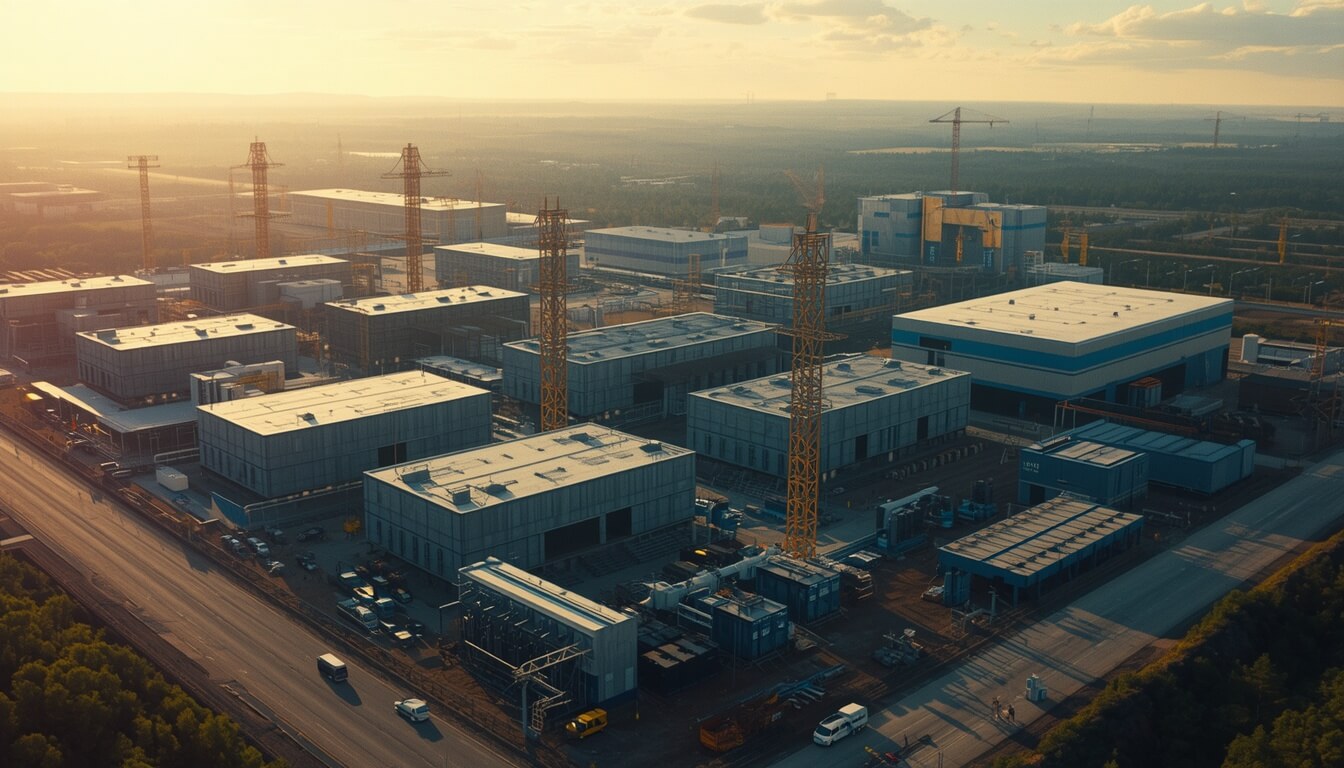
Flex has secured a $2 billion investment in Axiom, its Cloud and Power Infrastructure business, as the company prepares to separate the unit into an independent publicly traded company in early 2027. The investment, led by General Catalyst with Koch Equity Development and other investors, gives Axiom an initial enterprise value of $37.5 billion.
The deal, announced on October 5, 2026, is particularly important because Axiom is being built around one of the biggest investment themes in technology: the enormous amount of power, cooling and computing infrastructure required by AI data centers. For Flex shareholders, the transaction also provides the first major outside valuation of Axiom before the planned separation — and $37.5 billion is a substantial number for a business that is currently only one part of Flex.
What Exactly Did Flex Announce?
Flex has entered into an agreement to sell $2 billion of Series A convertible preferred stock in Axiom to funds affiliated with General Catalyst, Koch Equity Development and other co-investors.
Convertible preferred stock is different from ordinary shares. It gives investors preferred financial terms and can later be converted into common equity under specified conditions. The important point for regular investors is simpler: major outside investors are committing $2 billion to Axiom before it becomes an independent public company, and the transaction establishes an initial enterprise value of $37.5 billion for the business.
The investment has been agreed but has not yet closed. Completion remains subject to regulatory approvals and other customary conditions.
Flex still intends to separate Axiom during the first quarter of 2027. After the separation, Flex and Axiom are expected to operate as two independent publicly traded companies.
What Is Axiom?
Axiom is the name Flex has given to the Cloud and Power Infrastructure business it plans to spin off. The business focuses on the physical systems required to build and operate large-scale computing infrastructure, including power systems, thermal management and computing infrastructure.
Those areas have become increasingly important because AI data centers consume enormous amounts of electricity and generate significant heat. Building more AI computing capacity therefore requires much more than buying advanced processors from companies such as Nvidia. Data-center operators also need equipment capable of delivering electricity reliably, converting that power efficiently, cooling increasingly dense computing systems and integrating thousands of components into functioning facilities.
Axiom is designed to operate in that less visible layer of the AI boom. Flex formally unveiled the Axiom name in September and filed a preliminary Form 10 registration statement with the U.S. Securities and Exchange Commission. Following the planned separation, Axiom is expected to trade on the Nasdaq under the ticker AXM.
Why Is Axiom Being Valued at $37.5 Billion?
The valuation reflects investor expectations that spending on AI infrastructure will remain extremely large.
Artificial intelligence models require increasingly powerful data centers. As companies expand AI capacity, the challenge is no longer simply obtaining enough processors. They also need enough electricity to run them. And once that electricity reaches the data center, operators need sophisticated systems to manage power distribution and remove the enormous amount of heat generated by high-performance computing equipment.
That creates opportunities for companies supplying power equipment, cooling systems and other critical infrastructure. General Catalyst described Axiom as sitting at the center of the power and infrastructure expansion required by AI. Flex similarly says the business is being positioned around the power, thermal and computing infrastructure demanded by the AI era.
The $37.5 billion valuation therefore represents a major bet that the physical infrastructure surrounding AI computing will become an increasingly valuable market of its own. But investors should distinguish between the valuation implied by this preferred-stock transaction and a future stock-market valuation. Axiom has not yet become an independent public company, and there is no guarantee that public investors will eventually value it at exactly $37.5 billion.
The $2 Billion Will Help Finance Another Major Deal
The new investment also has an immediate purpose. Flex plans to use proceeds from the transaction partly to finance Axiom's pending acquisition of EPC Power, a company specializing in power conversion systems used in data centers, energy storage and other grid applications.
Flex agreed in September to acquire EPC Power at a value of $4.4 billion. The acquisition is expected to close during the fourth quarter of 2026, after which EPC Power is expected to become part of Flex's Cloud and Power Infrastructure business before Axiom is separated.
That acquisition is strategically important because power availability is becoming one of the major constraints facing AI data-center expansion. EPC Power develops systems that convert and manage electricity for demanding applications. Flex specifically highlighted its potential role in next-generation 800-volt data-center power architectures, which are being developed to handle increasingly power-intensive AI computing systems.
The strategy becomes clearer when the two transactions are viewed together. Flex is not simply spinning off an existing business. It is investing heavily to create a larger company focused specifically on the infrastructure required to power and cool the AI computing boom.
Why Power Is Becoming a Major AI Investment Theme
For several years, the most visible beneficiaries of artificial intelligence spending have been semiconductor companies. Nvidia became the clearest example because its GPUs provide much of the computing power used to train and run advanced AI models.
But processors are only one part of a data center. As AI systems become larger, the amount of electricity required to operate them increases. Higher power density also creates more heat, increasing demand for sophisticated cooling systems.
That means the AI investment cycle is spreading outward. Semiconductor companies supply the computing engines. Networking companies connect them. Data-center operators provide the facilities. Utilities and energy companies supply electricity. And companies such as Axiom aim to provide the systems that connect power, cooling and computing infrastructure.
That broader infrastructure buildout is what makes the Axiom transaction relevant beyond Flex itself. The $2 billion investment is another indication that investors are assigning significant value to companies positioned around the physical constraints of AI growth — particularly electricity, cooling and data-center construction.
What Does the Deal Mean for Flex Shareholders?
For Flex investors, the $37.5 billion valuation provides an important reference point for a business that will soon be separated from the company.
The planned spin-off means existing Flex shareholders are ultimately expected to have exposure to two independent businesses rather than one combined company. Axiom would focus on cloud, data-center and power infrastructure, while the remaining Flex business would continue operating its other manufacturing and supply-chain activities.
Separating the businesses could make it easier for investors to value them independently. An AI infrastructure company growing around power and data centers may attract a very different valuation from a diversified electronics manufacturing business.
The $2 billion investment therefore does more than provide capital. It establishes an outside valuation for Axiom before the spin-off and brings major institutional investors into the business. General Catalyst will also have the right to nominate one director to Axiom's board after the separation is completed.
The Investment Comes With a Significant Cost
There is another side of the transaction investors should understand. The $2 billion investment is preferred equity, not ordinary common stock.
Before the separation, the preferred shares will pay investors a 10% annual cash dividend. After the spin-off, that rate falls to 6% if paid in cash or 7% if the dividend is paid in additional securities, subject to certain adjustments.
A 10% annual dividend on $2 billion represents a meaningful financing cost.
There are also protections for the investors if the planned separation does not happen. According to Flex's SEC filing, if the spin-off has not been completed by December 31, 2027, Axiom would be required to redeem the preferred shares under terms specified in the agreement. Flex guarantees that obligation, with the redemption price generally starting at 115% of the investment if paid in cash or 125% if paid in Flex shares, subject to adjustments described in the filing.
Those provisions matter because they show that the $2 billion investment is not simply inexpensive capital. Flex and Axiom are paying for the ability to secure a large amount of funding before the planned public separation.
What Are the Main Risks?
The biggest risk is that today's extraordinary AI infrastructure spending does not continue at the pace investors currently expect. Axiom's strategy depends heavily on growing demand for data centers, power equipment, cooling systems and other infrastructure supporting high-performance computing. If AI capital spending slows, projects are delayed or customers reduce infrastructure budgets, Axiom's growth expectations could come under pressure.
There is also execution risk. Flex must complete the EPC Power acquisition, integrate that business into its infrastructure operations and then separate Axiom into an independent public company within a relatively short period. The company itself identifies uncertainties around completing both the EPC Power acquisition and the spin-off, obtaining necessary approvals, integrating EPC Power and achieving the expected strategic and financial benefits.
Finally, the $37.5 billion valuation should not be treated as a guaranteed future market capitalization. Public markets will ultimately determine what Axiom is worth once its shares begin trading.
What Happens Next?
There are several concrete milestones for investors to watch.
The first is completion of the $4.4 billion EPC Power acquisition, currently expected during the fourth quarter of 2026.
The $2 billion preferred investment must also receive the required regulatory approvals before it closes.
Then comes the biggest event: the planned separation of Axiom from Flex during the first quarter of 2027. Axiom is expected to list on the Nasdaq under the ticker AXM, although completion of the spin-off remains subject to several conditions, including final Flex board approval, effectiveness of the Form 10 registration statement, Flex shareholder approval and approval from the Singapore High Court.
Investors will also get more information soon. Flex plans to provide additional details about the strategies of both companies at its Innovation Day on November 10, 2026.
The larger story is straightforward: the AI investment boom is expanding far beyond chips. Flex is preparing to create a standalone public company focused on the power, cooling and computing infrastructure needed to build AI data centers, and outside investors have now committed $2 billion at a $37.5 billion enterprise valuation. If AI computing continues expanding at today's pace, the infrastructure required to power and cool those systems could become one of the next major battlegrounds of the AI economy.
This article is for informational purposes only and does not constitute investment advice. Always do your own research before making investment decisions.