
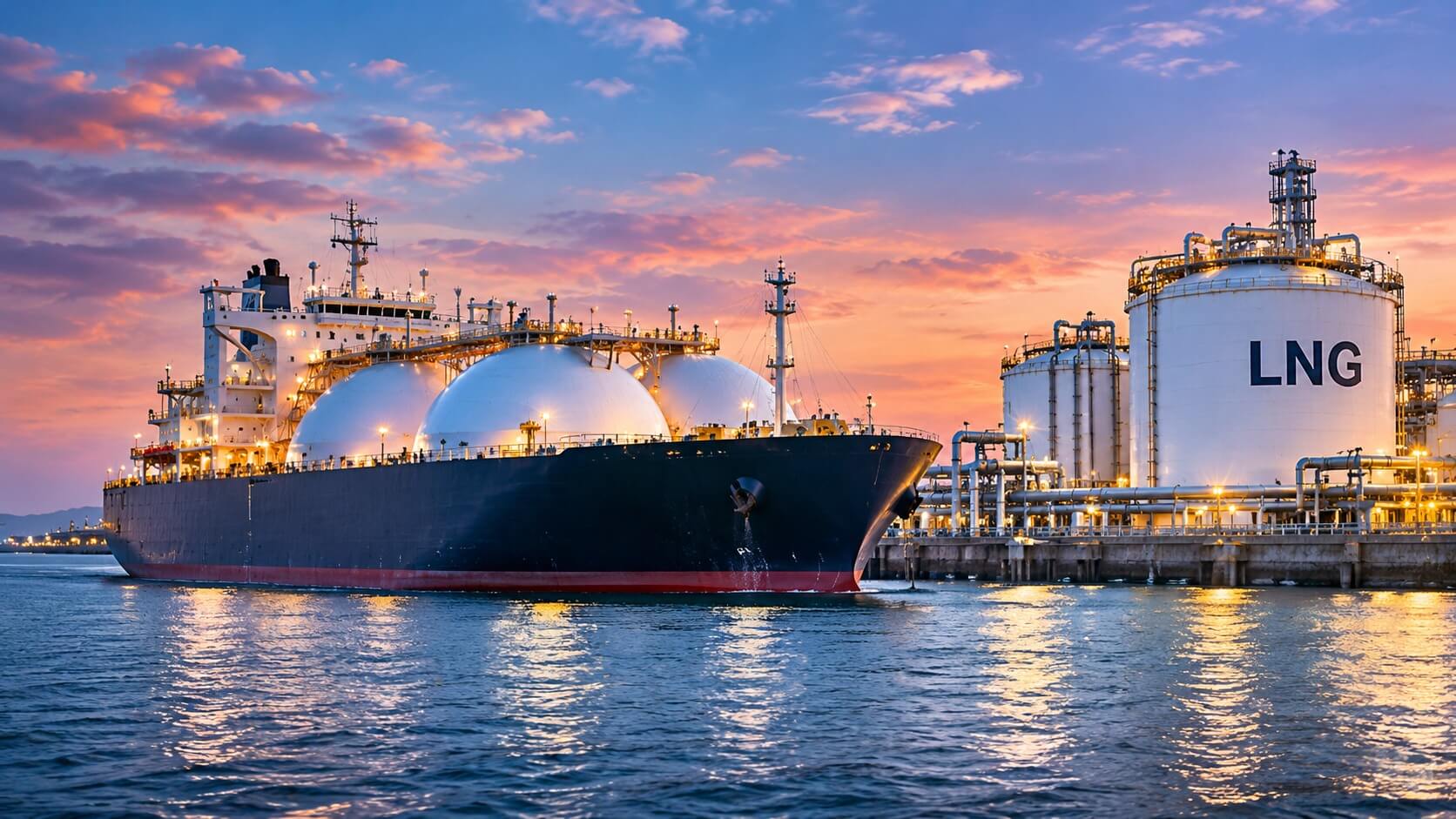
Liquefied natural gas (LNG) offers US investors exposure to natural gas production, export terminals, pipelines, shipping, and international energy demand. Companies such as Cheniere Energy, Venture Global, Sempra, Exxon Mobil, Chevron, and Kinder Morgan participate in different parts of this industry, with distinct business models and financial risks.
The United States is the world's largest LNG exporter. US Energy Information Administration (EIA) data indicate that exports averaged approximately 17.4 billion cubic feet per day during the first half of 2026, up 23% from the same period in 2025.
However, rising LNG exports do not guarantee rising stock prices. Some companies earn relatively predictable fees from long-term contracts, while others depend more heavily on natural gas prices, international demand, or the successful completion of expensive infrastructure projects.
For investors, the key is understanding how each LNG company makes money, what drives its cash flow, and whether its stock valuation reflects the risks.
What Is LNG and Why Does It Matter?
LNG stands for liquefied natural gas. It is natural gas, primarily methane, cooled to approximately -260°F (-162°C) until it becomes a liquid.
Liquefaction reduces natural gas volume by roughly 600 times, allowing large quantities to be transported across oceans in specialized vessels.
This makes LNG particularly important for countries that lack sufficient domestic gas production or cannot receive enough natural gas through pipelines.
The LNG supply chain involves five main steps:
- Natural gas is extracted from underground reserves.
- Pipelines deliver the gas to processing and liquefaction facilities.
- Export terminals cool the gas into liquid form.
- Specialized LNG carriers transport it to importing countries.
- Import terminals convert LNG back into gas for electricity generation, industrial operations, heating, and other uses.
Each stage supports a different type of business. An LNG investment can therefore involve natural gas production, transportation infrastructure, export facilities, shipping, or international energy trading.
How Does the LNG Industry Make Money?
LNG companies generate revenue in different ways. A natural gas producer selling fuel in Texas has a different financial profile from an exporter operating a terminal in Louisiana or a shipping company transporting cargoes to Asia.
| Business segment | How companies generate revenue | Main financial drivers |
|---|---|---|
| Natural gas producers | Sell natural gas extracted from reserves | Gas prices, production costs, output |
| LNG exporters | Sell LNG or provide liquefaction services | Contract fees, export volumes, operating costs |
| Pipeline operators | Transport natural gas to facilities and customers | Transportation contracts, capacity utilization |
| LNG shipping companies | Transport LNG between export and import terminals | Charter rates, fleet utilization, vessel costs |
| Integrated energy companies | Operate across production, trading, LNG projects, and distribution | Commodity prices, project economics, global demand |
| LNG infrastructure developers | Develop and expand LNG facilities | Financing, construction execution, future contracts |
Consider the difference between a gas producer and a contracted LNG exporter. Higher domestic gas prices can directly increase a producer's revenue, while an exporter earning fixed liquefaction fees may have more stable cash flow.
A shipping company, meanwhile, can benefit from transportation demand without owning the natural gas it carries.
These differences explain why LNG-related stocks do not necessarily rise or fall together.
Why Is the United States a Major LNG Exporter?
The United States combines substantial natural gas resources, established pipeline infrastructure, and export terminals with access to international shipping routes.
Major producing regions include the Permian Basin, Haynesville Shale, and Appalachian Basin. Gulf Coast terminals connect domestic supplies to overseas customers, particularly in Europe and Asia.
Large-scale US LNG exports began in 2016. Since then, new facilities and expansions have increased the country's export capacity.
According to the EIA, US LNG exports averaged approximately 15.0 billion cubic feet per day in 2025 and increased to 17.4 billion cubic feet per day during the first half of 2026.
Projects such as Plaquemines LNG and Corpus Christi Stage 3 illustrate the expansion of US liquefaction infrastructure. Golden Pass LNG represents another major addition to export capacity as its facilities enter service.
For investors, expanding exports can create opportunities beyond terminal operators. Pipeline companies may transport more gas, producers may gain additional customers, and infrastructure businesses may benefit from new construction.
However, LNG terminals require billions of dollars in investment and can take years to develop. Higher export capacity creates value only when the resulting revenue and cash flow justify those costs.
Which Companies Are Involved in the US LNG Market?
Several publicly traded companies offer exposure to LNG, although their dependence on the industry varies considerably.
Cheniere Energy (NYSE: LNG)
Cheniere Energy is one of the leading publicly traded US LNG exporters. It operates major liquefaction facilities at Sabine Pass in Louisiana and Corpus Christi in Texas.
Its business relies substantially on long-term customer agreements, including contracts that provide revenue visibility through fixed fees or other payment commitments.
Expansion projects can increase future capacity, but investors must evaluate construction spending, debt, and the cash flow generated by new facilities.
Importantly, LNG is also Cheniere Energy's NYSE ticker symbol. Searches for "LNG stock" often refer specifically to Cheniere rather than the entire industry.
Venture Global (NYSE: VG)
Venture Global develops and operates large-scale LNG export infrastructure along the US Gulf Coast.
Its investment profile combines revenue from operating facilities with potential growth from additional export projects.
Investors should distinguish facilities already generating cash flow from developments that still depend on construction progress, financing, regulatory approvals, and commercial arrangements.
Project execution and contractual obligations are particularly important when assessing its future earnings.
Sempra (NYSE: SRE)
Sempra is a diversified North American energy infrastructure company with LNG interests alongside regulated utility operations.
Its LNG projects provide exposure to international natural gas trade, but the company's overall financial performance also depends heavily on its broader utility and infrastructure businesses.
Sempra therefore offers a different investment profile from a company primarily focused on LNG exports.
Exxon Mobil (NYSE: XOM) and Chevron (NYSE: CVX)
Exxon Mobil and Chevron participate in international LNG through production, development projects, and integrated energy operations.
Both companies have substantial businesses outside LNG, including oil production and other energy activities.
As a result, LNG growth may support their earnings without becoming the main driver of their stock prices. Oil markets, capital spending, and company-wide profitability remain major considerations.
Kinder Morgan (NYSE: KMI)
Kinder Morgan operates extensive natural gas pipeline infrastructure in North America, including networks that serve LNG export facilities.
Its exposure comes primarily from transporting gas rather than selling LNG cargoes internationally.
Transportation contracts and demand for pipeline capacity can provide a different revenue profile from that of an LNG exporter or gas producer.
For a closer comparison of company size, operating facilities, and market positions, see The Largest LNG Companies in the US and Their Role in the Market.
What Makes an LNG Company Attractive to Investors?
An attractive LNG investment combines a sustainable business model, manageable financial obligations, realistic growth expectations, and a reasonable stock valuation.
Five factors are particularly useful when comparing companies.
Long-Term Contracts and Revenue Visibility
Many LNG exporters sign long-term agreements with utilities, energy companies, and international buyers.
Some contracts include fixed liquefaction fees or payment commitments that support revenue even when customers do not use all their contracted capacity. Other agreements expose companies more directly to market prices.
Investors should examine how much capacity is contracted, the duration of those agreements, and the financial strength of customers.
Contracted revenue can improve predictability, but it does not eliminate operating costs, counterparty risk, or financial obligations.
Operating Cash Flow and Free Cash Flow
LNG companies can generate substantial revenue while spending heavily on equipment, maintenance, construction, and financing.
Operating cash flow shows the cash generated by business operations. Free cash flow generally measures what remains after capital expenditures, although companies may calculate adjusted versions differently.
These figures help investors assess whether a company can support debt obligations, fund expansion, and potentially return capital to shareholders.
Debt and Financing Costs
Large LNG projects frequently rely on substantial borrowing.
Debt can support growth, but higher interest expenses, construction delays, and weaker cash generation can put pressure on shareholders.
Investors should review debt maturities, interest costs, available liquidity, and whether expected cash flow can support financial commitments.
Growth Projects and Execution
Additional liquefaction capacity can increase future earnings, but announced projects are not guaranteed to become profitable operations.
It is important to distinguish among facilities already operating, projects under construction, and proposals awaiting a final investment decision (FID).
A final investment decision generally indicates that a developer has formally committed to proceeding with a project, subject to its specific arrangements and remaining conditions.
Stock Valuation
Even a financially strong company can deliver disappointing returns if investors pay too much for expected growth.
Useful measures include free cash flow yield, enterprise value relative to operating earnings, and debt levels.
Enterprise value represents a company's overall value, including equity and net debt. Comparing it with operating earnings can help assess businesses with different financing structures.
Valuation comparisons work best between companies with similar business models and accounting characteristics.
For a practical framework covering financial fundamentals and company comparisons, read How to Evaluate the Best LNG Stocks to Buy.
What Drives Global Demand for LNG?
Global LNG demand depends primarily on electricity generation, industrial consumption, energy security, domestic gas availability, and the cost of competing energy sources.
Electricity Generation
Natural gas power plants can provide flexible electricity generation when demand increases or renewable output declines.
This can make LNG valuable for countries expanding their power systems without sufficient domestic gas resources.
However, renewable generation, battery storage, nuclear power, and improvements in electricity networks can reduce future gas requirements.
Industrial Demand
Natural gas is widely used in chemicals, fertilizers, manufacturing, and other energy-intensive industries.
Industrial expansion can increase demand, while high imported gas prices may force manufacturers to reduce consumption or switch fuels.
Energy Security
LNG allows importing countries to diversify suppliers instead of depending entirely on domestic production or specific pipeline routes.
Europe's efforts to diversify gas supplies illustrate the strategic importance of access to international LNG markets.
However, LNG imports also expose buyers to shipping disruptions and competition for available cargoes.
Emerging Market Growth
Developing economies may need more electricity and industrial energy as incomes and economic activity expand.
LNG can help meet that demand where domestic production and pipeline infrastructure are insufficient.
Affordability remains a major constraint. Price-sensitive importers may reduce purchases when international LNG prices rise sharply.
For a closer look at the countries shaping international trade, explore Who Buys the Most LNG? The Countries Driving Global Demand.
How Do Natural Gas Prices Affect LNG Stocks?
Natural gas prices affect LNG companies differently depending on their position in the supply chain and their contractual arrangements.
Three important benchmarks help explain the market:
- Henry Hub: A widely used benchmark for US natural gas prices.
- TTF: A major European natural gas trading benchmark.
- JKM: An important price benchmark for LNG delivered to Northeast Asia.
Price differences between US gas and international LNG markets can create trading opportunities, but the apparent spread is not pure profit.
Liquefaction, transportation, fuel consumption, financing, and other costs must be considered. Contract terms also determine which company receives the benefit of favorable prices.
Three simplified scenarios illustrate the differences:
- Higher US natural gas prices: Producers may benefit, while exporters purchasing domestic gas can face higher input costs, depending on contract terms.
- Higher international LNG prices: Companies with uncontracted cargoes or commodity-linked sales may benefit, although expensive LNG can weaken demand.
- Lower global LNG prices: Imports may become more affordable, but exporters exposed to spot prices could face narrower margins.
Geopolitical disruptions affecting Middle Eastern energy infrastructure and shipping routes in 2026 demonstrated how quickly supply conditions and international prices can change.
For investors, contract structures, production costs, and market exposure are usually more useful indicators of company profitability than the direction of natural gas prices alone.
Is the LNG Industry Expected to Keep Growing?
Global LNG supply capacity is expected to expand as new export facilities enter service, particularly in North America and other major producing regions. Demand growth is less certain and will depend on energy prices, economic conditions, infrastructure development, and competing technologies.
Several developments could support further growth:
- Additional demand for flexible electricity generation.
- Expansion of natural gas infrastructure in developing economies.
- Efforts to diversify energy suppliers.
- New long-term LNG purchasing agreements.
- Additional export capacity supported by commercially viable projects.
Other developments could limit growth:
- Faster adoption of renewable energy and storage.
- High LNG import costs.
- Slower economic growth.
- Competition among exporting countries.
- Stricter emissions requirements and regulatory restrictions.
- Excess supply if export capacity expands faster than demand.
Geopolitical disruptions and infrastructure damage can also change near-term supply expectations, making long-range forecasts uncertain.
For shareholders, the central question is not simply whether LNG consumption will increase. It is whether companies can earn sufficient returns on the capital required to produce, liquefy, and transport it.
For a broader examination of future opportunities and limitations, see Is LNG the Next Big Thing? The Market's Growth Potential and Limits.
What Are the Biggest Risks of Investing in LNG Companies?
LNG investments combine commodity-market exposure with the financial and operational risks of major energy infrastructure.
Construction Delays and Cost Overruns
Export terminals require specialized equipment, extensive engineering, regulatory approvals, and substantial capital.
Construction delays can postpone revenue and increase financing costs. Companies relying heavily on unfinished projects are particularly exposed.
Commodity Price Volatility
Natural gas and LNG prices respond to weather, storage levels, geopolitical events, and changes in supply and demand.
Companies with significant spot-market exposure can experience substantial earnings volatility.
Demand and Oversupply Risks
New export facilities can operate for decades, but future LNG demand is uncertain.
If capacity grows faster than consumption, international prices and project returns may come under pressure. Expensive facilities built on overly optimistic assumptions can become poor investments.
Regulatory and Environmental Risks
LNG developments face permitting requirements, environmental reviews, and potential changes in energy policy.
Methane emissions throughout the natural gas supply chain and the energy required for liquefaction are also important environmental considerations.
Stricter requirements can increase operating costs or delay new projects.
Financial Leverage
Heavy borrowing can magnify the impact of weaker earnings, higher interest rates, or unexpected expenses.
Companies with substantial debt may have less flexibility to finance expansion or return capital to shareholders.
Geopolitical and Shipping Risks
LNG depends on international shipping routes and commercial relationships between exporting and importing countries.
Conflicts, trade restrictions, port disruptions, and shipping bottlenecks can affect deliveries, transportation costs, and market prices.
These risks make financial strength and contract quality especially important when evaluating LNG stocks.
Is LNG a Good Investment Right Now?
LNG can be an attractive investment for investors seeking exposure to global energy infrastructure, but it is not automatically a good purchase at current market prices.
The industry benefits from established US export infrastructure, international customers, and long-term supply agreements. Some companies also have operating assets capable of generating substantial cash flow.
However, investors must consider whether expected growth is already reflected in stock valuations.
A company with profitable existing facilities and manageable debt presents a different risk profile from a developer whose future earnings depend on completing several expensive projects.
Before investing, compare current valuations, operating cash flow, debt, contract coverage, and realistic growth expectations.
For a more focused assessment of market conditions and investment risks, see Is LNG a Good Investment Now? Growth Drivers and Risks.
Understanding Cheniere Energy's LNG Stock
Cheniere Energy trades on the NYSE under the ticker LNG. This distinction matters because searches for "LNG stock price" generally refer to Cheniere's shares, not an index of LNG companies.
Cheniere's valuation depends on expected cash flow, contracted sales, operating capacity, expansion spending, debt, and investor expectations.
Its stock price can decline even when operations remain profitable. Higher interest rates, reduced growth expectations, or an expensive starting valuation can all affect shareholder returns.
A falling share price therefore does not automatically indicate financial weakness or an undervalued investment.
For a detailed discussion of these valuation factors, read Why Is LNG Stock So Low? Understanding Cheniere Energy's Valuation.
Long-term forecasts require additional assumptions about future capacity, operating costs, contracted revenue, capital allocation, and the valuation investors may assign to the business.
For example, a 2030 share-price scenario would need to account for both future cash flow and the price investors might be willing to pay for that cash flow. Neither can be predicted with certainty.
For a scenario-based perspective, see LNG Stock Forecast: What Could Shape Cheniere Energy's Future Price?.
How Can US Investors Gain Exposure to LNG?
US investors can access the LNG industry through individual stocks and diversified investment funds.
The most suitable approach depends on which part of the industry they want to own.
| Investment approach | Type of exposure | Important consideration |
|---|---|---|
| LNG exporters | Liquefaction facilities and international LNG sales | Contracts, operating capacity, expansion costs |
| Natural gas producers | Domestic natural gas production | Gas prices and production economics |
| Pipeline companies | Gas transportation infrastructure | Transportation agreements and capacity demand |
| Integrated energy companies | Diversified operations that include LNG | LNG may represent only part of total earnings |
| LNG shipping companies | Maritime transportation of LNG | Charter rates and shipping market cycles |
| Energy ETFs | Portfolios of energy-related companies | Holdings may provide limited direct LNG exposure |
Investors should review an ETF's actual holdings rather than assuming that a broad energy fund provides substantial exposure to LNG exports.
For example, an energy ETF dominated by oil producers and refiners may respond more strongly to crude oil prices than to LNG export growth.
Likewise, a natural gas futures fund tracks commodity-related returns rather than the earnings of LNG infrastructure companies. Futures-based funds can also be affected by contract roll costs and market structure.
Individual LNG stocks provide more targeted exposure but introduce company-specific risks. Diversification can reduce concentration without eliminating the possibility of losses.
What Should Investors Watch in the LNG Market?
Investors can monitor a small group of indicators to understand whether industry developments are translating into stronger company fundamentals.
- US export volumes and capacity: Rising shipments can indicate growing utilization of export infrastructure, although additional volume does not guarantee higher margins.
- Final investment decisions: New project commitments reveal expansion plans and future capital requirements.
- Long-term contracts: New supply agreements can support financing and improve revenue visibility.
- Regional natural gas prices: Henry Hub, TTF, and JKM help explain international trading conditions and potential price spreads.
- Construction progress: Delays, cost overruns, and commissioning milestones influence when new facilities begin generating revenue.
- Cash flow and debt: Financial results show whether growth is strengthening the business or increasing its obligations.
- Import demand: Purchasing patterns in Europe and Asia influence international LNG trade and future capacity requirements.
It is important to distinguish temporary market movements from developments that can affect earnings for years.
A short-lived price spike may benefit companies selling uncontracted cargoes, while a completed export facility or a major long-term agreement can have a more lasting impact on cash flow.
The LNG Investment Opportunity in Perspective
LNG connects US natural gas resources with international energy markets through a network of producers, pipelines, export terminals, shipping companies, and buyers.
Companies such as Cheniere Energy and Venture Global provide relatively direct exposure to LNG exports. Kinder Morgan participates through transportation infrastructure, while Sempra, Exxon Mobil, and Chevron offer exposure within broader energy businesses.
These investments differ in their dependence on commodity prices, long-term contracts, construction projects, and financial leverage.
For US investors, the most useful approach is to identify the company's role in the LNG supply chain, understand how it generates cash flow, assess its financial obligations, and compare its stock valuation with realistic earnings expectations.
Growing global LNG trade can create business opportunities, but shareholder returns ultimately depend on execution, financial discipline, and the price paid for those opportunities.
Disclaimer: This article is for informational and educational purposes only and does not constitute financial or investment advice. Investing in stocks and energy-related securities involves risk, including possible loss of principal. Investors should conduct their own research and consider their financial circumstances before making investment decisions.