
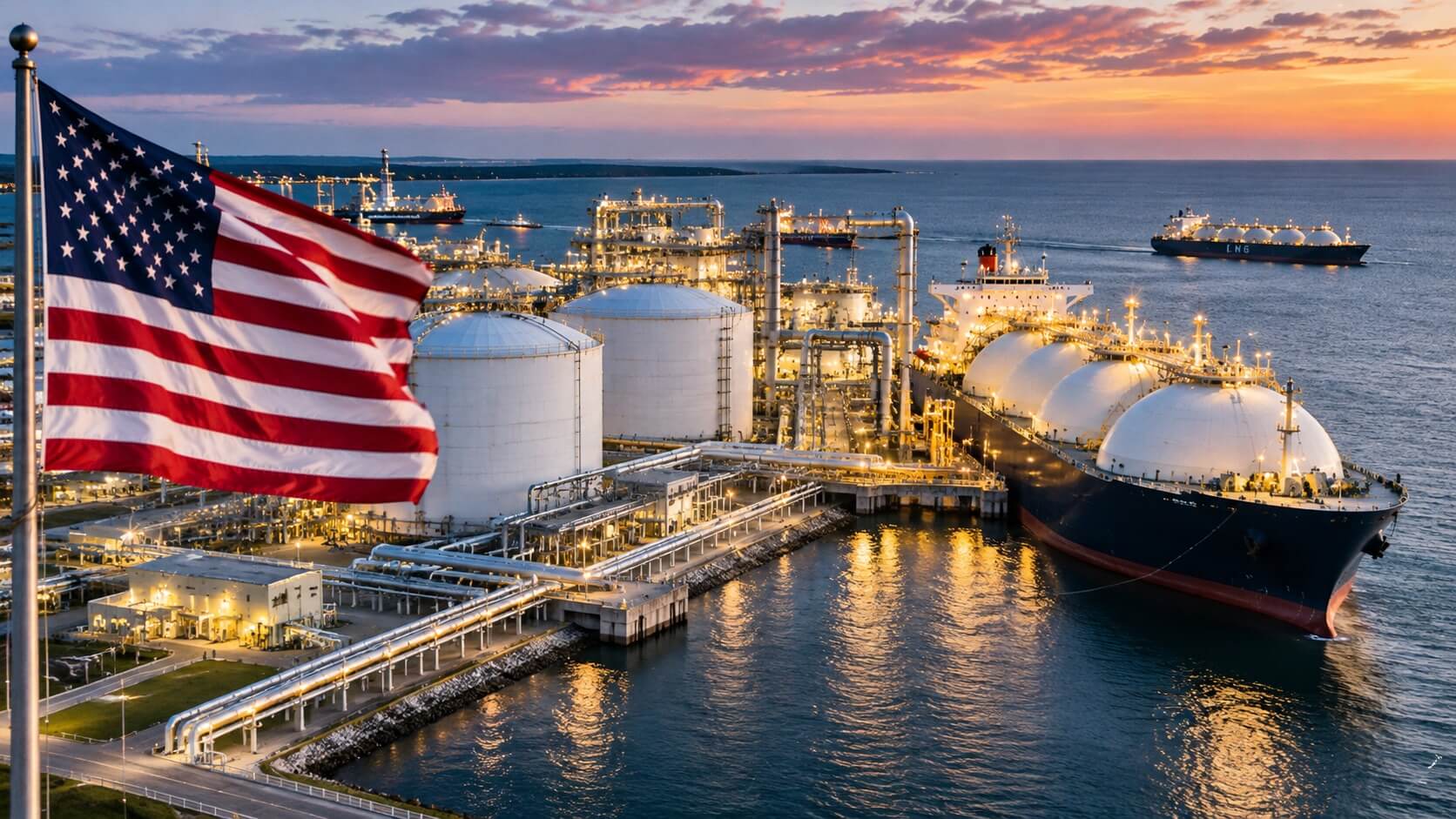
Cheniere Energy (NYSE: LNG) is one of the largest and most established LNG exporters in the United States, operating major liquefied natural gas facilities at Sabine Pass in Louisiana and Corpus Christi in Texas. However, identifying the biggest LNG company in the US depends on whether the comparison uses operating export capacity, actual shipments, revenue, market capitalization, or planned expansion.
Venture Global (NYSE: VG) is another major US LNG exporter, with substantial operating infrastructure and development projects. Exxon Mobil, Chevron, and Sempra also participate in LNG, although their businesses extend beyond American export terminals.
For investors, the distinction matters: the company with the most export capacity is not necessarily the largest by stock market value or the one offering the most attractive investment returns.
What Is the Biggest LNG Company in the United States?
Cheniere Energy is a leading answer when comparing established US LNG export operations.
Its two major export complexes are:
- Sabine Pass LNG: Located in Louisiana, with multiple liquefaction trains producing LNG for international customers.
- Corpus Christi LNG: Located in Texas, with operating facilities and expansion projects designed to increase export capacity.
These facilities receive natural gas through pipelines, cool it into liquid form, and load it onto specialized vessels for overseas transportation.
Cheniere's position reflects its established infrastructure, commercial relationships, and experience operating large-scale LNG facilities.
However, other definitions of company size produce different comparisons.
Venture Global has developed substantial LNG export capacity and maintains an extensive portfolio of operating and developing facilities.
Exxon Mobil and Chevron are much larger diversified energy companies by overall business scale, but LNG represents only one part of their operations.
Kinder Morgan, meanwhile, operates natural gas transportation infrastructure rather than competing primarily as an LNG exporter.
Investors should distinguish the following measures:
| Measure | What it tells investors |
|---|---|
| Operating LNG capacity | How much LNG existing facilities are designed to produce |
| Actual LNG exports | How much LNG a company ships during a specific period |
| Revenue | The scale of reported business activity |
| Market capitalization | The stock market value of the company's equity |
| Planned export capacity | The potential scale of future operations |
| Free cash flow | Cash generated after operating activities and capital expenditures |
Operating capacity and actual financial performance are generally more useful for evaluating an established LNG exporter than the total capacity of projects it has announced.
Who Are the Major LNG Companies in the US?
The American LNG industry includes dedicated exporters, infrastructure developers, integrated energy companies, and pipeline operators.
| Company | Stock ticker | Main LNG-related activity | Investment exposure |
|---|---|---|---|
| Cheniere Energy | NYSE: LNG | LNG liquefaction and exports | Established export operations |
| Venture Global | NYSE: VG | LNG export facilities and development | Operating assets and expansion projects |
| Sempra | NYSE: SRE | LNG and energy infrastructure | Diversified infrastructure |
| Exxon Mobil | NYSE: XOM | Global LNG production and projects | Integrated energy operations |
| Chevron | NYSE: CVX | International LNG production and trading | Diversified global energy |
| Kinder Morgan | NYSE: KMI | Natural gas pipeline transportation | Infrastructure supporting gas demand |
Cheniere and Venture Global provide relatively direct exposure to LNG export operations.
Sempra participates through LNG interests and broader infrastructure investments. Exxon Mobil and Chevron operate across multiple international energy markets, while Kinder Morgan supplies transportation infrastructure used by natural gas customers, including LNG export terminals.
These companies should not be ranked as though they operate identical businesses.
For a broader overview of how exporters, producers, and infrastructure operators fit into the industry, read LNG Companies and Stocks: A Guide to the Industry for US Investors.
Cheniere Energy: A Leading US LNG Exporter
Cheniere Energy is a major publicly traded LNG exporter with established operations on the US Gulf Coast.
Its importance comes from its operating facilities, international customer agreements, and substantial liquefaction capacity.
Sabine Pass LNG
Sabine Pass is located in southwestern Louisiana near the Texas border.
The facility uses multiple liquefaction trains to process natural gas for export. A liquefaction train is a production unit that cools natural gas until it becomes liquid.
Sabine Pass played an important role in the development of large-scale US LNG exports, which began in 2016.
Its established infrastructure provides a foundation for ongoing production and international deliveries.
Corpus Christi LNG
Cheniere also operates the Corpus Christi LNG complex in Texas.
The location benefits from access to Gulf Coast natural gas infrastructure and international shipping routes.
Expansion at Corpus Christi is an important part of the company's strategy to increase export capacity.
Additional liquefaction trains can support higher production, although actual output depends on commissioning, equipment reliability, and operating conditions.
Why Cheniere Matters to Investors
Cheniere combines established operating assets with long-term commercial agreements.
These contracts can support revenue visibility, although their financial value depends on pricing structures, customer obligations, and operating expenses.
Its existing facilities also distinguish the company from developers relying primarily on unfinished projects for future revenue.
However, Cheniere's market position does not guarantee attractive shareholder returns. Debt, expansion spending, future cash flow, and stock valuation remain essential considerations.
Venture Global: A Major Competitor in US LNG Exports
Venture Global has become a significant participant in American LNG exports through the development and operation of large liquefaction facilities.
Its major projects include Calcasieu Pass, Plaquemines LNG, and CP2 LNG.
Calcasieu Pass LNG
Calcasieu Pass is an LNG export facility in Louisiana that uses modular liquefaction technology.
This approach involves constructing standardized processing units that are assembled into a larger production complex.
Modular construction is intended to support efficient development, but its economic benefits depend on actual construction costs, operating performance, and project execution.
Investors should also consider contractual obligations and commercial disputes when evaluating the facility's financial contribution.
Plaquemines LNG
Plaquemines LNG is another major Venture Global facility in Louisiana.
The project has added substantial export capacity as production units have entered service and development has progressed.
Investors should distinguish between LNG shipments from operating equipment and capacity still undergoing commissioning or construction.
Initial exports do not necessarily mean that an entire facility has reached full commercial operation.
CP2 LNG
CP2 is a major LNG development associated with Venture Global's expansion strategy.
Its future contribution depends on financing, construction progress, customer agreements, regulatory requirements, and operating economics.
Large projects can increase production and revenue, but they also require substantial capital and expose shareholders to execution risk.
How Venture Global Differs From Cheniere
Both companies offer direct exposure to US LNG exports, but their investment profiles differ in the mix of established operations and development commitments.
Cheniere has a long operating history at Sabine Pass and Corpus Christi.
Venture Global combines operating facilities with major expansion activity, making construction costs, project timelines, and contractual performance particularly relevant.
Investors should compare actual cash generation, remaining capital commitments, debt, and valuations rather than relying solely on planned export capacity.
Sempra: LNG as Part of a Diversified Energy Infrastructure Business
Sempra participates in LNG through infrastructure ownership and development alongside major regulated energy businesses.
Unlike a dedicated exporter, its financial results are also influenced by utility operations, infrastructure spending, regulatory decisions, and financing conditions.
Cameron LNG
Sempra holds an ownership interest in Cameron LNG, an export facility in Louisiana.
The project connects US natural gas supplies with international markets.
Sempra's participation illustrates how investors can gain LNG exposure through ownership interests in infrastructure projects rather than through a company focused exclusively on exports.
Port Arthur LNG
Port Arthur LNG is a major export development in Texas associated with Sempra's LNG infrastructure activities.
Its financial contribution depends on construction costs, financing arrangements, customer contracts, and the timing of commercial operations.
Why Sempra Is Different
Sempra's broader portfolio means LNG is only one factor affecting its stock performance.
Investors also gain exposure to regulated utilities and other energy infrastructure assets.
This diversification can reduce dependence on LNG-specific developments, although it also limits how directly the stock reflects growth in American LNG exports.
Exxon Mobil: LNG Within a Global Energy Portfolio
Exxon Mobil is a major integrated energy company involved in oil and natural gas production, refining, chemicals, and international energy projects.
LNG is an important component of its global natural gas business, but it represents only part of the company's operations.
Golden Pass LNG
Golden Pass LNG is a major Texas export project associated with Exxon Mobil and QatarEnergy.
The facility is designed to liquefy US natural gas for international customers.
Its contribution to future earnings depends on commissioning, operating performance, commercial arrangements, and project economics.
For Exxon Mobil, even substantial LNG growth must be evaluated within a much larger corporate portfolio.
What Investors Should Understand
Exxon Mobil provides diversified exposure to global energy markets rather than concentrated exposure to US LNG exports.
Its stock performance is influenced by crude oil prices, natural gas production, refining, capital spending, and other business activities.
Investors should therefore avoid evaluating Exxon Mobil's overall valuation based on LNG production or export capacity alone.
Chevron: International LNG Experience and Diversified Energy Exposure
Chevron is another major integrated energy company with substantial experience in LNG production and development.
Its international LNG activities include major operations in Australia and interests in other global energy projects.
These businesses provide exposure to natural gas trade, but Chevron is not primarily a dedicated US LNG exporter.
Its earnings also depend on crude oil production, refining, natural gas operations, and broader corporate performance.
For investors, Chevron offers LNG exposure within a diversified energy portfolio.
This distinction matters when comparing it with Cheniere or Venture Global: a company can be much larger overall while having less concentrated exposure to American LNG export terminals.
Kinder Morgan: The Pipeline Infrastructure Behind LNG Exports
LNG export terminals require substantial volumes of natural gas delivered reliably through pipeline networks.
Kinder Morgan operates extensive natural gas transportation infrastructure across North America, connecting producing regions with utilities, industrial customers, and other major consumers.
How Pipeline Companies Benefit From LNG
Expanding LNG exports can increase demand for pipeline capacity serving Gulf Coast liquefaction facilities.
New terminals may require additional connections or expansions to existing networks.
Pipeline operators can earn revenue under transportation agreements, including contracts that provide payments for reserved capacity.
However, not all pipeline revenue is directly connected to LNG exports. Domestic utilities, industrial facilities, and other customers also contribute to demand.
Why Pipeline Stocks Behave Differently
Pipeline companies generally have a different financial profile from dedicated LNG exporters.
Their earnings may depend on contracted transportation capacity, tariffs, operating costs, financing, and infrastructure investment.
Consequently, pipeline stocks may be less directly exposed to international LNG price movements, although they remain sensitive to interest rates, debt, regulation, and transportation demand.
Investors should examine the actual share of company activity connected to LNG exports rather than assuming every natural gas pipeline business offers equivalent exposure.
How Does US LNG Export Capacity Compare Across Companies?
LNG export capacity is commonly measured in million metric tons per annum (MTPA).
For example, a facility rated at 10 MTPA is designed to produce approximately 10 million metric tons of LNG annually under specified operating conditions.
However, nameplate capacity is not equivalent to actual production.
Maintenance, equipment reliability, commissioning, and operating conditions can affect output.
Four categories are important when comparing companies:
| Capacity measure | Meaning |
|---|---|
| Operating capacity | Facilities capable of producing LNG |
| Capacity under commissioning | New equipment being tested and brought into service |
| Capacity under construction | Facilities being built but not yet fully operational |
| Planned capacity | Proposed projects that may depend on approvals and financing |
These categories should not be combined and presented as current production.
A company may announce a large development portfolio while operating much less capacity today.
Similarly, a facility can begin shipping LNG before reaching its intended annual production rate.
Ownership also matters. A company holding a minority interest in an export project should not automatically be credited with the facility's entire capacity when comparing attributable production.
For a meaningful ranking, investors should compare figures from the same reporting period and distinguish gross facility capacity from capacity attributable to each company's ownership.
Why Is the US Gulf Coast So Important to LNG Companies?
Louisiana and Texas form the center of American LNG export infrastructure.
The Gulf Coast offers several advantages:
- Extensive natural gas pipeline networks.
- Connections to major producing regions, including the Permian Basin and Haynesville Shale.
- Established ports and industrial infrastructure.
- Access to international shipping routes.
- Experience developing large-scale energy facilities.
These characteristics help explain why major LNG projects are concentrated along the coast.
However, geographic concentration introduces physical and operational risks.
Hurricanes, flooding, industrial incidents, and shipping disruptions can affect multiple facilities in the region.
Export terminals must also manage environmental requirements and coastal infrastructure challenges.
Gulf Coast access is therefore an important competitive advantage, but it does not eliminate operational risk.
Does Being the Largest LNG Company Make a Stock a Better Investment?
No. Company size can provide advantages, but it does not determine future shareholder returns.
Large LNG companies may benefit from established infrastructure, customer relationships, operating experience, and access to financing.
However, a smaller business can potentially deliver stronger returns if it expands profitably and its shares are reasonably valued.
Investors should consider five factors beyond size:
- Cash flow: Does the company generate sufficient cash after operating costs and capital expenditures?
- Financial leverage: Can it manage debt and financing obligations?
- Contract quality: Are future revenues supported by reliable customers and commercially attractive agreements?
- Expansion economics: Are new projects expected to earn adequate returns on invested capital?
- Stock valuation: Does the share price reasonably reflect expected future earnings and risks?
For a practical framework covering these questions, read How to Evaluate the Best LNG Stocks to Buy.
What Could Change the Ranking of US LNG Companies?
Company rankings can change as new facilities enter service, ownership structures evolve, and operating performance differs.
New Liquefaction Capacity
Companies completing major projects can increase their production capacity.
However, planned capacity becomes meaningful operating output only after successful commissioning and sustained production.
Project Delays
Construction problems, financing challenges, and regulatory requirements can postpone new capacity.
Companies with ambitious expansion plans may fall behind competitors that complete projects more efficiently.
Acquisitions and Ownership Changes
Acquisitions, joint ventures, and changes in project ownership can alter the amount of LNG capacity attributable to individual companies.
Investors should distinguish wholly owned facilities from minority interests.
Operational Performance
Production depends on equipment reliability, maintenance, and facility utilization.
A company with less nameplate capacity may export more LNG during a particular period if its facilities operate more consistently.
Financial Discipline
Companies that maintain manageable debt and invest profitably may strengthen their competitive positions.
Expanding production without generating adequate financial returns can weaken a business despite its increasing market share.
How Does International Demand Influence US LNG Companies?
US LNG exporters serve international customers, with Europe and Asia playing important roles in global trade.
Importing countries purchase LNG for electricity generation, industrial operations, heating, and energy security.
Demand can support long-term supply agreements and investment in additional export facilities.
However, international consumption is affected by prices, economic growth, domestic gas production, and competition from other energy sources.
High LNG prices can reduce purchases in price-sensitive markets, while economic slowdowns can weaken industrial demand.
Renewable energy, nuclear power, storage, and efficiency improvements may also influence future gas requirements.
Shipping costs, import terminal availability, and regional price differences determine where LNG cargoes can be delivered economically.
For a closer examination of major importing countries, see Who Buys the Most LNG? The Countries Driving Global Demand.
Which US LNG Companies Have the Greatest Growth Potential?
Growth potential depends on existing operations, planned expansion, financing requirements, and the ability to generate returns on new investment.
Dedicated LNG exporters provide relatively direct exposure to increased liquefaction capacity.
Established operators may expand existing terminals while benefiting from current cash flow. Developers may achieve faster production growth but face greater construction and financing uncertainty.
Integrated energy companies can participate in LNG growth without relying entirely on the sector, while pipeline operators may benefit indirectly from additional gas transportation requirements.
| Business model | Potential growth driver | Main uncertainty |
|---|---|---|
| Established LNG exporter | Additional liquefaction capacity | Expansion costs and valuation |
| LNG infrastructure developer | New export facilities | Financing, construction, and commercial execution |
| Integrated energy company | Global LNG projects | LNG's contribution to overall earnings |
| Pipeline operator | Increased transportation demand | Project economics and contract commitments |
| Diversified infrastructure company | New energy investments | Capital allocation and financing costs |
The companies announcing the largest projects are not necessarily those offering the greatest potential shareholder returns.
Investors must consider how much expected growth is already reflected in current stock valuations.
For a closer look at how future capacity, cash flow, and valuation assumptions could affect Cheniere Energy's share price, see LNG Stock Forecast: What Could Shape Cheniere Energy's Future Price?.
What Should Investors Watch in the US LNG Industry?
Several indicators can help investors track changes in company positions and industry competition:
- New export capacity entering service: Increases the potential volume available to international customers.
- Final investment decisions: Indicate commitments to major developments and future capital spending.
- Long-term supply agreements: Provide information about contracted demand and potential revenue visibility.
- Quarterly financial results: Reveal operating cash flow, debt, capital spending, and profitability.
- Construction progress: Shows whether projects are advancing within expected budgets and schedules.
- International natural gas prices: Influence trading conditions and earnings for companies with commodity exposure.
- Regulatory developments: Can affect project approvals, operating requirements, and future investment costs.
A new terminal may increase a company's market share, but its financial value ultimately depends on the cost of construction, commercial arrangements, and operating performance.
Which LNG Company Matters Most for US Investors?
Cheniere Energy remains a central company for investors researching established American LNG export operations, supported by its Sabine Pass and Corpus Christi facilities.
Venture Global is another major exporter whose operating assets and development projects contribute to the changing structure of the US LNG market.
Sempra provides exposure through LNG interests and broader energy infrastructure, while Exxon Mobil and Chevron participate through diversified international energy businesses.
Kinder Morgan illustrates the importance of pipeline transportation in supporting export activity.
For investors, the most useful comparison is not simply which company is largest. It is which businesses combine productive operating assets, reliable contracts, sustainable cash flow, manageable debt, and economically justified expansion.
As new facilities begin operating, the ranking of US LNG companies will continue to evolve. Understanding how those changes affect profitability and shareholder value is more important than selecting a stock based on size alone.
Disclaimer: This article is for informational and educational purposes only and does not constitute financial or investment advice. LNG and energy-related stocks involve risks, including commodity price volatility, construction delays, financial leverage, and potential loss of principal. Investors should conduct independent research and consider their financial circumstances before making investment decisions.