
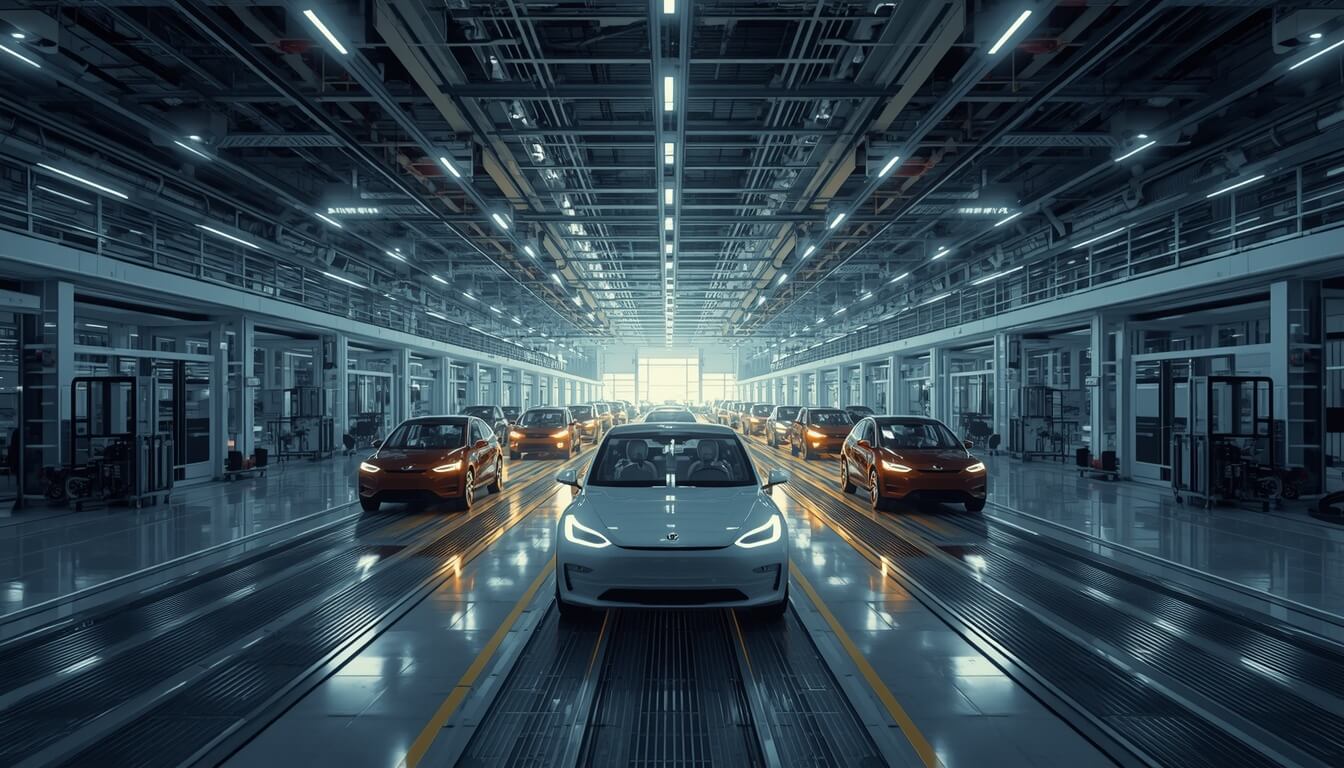
The global electric vehicle market is increasingly becoming more than a competition between automakers. As electric vehicles move from an emerging technology toward a mainstream industrial product, the companies and countries able to control production capacity, battery supply, manufacturing costs and critical components are gaining greater importance.
The transition from internal combustion engines to electric drivetrains is changing the structure of the automotive industry. Traditional competitive advantages such as engine technology, dealership networks and decades of manufacturing experience remain relevant, but they now interact with a different set of industrial capabilities. Battery production, software, power electronics, raw-material access and manufacturing scale are becoming central elements of competition.
This transformation helps explain why the global EV market cannot be understood simply by comparing vehicle sales between individual brands. The more important question is increasingly how efficiently companies can build an entire industrial system around electric vehicles.
From Automobiles to Industrial Systems
A conventional automobile is the result of a highly complex supply chain, but electric vehicles change the relative importance of some of its components.
Electric motors are mechanically simpler than internal combustion engines, while batteries represent a much larger share of the vehicle's technological and economic value. This shifts competitive attention toward battery cells, battery packs, charging systems, power electronics and the software controlling the vehicle.
At the same time, manufacturing scale can have a particularly significant effect on EV economics. A company producing batteries, motors, electronic components and vehicles at large volumes can potentially spread fixed costs across more units and develop manufacturing processes that smaller competitors may find difficult to replicate.
This creates a feedback loop. Higher production volumes can support lower costs, while lower costs can make vehicles more competitive and support further increases in volume.
The result is an industry in which manufacturing capability itself becomes a strategic asset.
China and the Expansion of EV Manufacturing
China has become a central part of the global electric vehicle manufacturing ecosystem. Its importance extends beyond the number of vehicles produced domestically.
The country has developed extensive capabilities across battery materials, battery cells, components, electric drivetrains and vehicle manufacturing. This concentration allows companies operating within the ecosystem to access suppliers and industrial infrastructure at scale.
Chinese automakers have also expanded internationally, increasing competition in markets where established manufacturers historically dominated.
BYD provides one of the clearest examples of this industrial approach. The company has developed capabilities spanning batteries, electric drivetrains and vehicle production, allowing it to approach the EV market through a relatively integrated manufacturing structure.
This makes the competitive landscape different from a traditional automotive market. Instead of competing only on vehicle design or brand recognition, manufacturers increasingly compete on the efficiency of the industrial system behind the vehicle.
Tesla and the Importance of Manufacturing Scale
Tesla represents another important development in the evolution of the EV industry.
The company demonstrated that an electric vehicle manufacturer could build a large global business around battery-powered vehicles while treating software, manufacturing processes and vehicle architecture as interconnected elements.
Its production expansion showed the importance of manufacturing scale in reducing costs and increasing availability. Gigafactories became an important part of the company's industrial strategy, bringing battery and vehicle production into large-scale manufacturing facilities.
Tesla's experience also illustrates an important characteristic of the EV transition: manufacturing capacity cannot be developed overnight.
Building factories requires capital, engineering expertise, supplier relationships, logistics infrastructure and time. Increasing production is therefore not simply a question of receiving more customer orders. Companies must first build the industrial capacity required to satisfy those orders.
This is one reason why the future structure of the EV market will depend heavily on manufacturing investment.
Batteries Are Becoming a Core Industrial Constraint
The battery is arguably the component that most clearly distinguishes the EV industrial model from the traditional automotive model.
Battery costs influence vehicle prices, driving range and profitability. Battery chemistry also affects energy density, safety, charging characteristics and the availability of raw materials.
Consequently, access to competitive battery technology and production capacity can influence the entire economics of an EV manufacturer.
The battery supply chain is itself highly complex. It includes mining and processing of raw materials, production of cathode and anode materials, cell manufacturing, pack assembly and recycling.
This creates dependencies that extend far beyond the automotive industry.
A manufacturer may have excellent vehicle engineering capabilities but still face constraints if battery costs are too high or production capacity is insufficient. Conversely, a company with strong control over battery technology and manufacturing can potentially use that advantage to compete on vehicle pricing and production scale.
The importance of this relationship is explored in greater depth in Why Battery Technology Could Decide the Next Phase of the Electric Vehicle Market.
Cost Is Becoming a Structural Competitive Variable
The EV transition is also changing the role of cost competition.
During the early development of the electric vehicle market, manufacturers could often emphasize technology, performance, design and environmental benefits. As EV adoption expands, however, price becomes increasingly important.
A manufacturer that can reduce battery costs, simplify vehicle architecture and increase factory utilization may have more flexibility in setting prices.
This does not necessarily mean that the lowest-cost manufacturer will dominate the market. Automobiles remain differentiated products, and consumers consider factors such as:
- brand and design
- safety and range
- charging infrastructure
- software and after-sales service
Nevertheless, manufacturing economics increasingly influence the ability of companies to compete across different market segments.
This is particularly important as EVs move beyond premium vehicles and early adopters toward larger consumer markets.
Vertical Integration Returns to the Center
Another major change is the renewed importance of vertical integration.
Traditional automakers have historically relied on extensive networks of specialized suppliers. This model allowed companies to concentrate on vehicle design, assembly and brand management while purchasing many components from external suppliers.
Electric vehicles create incentives to reconsider where critical technologies should sit within the corporate structure.
Battery production is one example. A manufacturer that depends entirely on external battery suppliers may have less control over costs, capacity and technology development. Companies that develop greater internal capabilities can potentially coordinate battery technology with vehicle design and manufacturing.
The same principle can apply to electric motors, power electronics, software and other components.
The degree of integration differs significantly between manufacturers. Some companies continue to rely heavily on external suppliers, while others are building capabilities across multiple stages of the EV value chain.
Tesla, BYD and other major manufacturers therefore represent different approaches to the same industrial transformation. Their strategies are not simply about selling different vehicles; they reflect different answers to the question of how much of the EV production system a company should control itself.
A closer examination of this structural change can be found in Tesla, BYD and the Changing Structure of the EV Industry.
A Global Competition for Industrial Capacity
The EV transition is also becoming a competition between industrial ecosystems.
Governments are supporting domestic battery production, semiconductor manufacturing and vehicle factories because the economic implications extend beyond the automotive sector.
EV manufacturing creates demand for batteries, chemicals, electronics, software, industrial machinery and energy infrastructure. Countries with strong positions in these industries can capture value across multiple layers of the supply chain.
This has contributed to policies designed to attract battery factories and vehicle manufacturing investment. At the same time, trade measures and local-content requirements can influence where companies build factories and source components.
As a result, the geography of EV production is becoming strategically important.
Manufacturers must consider not only where vehicles can be sold but also where batteries and components can be produced competitively and where supply chains can remain resilient.
The Next Stage of the EV Market
The next phase of the electric vehicle industry is therefore likely to be shaped by industrial capabilities as much as by vehicle-level innovation.
Production scale, battery economics, manufacturing efficiency and supply-chain control can determine how quickly companies expand and how aggressively they can compete on price.
This does not eliminate the importance of product differentiation. Design, software, charging experience, brand reputation and vehicle performance will continue to influence consumers.
But the underlying industrial system is becoming harder to separate from the final product.
The most significant change may therefore be conceptual. Electric vehicles are transforming the automobile from a machine dominated by mechanical engineering into a product that combines batteries, electronics, software, energy systems and advanced manufacturing.
That transformation is creating a new competitive landscape.
Companies are no longer competing only to build better electric cars. They are increasingly competing to build the industrial systems capable of producing those cars efficiently, at scale and at globally competitive costs.
Understanding that shift is essential for analyzing the future structure of the EV industry. The competition will increasingly extend from showrooms and vehicle specifications into factories, battery plants, supply chains and the technologies that connect them.