
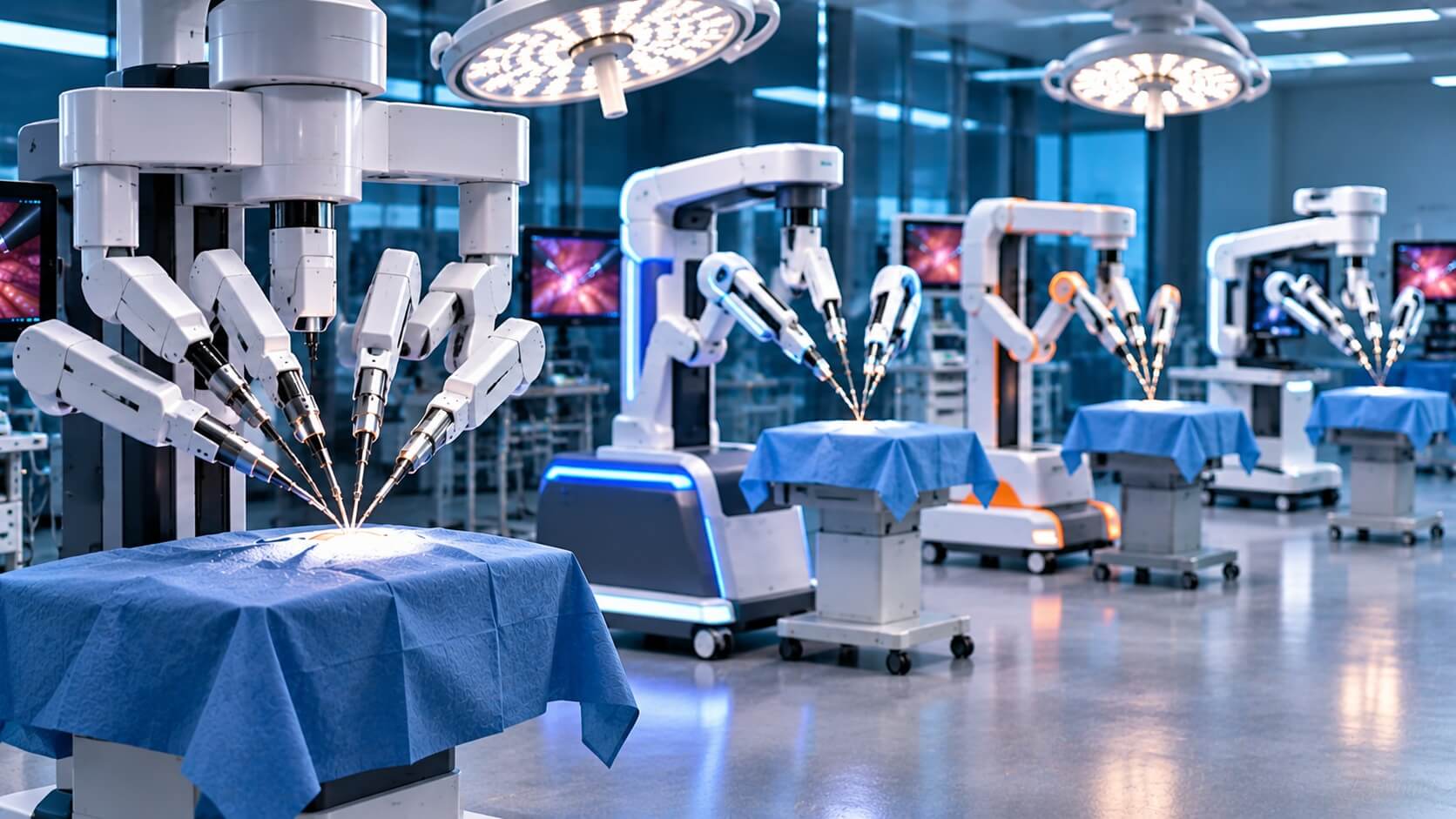
The da Vinci 5 from Intuitive Surgical is among the most advanced commercially available robotic systems for minimally invasive soft-tissue surgery. However, there is no single surgical robot that can be considered the most advanced across every medical specialty.
Different surgical robots are designed for different purposes. Intuitive Surgical's da Vinci systems focus on soft-tissue procedures, Stryker's Mako platform specializes in joint replacement, and other manufacturers develop robotic technology for spinal surgery, urology, and specialized interventions.
The most advanced system is not necessarily the newest or most expensive. What matters is how effectively its technology supports surgeons, improves clinical capabilities, and delivers value to hospitals and patients.
For investors, comparing surgical robots also reveals which manufacturers are developing competitive technologies and where future industry growth may emerge.
What Is the Most Advanced Surgical Robot Today?
The answer depends on the type of surgery.
For complex minimally invasive soft-tissue procedures, Intuitive Surgical's da Vinci 5 represents one of the most sophisticated established platforms.
It combines advanced visualization, robotic instrument control, computing capabilities, and force feedback technology.
For orthopedic surgery, Stryker's Mako platform is an important example of advanced robotic assistance.
It helps surgeons plan and perform certain joint replacement procedures using patient-specific anatomical information and controlled surgical guidance.
In spinal surgery, systems developed by companies such as Globus Medical combine robotic guidance with surgical navigation technology.
These systems cannot be ranked fairly using a single technical specification.
A robot designed to guide the placement of spinal implants performs a fundamentally different function from one designed to manipulate instruments during abdominal surgery.
The most meaningful comparison considers the surgical application, clinical capabilities, regulatory authorization, and evidence of patient benefit.
Which Surgical Robots Are the Most Advanced?
Several established and emerging platforms illustrate the range of modern surgical robotics.
| Surgical robot | Manufacturer | Main application | Notable capabilities |
|---|---|---|---|
| da Vinci 5 | Intuitive Surgical | Minimally invasive soft-tissue surgery | Advanced visualization, articulated instruments, force feedback |
| da Vinci Xi | Intuitive Surgical | Minimally invasive soft-tissue surgery | Multi-arm robotic control and broad procedural flexibility |
| Mako | Stryker | Hip and knee replacement | Surgical planning and robotic-arm assisted bone preparation |
| Hugo | Medtronic | Minimally invasive soft-tissue surgery | Modular robotic arms and surgeon-controlled instruments |
| Versius | CMR Surgical | Minimally invasive soft-tissue surgery | Modular configuration and compact robotic arm units |
| ROSA | Zimmer Biomet | Orthopedic surgery | Robotic assistance and anatomical guidance |
| ExcelsiusGPS | Globus Medical | Spine surgery | Robotic guidance and navigation for implant placement |
The capabilities listed describe the platforms rather than establishing an overall ranking.
Commercial availability and authorized surgical applications vary by country, system version, and regulatory status.
A robot may be authorized for certain procedures in one market but not in another.
1. Da Vinci 5: Advanced Soft-Tissue Robotic Surgery
The da Vinci 5 is developed by Intuitive Surgical, one of the most established companies in robotic-assisted surgery.
The system received clearance from the US Food and Drug Administration in March 2024.
It builds on earlier generations of da Vinci technology while introducing improvements in computing, imaging, ergonomics, and instrument capabilities.
What Makes the Da Vinci 5 Advanced?
One of its most notable features is force feedback.
Traditional robotic-assisted surgery often relies heavily on visual information because the surgeon does not directly feel the instruments interacting with tissue.
Force feedback technology provides information about forces applied through compatible instruments.
This can give surgeons an additional source of information during certain surgical movements.
The da Vinci 5 also includes improved computing capabilities intended to support surgical technology development and data-driven features.
Its imaging and control systems are designed to provide detailed visualization and precise instrument movement.
Does Force Feedback Make Surgery Safer?
Force feedback is a potentially valuable technological feature, but its presence does not automatically establish superior clinical outcomes.
Whether it improves safety or effectiveness depends on the procedure, surgeon experience, and supporting clinical evidence.
A technically advanced feature must be distinguished from a proven reduction in complications.
Why Does the Da Vinci 5 Matter for Investors?
The platform represents an opportunity for Intuitive Surgical to support equipment upgrades and continued customer adoption.
Hospitals already using da Vinci systems may evaluate whether newer capabilities justify replacing older equipment.
However, new product introductions do not guarantee immediate sales growth.
Hospitals must consider capital budgets, clinical requirements, and the total cost of ownership.
For a detailed explanation of the company behind da Vinci, see Who Makes the Da Vinci Surgical Robot? Inside Intuitive Surgical.
2. Da Vinci Xi: An Established and Versatile Surgical Platform
The da Vinci Xi is an earlier-generation platform that remains important in understanding the development of robotic-assisted surgery.
It was designed to support a broad range of minimally invasive procedures.
The system uses multiple robotic arms and specialized instruments controlled by a surgeon.
Its configuration supports access to different anatomical areas during certain operations.
Why Is the Da Vinci Xi Still Relevant?
The newest equipment is not automatically the best economic choice for every hospital.
An established platform may already meet the clinical needs of a surgical department.
Hospitals must evaluate whether replacing functioning equipment provides sufficient additional value.
The da Vinci Xi also illustrates the importance of Intuitive Surgical's installed equipment base.
Established systems can continue generating instrument, accessory, and service revenue even after newer generations become available.
For investors, the relationship between installed equipment and recurring revenue is an important part of the company's business model.
3. Stryker Mako: Advanced Robotics for Joint Replacement
Stryker's Mako platform is one of the most recognizable robotic-assisted technologies in orthopedic surgery.
It supports selected knee and hip replacement procedures.
Unlike da Vinci, Mako is not designed primarily for manipulating instruments during soft-tissue surgery.
Instead, it helps surgeons plan and execute certain steps involved in joint replacement.
How Does Mako Work?
The system uses anatomical information to support surgical planning.
During the procedure, robotic-arm assistance helps the surgeon operate within defined boundaries.
This can support controlled bone preparation and implant positioning.
The surgeon remains responsible for the procedure and clinical decisions.
What Makes Mako Advanced?
Its main technological strength is the integration of planning, anatomical information, and robotic guidance.
This is particularly relevant in orthopedic surgery, where implant positioning and alignment are important considerations.
However, improved technical precision does not automatically guarantee better long-term patient outcomes.
Clinical benefits must be evaluated through appropriate studies.
Why Does Mako Matter for Investors?
Stryker manufactures both orthopedic implants and robotic technology.
This creates opportunities to integrate robotic systems with the company's broader orthopedic product portfolio.
The economic relationship differs from Intuitive Surgical's soft-tissue robotics model.
Stryker may benefit from both robotic platform adoption and associated orthopedic implant demand.
4. Medtronic Hugo: A Modular Alternative
Medtronic's Hugo robotic-assisted surgery system is designed for minimally invasive soft-tissue procedures.
Its architecture differs from some established platforms because it uses separate robotic arm units.
This modular configuration may provide flexibility in how equipment is arranged within an operating room.
What Makes Hugo Different?
The system combines robotic instrument control, visualization, and a modular equipment design.
For hospitals, flexibility in operating room configuration can be an important consideration.
However, a modular architecture is not automatically superior.
Hospitals must evaluate setup requirements, workflow efficiency, surgeon training, reliability, and costs.
Is Hugo More Advanced Than Da Vinci?
There is no universal basis for declaring Hugo more advanced than da Vinci.
The platforms have different designs and commercial histories.
A meaningful comparison would need to examine specific procedures, clinical outcomes, instrument capabilities, operating room efficiency, and economic performance.
Regulatory authorization and commercial availability also vary by market.
Why Does Hugo Matter for Investors?
Medtronic has extensive relationships with hospitals and experience in medical technology.
These resources may support the commercialization of robotic surgery equipment.
However, challenging an established competitor requires more than developing a capable system.
Medtronic must demonstrate clinical value, secure appropriate regulatory authorizations, and achieve meaningful hospital adoption.
5. CMR Surgical Versius: Flexible Robotic Surgery
Versius is developed by CMR Surgical, a privately held medical technology company.
The platform is designed for minimally invasive soft-tissue surgery.
Its modular robotic arms are intended to provide flexibility in operating room arrangements.
What Makes Versius Different?
Versius uses separate robotic arm units that can be positioned around the patient.
This configuration offers an alternative to larger integrated robotic structures.
The system is designed to support surgeon-controlled minimally invasive procedures.
However, compact or modular equipment does not necessarily mean lower operating costs or better clinical outcomes.
Hospitals must consider equipment requirements, setup time, training, maintenance, and procedural performance.
Why Is Versius Important?
The platform illustrates how competitors are exploring alternative approaches to surgical robotics.
Instead of copying established systems exactly, manufacturers may focus on flexibility, ergonomics, and different commercial arrangements.
For investors, CMR Surgical demonstrates that technological competition extends beyond publicly traded companies.
Because CMR Surgical is privately held, investors generally cannot obtain direct exposure through an ordinary publicly traded share.
6. Zimmer Biomet ROSA: Robotic Assistance in Orthopedics
Zimmer Biomet's ROSA platform is another important example of robotic technology used in orthopedic surgery.
ROSA supports certain procedures involving joint replacement.
The platform combines surgical planning information with robotic assistance.
What Makes ROSA Advanced?
ROSA is designed to help surgeons perform selected surgical steps using anatomical guidance and positioning information.
Its purpose is different from that of robotic systems used for abdominal or pelvic surgery.
The value of the technology depends on whether it improves relevant aspects of surgical performance and patient outcomes.
Why Does ROSA Matter for Investors?
Zimmer Biomet has an established orthopedic implant business.
Robotic technology can support its broader relationships with surgeons and hospitals.
The company may benefit when robotic assistance strengthens demand for compatible orthopedic products.
However, robotics represents only one component of Zimmer Biomet's overall business.
Investors should evaluate its financial contribution within the wider orthopedic portfolio.
7. Globus Medical ExcelsiusGPS: Robotics for Spine Surgery
Globus Medical develops technologies for spinal surgery, including the ExcelsiusGPS robotic navigation platform.
The system combines robotic guidance with navigation capabilities.
Its purpose is to help surgeons plan and guide certain aspects of spinal procedures, including implant placement.
What Makes ExcelsiusGPS Advanced?
Spinal surgery can require accurate positioning of surgical instruments and implants near sensitive anatomical structures.
Robotic guidance and navigation technology can assist surgeons in following planned trajectories.
This differs substantially from the instrument manipulation performed by soft-tissue surgical robots.
The system's capabilities must be evaluated in the context of spine surgery rather than compared directly with da Vinci's soft-tissue instruments.
Why Does It Matter for Investors?
Globus Medical provides exposure to specialized surgical technology.
Robotic navigation may complement the company's spinal implant and surgical equipment businesses.
Its commercial success depends on adoption by surgeons and hospitals, clinical performance, and the economics of the broader surgical offering.
Which Surgical Robot Has the Best Technology?
There is no single technical feature that determines which surgical robot is best.
Several capabilities matter, but their importance changes according to the procedure.
Instrument Precision
Precise instrument control can be particularly important in delicate surgical environments.
However, technical precision alone does not guarantee better outcomes.
Visualization
High-quality imaging helps surgeons identify anatomical structures and understand the surgical field.
Different platforms use different imaging and navigation technologies.
Force Feedback
Force feedback provides information about forces applied through instruments.
It may help surgeons understand certain interactions with tissue, although clinical benefits require appropriate evaluation.
Surgical Navigation
Navigation technology can be particularly important in orthopedic and spinal procedures.
It helps surgeons relate instruments and planned movements to patient anatomy.
Operating Room Flexibility
The physical design of a robotic platform affects equipment positioning and surgical workflows.
Modular systems may offer different configuration options from integrated platforms.
Software and Data Capabilities
Advanced computing and software can support planning, visualization, system performance, and analysis of surgical information.
These features may become increasingly important as surgical technology develops.
The most useful technology is the one that addresses the actual requirements of a particular operation.
Are Newer Surgical Robots Better Than Older Ones?
Newer surgical robots may introduce valuable capabilities, but they are not automatically better for every hospital or procedure.
A newer system may offer improved imaging, computing performance, ergonomics, or instrument technology.
However, hospitals must also consider clinical evidence, training requirements, reliability, and cost.
An established robotic platform may already provide satisfactory capabilities for a hospital's surgical program.
Replacing it with newer equipment may not be financially justified if the additional benefits are limited.
Why Does This Matter for Investors?
New product launches can create opportunities for equipment sales and upgrades.
However, the timing of hospital purchases is uncertain.
Hospitals may continue operating older systems for years.
Investors should distinguish between technological innovation and actual commercial demand.
A new robotic system can attract attention without immediately generating substantial revenue.
Can Surgical Robots Operate Without a Surgeon?
Most commercially established surgical robots are not autonomous.
They assist surgeons rather than independently performing operations.
A surgeon controls the instruments or supervises the relevant surgical steps, depending on the platform.
Robotic systems may include software that helps with planning, positioning, movement constraints, or imaging.
However, these functions should not be confused with a robot independently deciding how to perform an entire operation.
What About Artificial Intelligence?
Artificial intelligence may eventually play a larger role in surgical robotics.
Potential applications include:
- Identifying anatomical structures in surgical images.
- Supporting preoperative planning.
- Analyzing surgical workflow.
- Assisting with instrument positioning.
- Providing information during procedures.
- Supporting training and performance assessment.
Some capabilities are already being researched or incorporated into specific medical technologies.
However, future AI applications must meet appropriate clinical and regulatory requirements.
The development of AI-assisted features does not mean fully autonomous surgery is commercially established.
Could AI Create the Next Generation of Surgical Robots?
Artificial intelligence could influence how surgical robots are designed and used.
Advanced imaging analysis may help surgeons interpret visual information.
Software may support surgical planning and provide additional information during procedures.
Data collected from robotic systems may also help manufacturers study workflows and develop future improvements.
However, medical applications of AI face important challenges.
Surgical decisions can involve unpredictable anatomical conditions, complications, and patient-specific factors.
AI systems must demonstrate appropriate reliability and clinical value.
Privacy, cybersecurity, regulatory oversight, and responsibility for medical decisions are also important.
For investors, AI creates potential opportunities but should not be treated as a guarantee of faster growth or higher profitability.
A company must still demonstrate that its technology is useful, commercially viable, and appropriately authorized.
What Is the Most Advanced Surgical Robot for Different Procedures?
A practical comparison is more useful when organized by surgical specialty.
| Surgical application | Relevant robotic platforms | Important capabilities |
|---|---|---|
| Soft-tissue minimally invasive surgery | da Vinci 5, da Vinci Xi, Hugo, Versius | Instrument control, visualization, procedural flexibility |
| Knee replacement | Mako, ROSA | Surgical planning, anatomical guidance, implant positioning |
| Hip replacement | Mako | Planning and robotic-arm assisted preparation |
| Spine surgery | ExcelsiusGPS | Navigation and robotic guidance |
| Specialized urologic procedures | Procedure-specific robotic platforms | Targeted treatment and controlled instrument guidance |
This table identifies relevant systems rather than declaring a clinical winner.
Different procedures require different technologies.
Even within the same specialty, patient characteristics and surgeon experience can influence which approach is appropriate.
The most advanced equipment is not necessarily the most suitable choice for every patient.
Which Companies Are Leading Surgical Robotics Innovation?
Several established manufacturers are investing in new robotic capabilities.
Intuitive Surgical continues developing its da Vinci ecosystem.
Stryker is advancing robotic-assisted orthopedic technology.
Medtronic is developing and commercializing robotic surgery platforms.
Zimmer Biomet combines robotics with orthopedic implants and surgical planning.
Globus Medical focuses on technologies relevant to spine surgery.
Other manufacturers, including CMR Surgical and Johnson & Johnson, are pursuing additional robotic platforms.
However, leadership in innovation is different from leadership in commercial adoption.
A company may introduce a technically sophisticated product but struggle to gain market share.
Another manufacturer may operate a less recently developed platform while benefiting from strong hospital relationships and recurring revenue.
For a detailed comparison of the industry's major manufacturers and competitive positions, see The Leading Surgical Robotics Companies: Who Dominates the Market.
What Should Investors Look for in Advanced Surgical Robots?
Investors should avoid evaluating surgical robotics companies solely on product specifications.
Technological capabilities matter, but commercial success depends on several additional factors.
| Factor | Why It Matters |
|---|---|
| Regulatory authorization | Determines where and for which uses a system can be marketed |
| Clinical evidence | Helps establish safety and effectiveness |
| Hospital adoption | Indicates commercial acceptance |
| Procedure volume | Measures actual utilization |
| Equipment pricing | Influences hospital purchasing decisions |
| Instruments and accessories | Can generate recurring revenue |
| Service contracts | Support ongoing customer relationships |
| Manufacturing costs | Affect profitability |
| Competitive differentiation | Influences long-term market position |
For example, a manufacturer might introduce a robot with sophisticated imaging and AI features.
Those capabilities could attract interest.
But if hospitals consider the equipment too expensive or difficult to integrate into existing workflows, adoption may remain limited.
Conversely, a system with fewer headline features may succeed commercially if it delivers reliable clinical performance at an acceptable cost.
For investors, sustainable business performance matters more than technological novelty alone.
Will the Most Advanced Surgical Robots Replace Traditional Surgery?
Robotic-assisted surgery may continue expanding into additional procedures, but it is unlikely to replace every conventional surgical technique.
Some operations are well suited to minimally invasive robotic assistance.
Others may be performed effectively through conventional laparoscopy or open surgery.
The appropriate approach depends on the patient's condition, procedure complexity, surgeon experience, and available equipment.
Robotic systems also require substantial investment, training, and maintenance.
These factors can limit adoption, particularly in healthcare settings with fewer resources.
Future technological improvements may expand the number of suitable procedures, but adoption will depend on clinical and economic evidence.
For manufacturers, this means market growth is possible without every hospital or surgical procedure becoming robotic.
What Is the Future of Advanced Surgical Robotics?
The next generation of surgical robots may emphasize several areas of development.
More sophisticated imaging
Improved visualization could help surgeons understand anatomy and navigate complex procedures.
Better instrument feedback
Force feedback and other sensing technologies may provide additional information during surgery.
Greater software integration
Surgical planning, imaging, navigation, and robotic control may become more closely connected.
More specialized platforms
Manufacturers may develop robots optimized for particular procedures rather than relying exclusively on multipurpose systems.
Improved affordability
Competition and alternative equipment designs could reduce some barriers to hospital adoption.
AI-assisted capabilities
Software may increasingly support planning, analysis, and selected surgical tasks while surgeons remain responsible for patient care.
These developments could expand the industry, but their commercial impact remains uncertain.
Some innovations may strengthen established manufacturers.
Others may create opportunities for new competitors.
The long-term winners will depend on which companies can combine useful technology with clinical evidence, hospital adoption, and sustainable economics.
Which Surgical Robot Is Actually the Most Advanced?
The da Vinci 5 is among the most technologically sophisticated established platforms for minimally invasive soft-tissue surgery, particularly because of its advanced instrument control, visualization, computing capabilities, and force feedback technology.
But it would be misleading to describe it as the best robot for every surgical application.
Stryker's Mako addresses different requirements in orthopedic surgery.
Globus Medical's ExcelsiusGPS focuses on robotic navigation and guidance for spinal procedures.
Medtronic, Zimmer Biomet, CMR Surgical, and other manufacturers offer alternative technologies designed for particular clinical needs.
The most meaningful comparison depends on what the robot is designed to accomplish, how effectively it supports the surgeon, and whether its benefits are supported by clinical evidence.
For investors, the key lesson is that technological sophistication and investment attractiveness are not the same thing.
A highly advanced robot can fail commercially if hospitals cannot justify its cost.
An established platform can remain financially successful even when competitors introduce newer features.
The strongest long-term businesses will be those capable of translating surgical innovation into meaningful clinical value, consistent adoption, recurring revenue, and sustainable profitability.
For a broader explanation of the industry's economics, growth opportunities, and investment risks, read Surgical Robotics: How the Industry Works and What Investors Should Know.
Disclaimer: This article is for informational and educational purposes only and does not constitute financial, investment, or medical advice. Product capabilities, regulatory authorizations, and commercial availability may change. Investing involves risk, including the possible loss of principal. Medical decisions should be discussed with qualified healthcare professionals.