
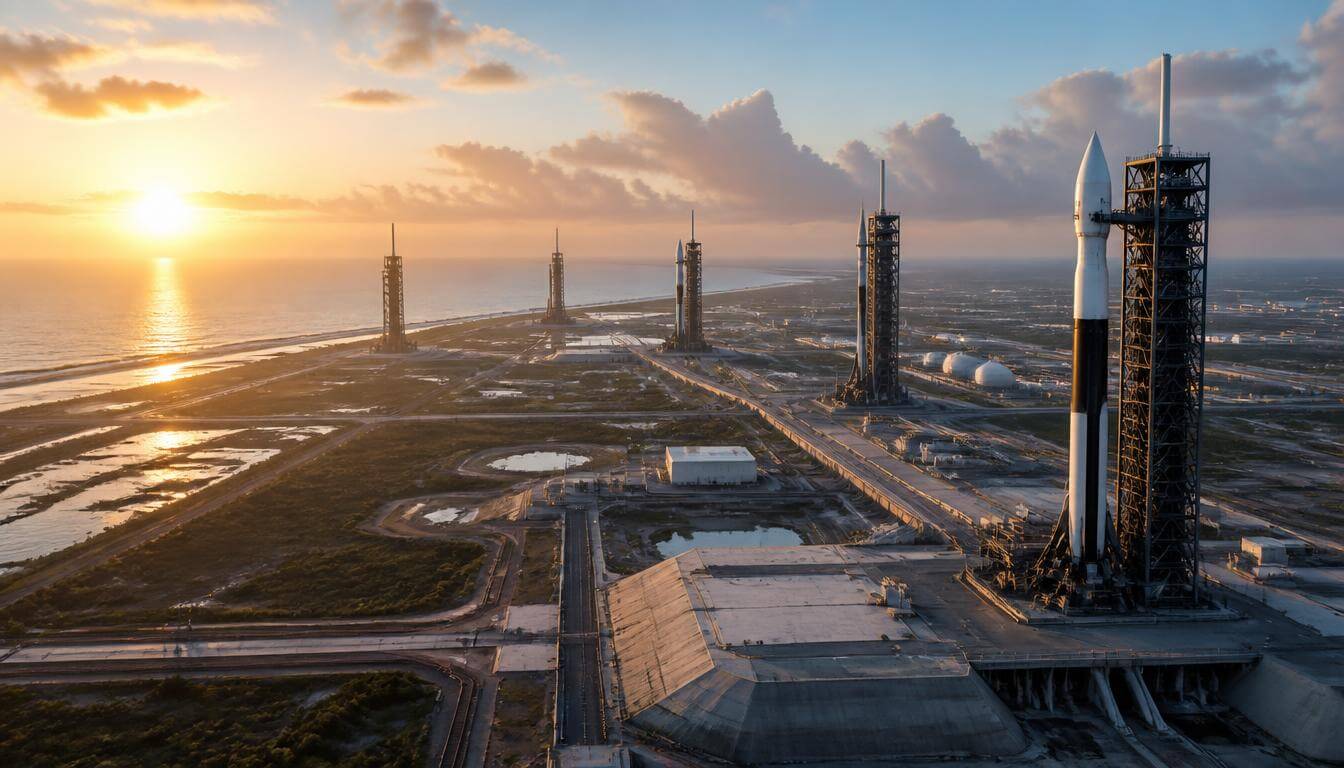
For decades, access to space was dominated by a relatively small number of governments and aerospace contractors. Launch vehicles were expensive, production cycles were long, and orbital missions were often associated with national programs rather than commercial markets. That structure is changing.
The expansion of commercial satellite constellations, Earth observation systems, telecommunications networks, navigation services and space-based data infrastructure is creating sustained demand for orbital launches. As a result, launch infrastructure is increasingly becoming a competitive industrial sector in its own right.
The new space race is therefore not simply about building better rockets. It is about developing an integrated industrial system capable of manufacturing launch vehicles, operating launch sites, managing ground infrastructure, coordinating orbital logistics and reducing the cost and time required to place payloads into space.
From Government Programs to Commercial Infrastructure
The traditional space industry was largely organized around individual missions. A government agency or telecommunications company would define a mission, select a launch provider and purchase a launch service. The rocket was effectively a specialized transportation system used for a specific payload.
The growth of large satellite constellations changes this model.
Instead of launching a handful of large satellites every year, operators can require dozens or hundreds of launches over the lifetime of a constellation. This creates a recurring demand for launch capacity and changes the economics of the industry.
Launch providers can therefore benefit from scale. A rocket designed for repeated commercial missions can be manufactured more systematically, launch operations can become more standardized and infrastructure can be used more frequently.
This is one reason reusable launch technology has become strategically important. If a launch vehicle or part of its architecture can be recovered and flown again, the economics of space transportation can potentially move away from the traditional model of manufacturing a largely new vehicle for every mission.
The resulting competition increasingly resembles other infrastructure industries: companies compete not only on technological performance but also on production capacity, reliability, turnaround time, logistics and the ability to support customers at scale.
Launch Infrastructure Is More Than the Rocket
A rocket is only one component of an orbital transportation system.
A commercial launch operation requires launch pads, integration facilities, propellant infrastructure, tracking systems, range coordination, mission control, transportation networks and specialized personnel. The availability of these assets can determine how frequently a provider can launch.
This means that launch capacity can become a bottleneck even when demand for satellites is strong.
A company might have a technically capable launch vehicle but still face constraints if it cannot manufacture enough rockets, secure sufficient launch windows or process payloads quickly enough. Conversely, an operator with highly integrated infrastructure may be able to support a much larger number of missions without simply increasing the size of its workforce or facilities at the same rate.
This industrial dimension is particularly important as satellite networks expand.
The relationship between orbital launches and satellite infrastructure is explored in greater detail in SpaceX, Amazon and the Competition to Build Global Satellite Networks.
SpaceX and the Reusable Launch Model
SpaceX has played a central role in changing expectations around commercial launch operations.
The company's Falcon launch architecture demonstrated the commercial potential of partially reusable orbital launch vehicles. Reusing major components can reduce the amount of hardware that must be manufactured for each mission and can support a higher launch cadence.
The significance of this approach extends beyond the cost of an individual launch.
Frequent reuse creates the possibility of treating launch vehicles as operational assets rather than largely disposable products. That distinction matters because industrial economics depend heavily on asset utilization.
An aircraft, for example, generates economic value through repeated operation. A reusable rocket can potentially move toward a similar model, although the engineering requirements, maintenance cycles and operating environment remain very different.
SpaceX has also benefited from vertical integration and from having a major internal customer for launch capacity through its Starlink satellite network. This combination creates an unusual relationship between launch infrastructure and satellite infrastructure.
The company is simultaneously developing transportation capacity and deploying a large orbital network that requires transportation capacity.
That structure can provide an important source of launch demand while also allowing the company to optimize its systems around repeated missions.
Amazon and the Rise of Large Satellite Networks
Amazon represents a different path into the space infrastructure market.
Through Project Kuiper, Amazon has been developing a large low-Earth-orbit satellite network intended to provide broadband connectivity. Unlike a traditional telecommunications satellite business based on a relatively small number of spacecraft, a large constellation requires a continuous supply of satellites and launch opportunities.
This creates a direct connection between launch providers and satellite-network economics.
Amazon does not need to manufacture every launch vehicle itself to participate in the space infrastructure industry. Instead, it can purchase launch capacity from multiple providers while concentrating on satellite production, network deployment, ground infrastructure and customer services.
That model illustrates an important characteristic of the new space economy: the industry can become increasingly modular.
One company may specialize in rockets, another in satellites, another in ground stations and another in data services. At the same time, some companies may attempt to integrate several of these layers.
The competition between vertically integrated and more specialized business models could become one of the defining industrial questions of the sector.
New Entrants Are Expanding the Competitive Landscape
The commercial launch market is no longer limited to established aerospace contractors.
Companies such as Rocket Lab, Blue Origin, Arianespace and other emerging or established providers are developing different approaches to launch services, reusable systems and orbital transportation.
Their strategies vary considerably.
Some focus on smaller payloads and dedicated launch services. Others are developing larger reusable rockets designed for high-volume missions. Some combine launch services with satellite manufacturing or space systems.
This diversity matters because the future market may not converge on a single launch architecture.
Different customers have different requirements:
- a scientific spacecraft may prioritize orbital precision;
- a large constellation may prioritize price and launch cadence;
- a national security payload may place greater emphasis on reliability, schedule control and specialized mission requirements.
As the market expands, these different requirements can support multiple business models.
Why Launch Costs Matter
Launch cost remains one of the most visible variables in the economics of space infrastructure.
Historically, the cost of sending material into orbit limited what could be economically deployed. Lower launch costs can change that calculation by making larger satellite constellations, more frequent replacements and additional orbital infrastructure economically viable.
But the relationship is not simply linear.
A cheaper rocket does not automatically produce a cheaper space service. Satellite manufacturing, insurance, ground infrastructure, spectrum access, network operations and maintenance all contribute to total system costs.
The broader implications of launch economics are examined in Why Launch Costs Could Reshape Competition in the Space Economy.
The important point is that launch cost can influence the entire value chain.
If launch becomes significantly cheaper and more frequent, companies may be able to deploy larger networks. Larger networks can create new demand for satellites, ground stations, software and data services. That additional demand can then support further investment in space infrastructure.
This creates a potential industrial feedback loop.
The Importance of Launch Cadence
Cost is only one measure of launch competitiveness.
Cadence may become equally important.
A satellite operator waiting several months for a launch opportunity faces different economics from one that can regularly access orbital transportation. Faster deployment can accelerate revenue generation, network expansion and replacement of failed or obsolete satellites.
For constellation operators, launch cadence can therefore become a strategic input.
A provider capable of launching frequently may offer customers greater scheduling flexibility. It may also be able to spread fixed infrastructure costs across more missions.
This is why the future competition between launch providers may increasingly revolve around operational execution rather than headline rocket specifications alone.
Manufacturing rates, refurbishment procedures, launch-site utilization and supply-chain management can all become sources of competitive differentiation.
Supply Chains Become Strategic
The expansion of launch activity also creates new industrial dependencies.
Rocket engines require specialized manufacturing capabilities. Propellant systems, avionics, composite materials, electronics and precision components all depend on complex supply chains.
A company seeking high launch cadence must therefore control or secure access to these inputs.
This creates similarities with other strategic technology industries. Semiconductor manufacturers, electric vehicle companies and telecommunications providers have all demonstrated that supply-chain resilience can influence industrial competitiveness.
Space infrastructure faces an additional complication: some components have highly specialized production requirements, and replacing suppliers can take considerable time.
As launch volumes increase, companies may respond by increasing vertical integration, building redundant supplier networks or investing in domestic manufacturing capacity.
A Broader Space Infrastructure Industry
The emerging commercial space economy is gradually moving beyond the traditional distinction between aerospace manufacturers and launch contractors.
Launch infrastructure increasingly interacts with satellite manufacturing, telecommunications, cloud computing, Earth observation, navigation, defense and data services.
This integration changes the competitive structure of the industry.
A company controlling launch capacity may gain advantages in deploying its own satellite network. A company controlling a large satellite network may create predictable demand for launch services. A company controlling ground infrastructure and cloud computing may capture value further downstream.
The result is an ecosystem in which competition can occur at multiple layers simultaneously.
The central question is therefore no longer simply who can build the best rocket.
It is who can build a reliable, scalable and economically sustainable infrastructure connecting Earth-based manufacturing with orbital operations.
The Next Phase of the Space Race
The commercial space industry is entering a phase in which scale is becoming increasingly important.
The first generation of private space companies demonstrated that commercial launch services could challenge traditional industry structures. The next phase is likely to focus on industrialization: higher production volumes, reusable launch systems, larger satellite constellations, more efficient launch sites and increasingly integrated infrastructure.
SpaceX provides one example of vertical integration between launch and satellite operations. Amazon illustrates how a technology company can enter the space economy through a large communications constellation while relying on multiple launch providers.
At the same time, other companies are developing alternative launch systems and specialized services.
This competition could gradually transform orbital access from a limited and expensive service into a more standardized component of global infrastructure.
The implications extend well beyond rockets. If launch becomes more frequent, reliable and economically accessible, the number of commercial activities that can be supported in orbit could expand substantially.
The new space race is therefore fundamentally an industrial race: not only to reach orbit, but to build the infrastructure capable of operating there at scale.