
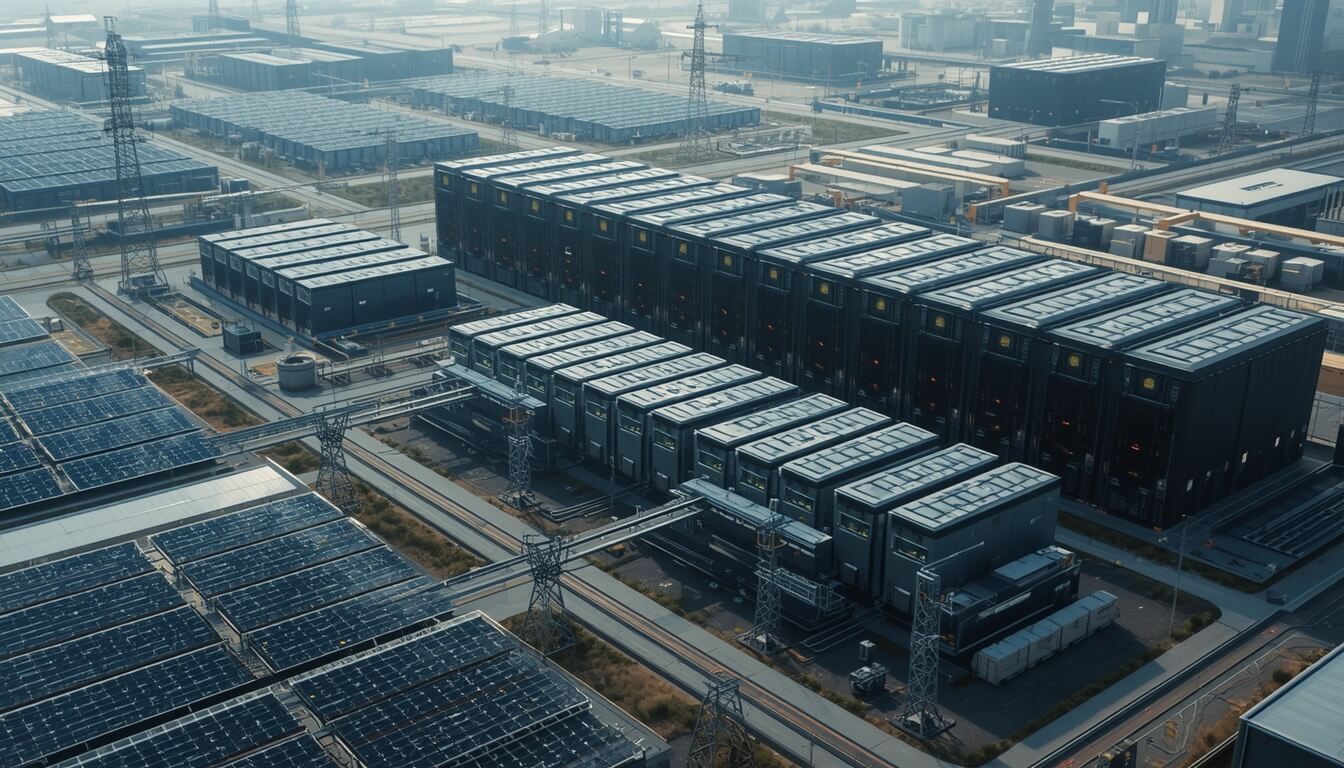
Artificial intelligence is becoming an increasingly energy-intensive industry. The rapid expansion of large language models, AI training systems, inference workloads and specialized data centers is creating a new challenge for the technology sector: finding enough reliable electricity to support continued growth.
For years, computing capacity was largely constrained by processors, memory, networking equipment and access to capital. Energy was often treated as a background requirement. That assumption is changing. As AI infrastructure expands, access to electricity, grid capacity and suitable energy technologies is becoming a strategic part of the economics of computing.
The relationship between AI and energy is therefore moving in both directions. AI requires large amounts of electricity, while AI itself can also improve how electricity is generated, distributed and consumed. This interaction is creating an emerging technology market that extends well beyond traditional power generation.
The emerging energy race is not separate from the technology industry. It is becoming one of its foundations.
AI Is Creating a New Class of Electricity Demand
Modern AI systems require substantial computing infrastructure. Training advanced models can involve large clusters of accelerators operating continuously for extended periods, while inference requires data centers to process requests from users and applications around the clock.
The growth of these workloads is contributing to rising electricity requirements from data centers. The challenge is not simply the total amount of electricity available in a country or region. Location and reliability matter as well.
A new data center may require a large connection to the electrical grid, but obtaining that connection can take years where transmission networks are already constrained. This creates a bottleneck between the speed at which technology companies want to deploy computing capacity and the speed at which energy infrastructure can expand.
For AI developers, electricity is therefore becoming an infrastructure variable rather than just an operating expense.
Why Conventional Grid Expansion May Not Be Enough
Electricity demand has historically been distributed across households, commercial buildings and industrial facilities. Large AI data centers can create concentrated demand in a single location.
This concentration can place pressure on local transmission and distribution infrastructure. Even where a country has sufficient overall generation capacity, a particular region may not have enough grid capacity to support a new multi-hundred-megawatt facility.
Expanding transmission lines, substations and generation capacity can solve part of the problem, but these projects often involve long planning and construction timelines.
That has increased interest in energy technologies that could provide additional electricity closer to major computing facilities or improve the flexibility of existing power systems.
The result is a broader technology race involving:
- Nuclear power
- Renewable generation
- Battery storage
- Advanced grids
- Geothermal systems
- Other approaches
Nuclear Power and the Search for Reliable Energy
One of the technologies receiving renewed attention is nuclear power.
Nuclear reactors can produce electricity continuously and are not dependent on sunlight or wind conditions. This characteristic makes nuclear generation potentially useful for facilities that require stable power around the clock.
A recent example is Google's 3.6-GW power agreement with Constellation Energy, which highlights how major technology companies are turning to long-term energy agreements to secure reliable electricity for expanding AI infrastructure.
Traditional nuclear plants, however, are large infrastructure projects with significant construction, financing and regulatory requirements. A newer generation of developers is therefore investigating smaller reactor designs.
Small modular reactors are designed around standardized components and smaller generating capacities than conventional reactors. Their potential role in future electricity systems is examined in more detail in Small Modular Reactors: Could Nuclear Power Enter a New Era?.
Whether these designs can achieve their expected cost and deployment advantages remains an important question. The technology still faces regulatory, manufacturing, financing and construction challenges.
Renewable Energy Is Becoming More Important Too
Renewable generation represents another major part of the emerging energy landscape.
Solar and wind power have become increasingly important sources of new electricity generation. Their relatively rapid deployment compared with some large conventional infrastructure projects makes them attractive for regions experiencing rising electricity demand.
However, variable generation creates a different challenge for AI infrastructure.
A data center cannot simply stop operating when solar output falls or wind conditions change. Electricity systems therefore need mechanisms that can balance variable generation with continuous demand.
This is increasing interest in energy storage technologies, grid-scale batteries and more sophisticated power-management systems.
AI data centers could eventually operate alongside combinations of renewable generation, storage and firm electricity sources rather than relying on a single technology.
Energy Storage Could Become a Critical Technology
Battery storage is particularly important because it can separate the timing of electricity generation from the timing of electricity consumption.
For example, solar power generated during the middle of the day can potentially be stored and used later when demand remains high but solar production declines.
Lithium-ion batteries currently dominate many energy-storage applications, but other technologies are also being developed:
| Storage technology | Key characteristic |
|---|---|
| Lithium-ion | Dominant technology, improving economics |
| Flow batteries | Long-duration storage potential |
| Sodium-ion | Alternative chemistry, material availability advantages |
| Thermal storage | Heat-based storage for industrial applications |
For AI infrastructure, the most valuable storage technologies may not necessarily be those with the highest energy density. Cost, durability, safety, cycle life and the ability to provide electricity for several hours can be equally important.
AI Could Also Help Optimize the Energy System
The relationship between AI and energy is not entirely one-directional.
AI can potentially improve electricity forecasting, demand management, equipment maintenance and grid optimization. Machine-learning systems can analyze large amounts of data from power networks and identify patterns that are difficult to detect using traditional methods.
AI can also help forecast renewable generation based on weather information, optimize battery charging and discharging, and identify potential failures in industrial equipment.
This creates an unusual feedback loop.
AI increases electricity demand, but the same technology can potentially make electricity systems more efficient and flexible.
The economic value of these applications could become increasingly important as power networks become more complex.
The Future Energy System May Be More Diverse
There is unlikely to be a single technology capable of solving every energy challenge created by AI.
- Renewables can provide large amounts of low-carbon electricity, but their output varies.
- Batteries can provide flexibility, but storage duration and material requirements matter.
- Nuclear power can provide continuous generation, but new reactor projects face significant development challenges.
- Grid upgrades can increase capacity, but transmission infrastructure takes time to build.
The future system may therefore combine several technologies.
AI data centers could increasingly be built in regions where electricity generation, transmission capacity, cooling resources and industrial infrastructure are available. Some facilities may sign long-term power agreements with renewable generators, while others could be supported by nuclear or other firm generation.
This creates opportunities across the entire energy technology ecosystem rather than concentrating investment on one generation source.
Energy Is Becoming Part of the AI Infrastructure Stack
The expansion of AI is changing the definition of technology infrastructure.
Servers, accelerators and data networks remain fundamental, but they cannot operate without electricity. As computing facilities become larger, the availability and cost of power can influence where new AI infrastructure is built and how quickly it can be deployed.
That makes energy technology increasingly relevant to the future of artificial intelligence.
The question is no longer simply how many processors can be installed in a data center. It is also whether the surrounding energy system can reliably support them.
This is pushing technology companies, utilities, governments and infrastructure investors to examine new approaches to electricity generation and storage.
The broader competition extends beyond nuclear and renewables. Different technologies are targeting different parts of the problem, from continuous generation to short-duration storage, long-distance transmission and decentralized power systems. The wider landscape is explored in The Technologies Competing to Power the Future Economy.
As AI continues to expand, electricity could become one of the defining constraints on the next phase of digital infrastructure. The companies capable of securing reliable power may have an important advantage in deploying computing capacity, while energy technology developers could find themselves increasingly connected to the growth of the AI economy.