
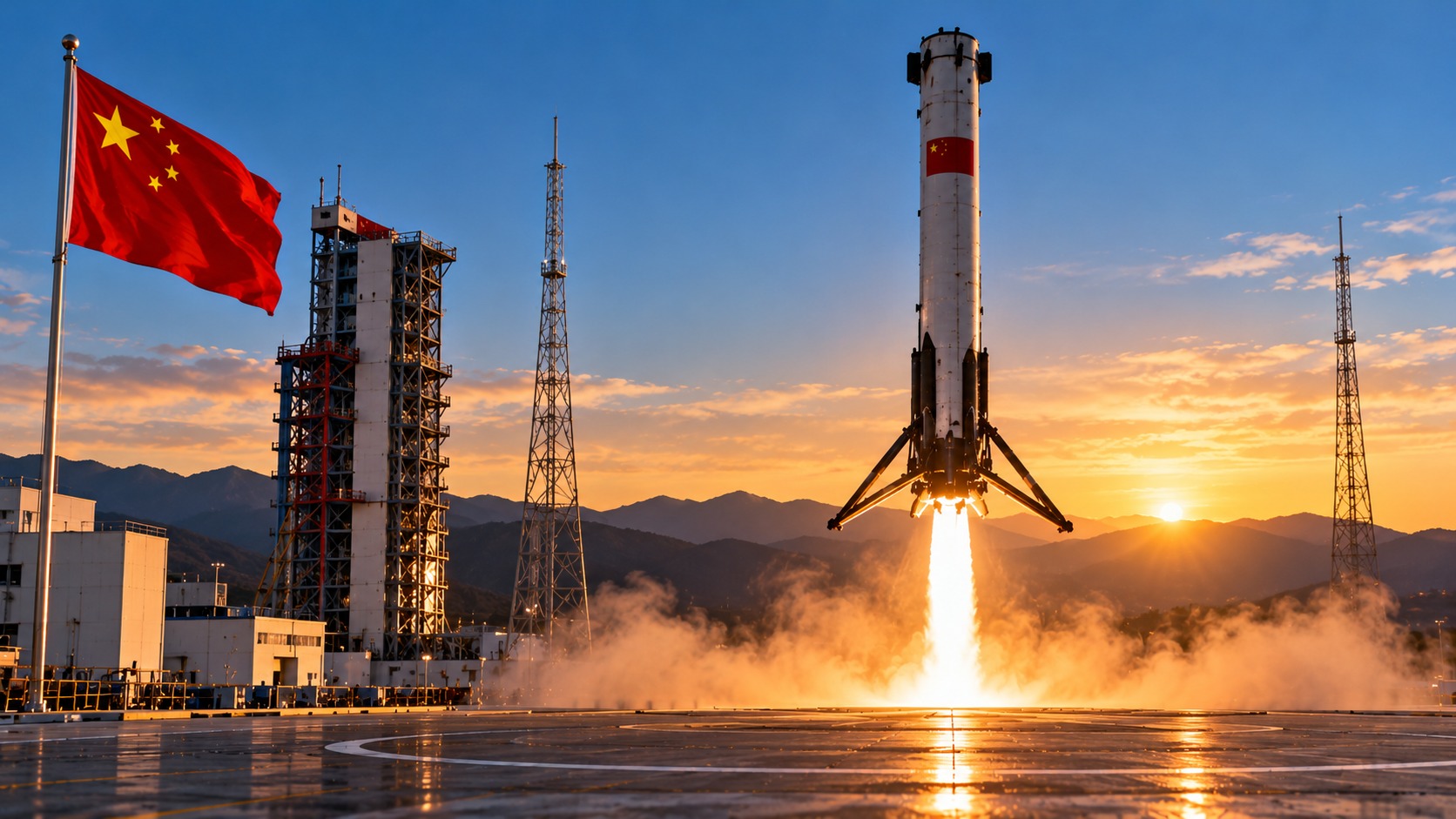
China is advancing in reusable rocket technology, but it has not matched SpaceX's established record of routine orbital booster reuse. Chinese companies and government-backed organizations are developing rockets designed to land and fly again, while SpaceX has demonstrated repeated commercial flights of Falcon 9 boosters.
The competitive gap is not simply about landing a rocket. It involves flying recovered hardware again, achieving reliable operations, controlling refurbishment costs, and maintaining a high launch frequency.
China's progress matters because reusable rockets could reduce satellite deployment costs, strengthen independent access to space, and increase competition in the launch industry.
For investors, the central question is whether Chinese developers can turn technical progress into an operational and economic advantage comparable to SpaceX's.
Does China Have Reusable Rockets?
China has developed reusable rocket technology and demonstrated important recovery capabilities, but its orbital launch industry remains less mature in routine reuse than SpaceX.
Several Chinese organizations are pursuing reusable launch systems, including commercial companies and state-backed aerospace groups.
Prominent developers include LandSpace, Space Pioneer, Galactic Energy, Deep Blue Aerospace, iSpace, and organizations associated with the China Aerospace Science and Technology Corporation (CASC).
Their programs differ in vehicle size, technical design, development stage, and intended market.
Some have demonstrated vertical takeoff and landing technologies. Others are developing orbital-class vehicles with recoverable first stages.
The distinction is between a rocket designed for reuse and one that has repeatedly completed orbital missions using the same hardware.
What Counts as a Reusable Rocket?
To establish routine orbital booster reuse, a launch provider must demonstrate several capabilities:
- Complete an orbital-class launch mission.
- Recover the booster safely.
- Inspect and prepare the recovered hardware for another flight.
- Successfully launch the same booster again.
- Repeat the process with acceptable reliability and operating costs.
SpaceX's Falcon 9 has demonstrated this operating cycle extensively.
Chinese programs have advanced through different stages, but their operational histories remain much shorter.
For a broader comparison, see Fully Reusable Rockets Today: Which Companies and Countries Actually Have Them.
Which Chinese Companies Are Building Reusable Rockets?
China's reusable launch industry combines commercial developers with major state-backed organizations.
That creates a different competitive environment from the United States, where companies such as SpaceX and Blue Origin operate alongside government agencies and established aerospace contractors.
| Organization | Reusable rocket program | Main objective |
|---|---|---|
| LandSpace | Zhuque-3 | Develop a reusable orbital launch vehicle |
| Space Pioneer | Tianlong series | Expand commercial orbital launch capability |
| Galactic Energy | Pallas-1 | Develop reusable liquid-fueled orbital launch services |
| CASC and affiliated organizations | Long March reusable concepts | Support national launch requirements and reusable systems |
| Deep Blue Aerospace | Nebula series | Develop recoverable commercial orbital rockets |
| iSpace | Hyperbola series | Advance reusable liquid-propellant launch technology |
These programs are not equally mature.
A company may have demonstrated a landing test without completing a commercial orbital mission. Another may have reached orbit without establishing routine booster recovery and reflight.
Investors should distinguish demonstrated achievements from announced capabilities and development targets.
LandSpace: Could Zhuque-3 Challenge Falcon 9?
LandSpace is one of China's most closely watched commercial rocket developers.
Its Zhuque-3 vehicle is designed around reusable first-stage technology, reflecting China's broader shift toward liquid-fueled rockets and recovery systems.
LandSpace previously demonstrated orbital capability with its methane-fueled Zhuque-2 rocket.
That was an important propulsion milestone, but Zhuque-2 and Zhuque-3 are different vehicles. Success with one does not automatically establish the capabilities of the other.
Zhuque-3 targets a market where payload capacity, launch price, reliability, and flight frequency are central competitive factors.
Why Zhuque-3 Matters
A commercially viable reusable rocket could help Chinese satellite operators reduce deployment expenses and support domestic government and commercial missions.
However, completing an orbital mission or recovering a booster is only part of the challenge.
LandSpace must demonstrate reliable engines, repeatable reuse, efficient refurbishment, adequate manufacturing capacity, and sustained customer demand.
For investors, the decisive milestone is not simply whether Zhuque-3 can land. It is whether recovered hardware can fly repeatedly at an economically attractive cost.
What Is China's Long March Reusable Rocket Program?
China's Long March rocket family has supported national space missions for decades, historically relying heavily on expendable launch stages.
Chinese aerospace organizations have been developing new vehicles and technologies intended to support booster recovery and reuse.
These efforts include reusable first-stage designs, advanced propulsion systems, and controlled landing technologies.
State-backed programs can have objectives beyond commercial profitability, including scientific research, national security, exploration, and independent access to space.
This complicates comparisons with SpaceX.
A government-backed launch program may receive continued investment because it serves strategic national priorities, even when its immediate commercial economics are uncertain.
For investors, state support can accelerate development but also make the underlying financial performance harder to evaluate.
Why Is China Investing in Reusable Rockets?
China has several economic, operational, and strategic reasons to develop reusable launch systems.
- Lower recurring hardware costs: Reusing boosters could reduce the need to manufacture an entirely new first stage for every mission.
- Higher launch capacity: Efficient recovery and refurbishment could support more frequent missions.
- Independent access to space: Domestic launch systems support communications, Earth observation, scientific research, and national security.
- Industrial development: Rocket programs strengthen expertise in propulsion, software, materials, and advanced manufacturing.
- Satellite constellation deployment: Large networks require repeated launches and eventual satellite replacement.
These advantages are potential outcomes rather than automatic results.
Reusable rockets generate economic benefits only when operators can recover hardware reliably, refurbish it efficiently, and maintain sufficient launch demand.
Is China Copying SpaceX's Reusable Rocket Strategy?
Chinese developers are pursuing some of the same technical objectives as SpaceX, including vertical booster landings, reusable first stages, and lower launch costs.
However, similar engineering goals do not establish that one company has copied another's technology.
Reusable rocket concepts existed decades before SpaceX. NASA and other aerospace organizations investigated recovery and vertical landing technologies long before Falcon 9.
What SpaceX demonstrated was that booster reuse could become part of regular commercial orbital operations.
Its success provided a visible example of what was technically and operationally achievable.
Chinese developers now operate in an industry where reusable launch capability is an increasingly important competitive objective.
For investors, visual similarities between rockets are less important than measurable results: payload delivery, recovery success, refurbishment efficiency, launch frequency, and operating costs.
How Far Behind SpaceX Is China?
There is no reliable single number of years that measures the gap between China's reusable launch programs and SpaceX.
Different developers are progressing at different speeds, and technical milestones do not translate directly into commercial maturity.
However, the difference in demonstrated operating experience remains substantial.
SpaceX has accumulated extensive Falcon 9 booster recovery and reflight experience. Chinese developers have advanced in reusable rocket design, testing, and recovery, but have not established a comparable routine commercial reflight record.
| Capability | SpaceX | Chinese reusable rocket programs |
|---|---|---|
| Orbital launch experience | Extensive | Established nationally; varies by developer |
| Reusable booster recovery | Routine with Falcon 9 | Demonstrated by selected programs |
| Reflight of recovered orbital boosters | Extensive Falcon 9 experience | Not established at comparable commercial scale |
| High-frequency reusable operations | Demonstrated | Still developing |
| Commercial launch customer base | Broad domestic and international experience | Primarily developing within China's market |
| Fully reusable orbital system | Starship development | Development concepts and testing |
The table does not imply that every Chinese company has the same capabilities or that SpaceX's lead is permanent.
A successful new launch vehicle could accelerate a competitor's progress, particularly with sufficient financing and customer demand.
Nevertheless, developing a recoverable rocket is different from operating one reliably across hundreds of missions.
That operational experience takes time to accumulate.
Why Is Booster Reflight More Important Than Booster Landing?
A successful landing demonstrates that a booster can survive its return to Earth.
A successful reflight demonstrates that recovered hardware can be prepared for another mission.
Routine reflight shows that the process can become part of normal commercial operations.
These milestones have different economic implications.
Consider a hypothetical booster costing $40 million to manufacture.
If it flies once, its manufacturing cost is associated with one mission. If it flies ten times, that cost averages $4 million per flight before refurbishment and other operating expenses.
This creates potential savings, but recovery and maintenance costs must also be considered.
If a booster requires expensive repairs after each flight, the economic advantage may be much smaller.
Likewise, a rocket capable of many flights has limited commercial value without enough paying customers.
The objective is not simply to recover hardware. It is to reduce the total cost per successful mission.
For more detail, see How Much Cheaper Are Reusable Rockets? SpaceX Launch Costs and NASA Contracts Explained.
Could China's Satellite Networks Accelerate Reusable Rockets?
Yes. Large satellite constellations could create recurring demand for Chinese launch providers.
Satellite networks require many spacecraft to be deployed over time. Satellites may also need replacement because of limited operating lifetimes, technical failures, or changing network requirements.
SpaceX benefits from a similar relationship between Falcon 9 and Starlink.
Starlink deployments provide regular opportunities to use SpaceX's launch infrastructure and reusable boosters.
China is pursuing large satellite communications programs, including Guowang and Qianfan.
These projects could provide substantial domestic launch demand.
However, launch frequency and profitability are different measures.
Government-directed or internally generated demand may improve infrastructure utilization without necessarily producing the same financial results as independent commercial contracts.
For investors, the relevant question is whether satellite deployments help launch providers lower their cost per mission while maintaining reliable operations.
Could Chinese Reusable Rockets Be Cheaper Than SpaceX?
Chinese providers could eventually become competitive on price, but publicly available information is insufficient to establish that their reusable orbital launch services are already cheaper on a directly comparable basis.
Launch price comparisons are complicated because providers disclose different financial information.
Some publish customer prices without revealing internal operating costs. Others announce projected future prices that have not been demonstrated commercially.
Government-backed programs may receive infrastructure or financial support that is not reflected in advertised launch prices.
Mission requirements also differ.
Delivering a satellite to low Earth orbit is not equivalent to transporting a payload to a higher-energy destination.
Cost per kilogram can help compare launch services, but advertised maximum payload capacity may not reflect the payload carried on a particular mission.
What Would Make a Chinese Rocket Cost-Competitive?
A competitive reusable launch provider would need to combine:
- Reliable orbital missions.
- Successful booster recovery and reflight.
- Low refurbishment expenses.
- Efficient manufacturing.
- Sufficient launch frequency.
- Competitive payload capacity.
- Consistent customer demand.
Lower manufacturing or labor costs do not guarantee lower total mission costs if rockets require extensive maintenance or launch infrequently.
Similarly, government support can reduce financing pressure without proving that a commercial operating model is independently profitable.
The strongest evidence would be sustained operations, competitive contract pricing, and credible financial performance.
How Much Did It Cost Elon Musk to Start SpaceX?
Elon Musk founded SpaceX in 2002 and invested substantial personal capital during its early development.
He has publicly discussed investing approximately $100 million of his own money in the company.
That is a commonly cited historical estimate of his early investment, not a complete accounting of every dollar required to establish and expand SpaceX.
Starting a rocket company involves far more than incorporation expenses.
Developers must finance engineering, manufacturing, testing, launch facilities, regulatory compliance, and repeated development attempts.
SpaceX also benefited from subsequent government agreements, customer contracts, and outside investment.
Chinese reusable rocket developers face similarly capital-intensive requirements, although their financing arrangements and levels of government support differ.
For investors, the lesson is that reusable launch technology requires substantial funding before sustainable profitability can be demonstrated.
Can Chinese Companies Compete for American Launch Contracts?
Chinese launch providers face significant barriers to serving many American customers.
U.S. export controls, national-security requirements, and restrictions involving sensitive space technologies limit commercial relationships.
Satellites and launch services may involve equipment or technical information subject to strict regulatory controls.
Government and defense missions may also require approved domestic or allied launch providers.
Consequently, a Chinese company offering a lower launch price would not automatically gain access to the U.S. market.
Competition may instead develop across separate regional or geopolitical markets.
Chinese providers could serve domestic satellite programs and selected international customers, while American and European providers continue serving markets where regulatory and security requirements restrict Chinese participation.
For investors, technological competition does not always translate into direct price competition for the same contracts.
How Could China's Progress Affect SpaceX?
China's progress could influence SpaceX and the wider launch industry in several ways.
It could encourage additional investment in reusable launch technology, increase competition in accessible markets, and accelerate deployment of Chinese satellite networks.
It could also influence government decisions about national launch capacity and strategic aerospace investment.
However, SpaceX's competitive position depends on more than the performance of Chinese rockets.
Its advantages include established infrastructure, extensive reflight experience, commercial relationships, and recurring Starlink demand.
Chinese programs must develop comparable operating capabilities before directly challenging those advantages.
The competitive impact will depend on demonstrated performance rather than announcements alone.
For a broader industry comparison, see Who Leads the Space Launch Industry? SpaceX, Its Rivals, and How NASA Fits In.
Are Chinese Reusable Rocket Companies Publicly Traded?
Many prominent Chinese commercial reusable rocket developers have historically been privately held, limiting direct access for ordinary stock-market investors.
Some publicly traded aerospace businesses may offer indirect exposure through manufacturing, propulsion components, materials, electronics, or other parts of the space supply chain.
However, indirect exposure is not equivalent to owning shares in a specific rocket developer.
A large aerospace supplier may generate only a small portion of its revenue from reusable launch technology.
Investors must also consider financial disclosure standards, ownership structures, government influence, and market access.
A company's involvement in China's space industry does not automatically make it a direct investment in reusable rockets.
Likewise, a private-company valuation is not directly equivalent to the market capitalization of a publicly traded business.
Investment opportunities should be assessed using actual revenue sources, financial reporting, and ownership arrangements.
What Risks Face China's Reusable Rocket Industry?
Chinese launch developers face many of the same technical and financial challenges as Western competitors.
Technical Reliability
Reusable boosters must survive launch, atmospheric return, landing, and repeated operation. Failures can destroy hardware and delay development.
Refurbishment Costs
Recovery produces economic value only when the cost of preparing hardware for another flight is sufficiently low.
Capital Requirements
Rocket development and launch infrastructure require substantial investment, often before sustainable revenue is established.
Customer Demand
Successful vehicles need enough missions to support manufacturing, maintenance, and operating expenses.
Regulatory and Geopolitical Restrictions
International market access may be limited by export controls, national-security policies, and diplomatic relationships.
Financial Transparency
Limited disclosure can make it difficult to assess profitability, debt, cash flow, and development spending.
These risks do not mean China's reusable rocket programs will fail. They mean technical milestones should be evaluated alongside commercial and financial evidence.
What Should Investors Watch Next?
The most meaningful milestones will demonstrate that Chinese reusable rockets can move from development and testing into repeatable commercial operations.
| Milestone | Why it matters |
|---|---|
| Successful orbital missions | Demonstrates basic launch capability |
| Controlled booster recovery | Establishes recoverability |
| Reflight of recovered boosters | Demonstrates actual hardware reuse |
| Repeated successful reflights | Builds an operational reliability record |
| Shorter turnaround times | Indicates more efficient fleet utilization |
| Commercial launch contracts | Demonstrates paying customer demand |
| Competitive launch pricing | Tests the economic value of the technology |
| Sustainable cash flow | Indicates long-term business viability |
A company that lands a booster once has demonstrated an important technical capability.
A company that repeatedly launches recovered boosters while delivering customer payloads has demonstrated a more advanced operating model.
A company that can do so profitably has established a potential commercial advantage.
Can China Catch SpaceX in Reusable Rockets?
China has the technical resources, industrial capacity, government support, and growing satellite ambitions to become a stronger competitor in reusable launch technology.
Its developers are advancing systems designed to recover and reuse orbital rocket boosters.
However, SpaceX retains a substantial advantage in demonstrated operational experience.
Falcon 9 has established repeated booster flights as a routine part of commercial orbital launches.
Chinese companies must demonstrate comparable reliability, turnaround efficiency, launch frequency, and cost performance.
The outcome remains uncertain. Some programs may advance rapidly, while others could encounter technical delays or financial difficulties.
Geopolitical restrictions may also prevent direct competition for many Western contracts.
For investors, the central question is not whether China can build a rocket resembling Falcon 9. It is whether Chinese providers can establish reliable, repeatable, and economically sustainable launch operations.
China is becoming a more serious reusable rocket competitor, but matching SpaceX requires more than successful landings. The decisive milestone will be turning recovered boosters into dependable, economically competitive launch services.
Disclaimer: This article is for informational and educational purposes only and does not constitute investment advice. Aerospace and space-related investments involve substantial technological, financial, regulatory, and geopolitical risks. Investors should conduct independent research before making investment decisions.