
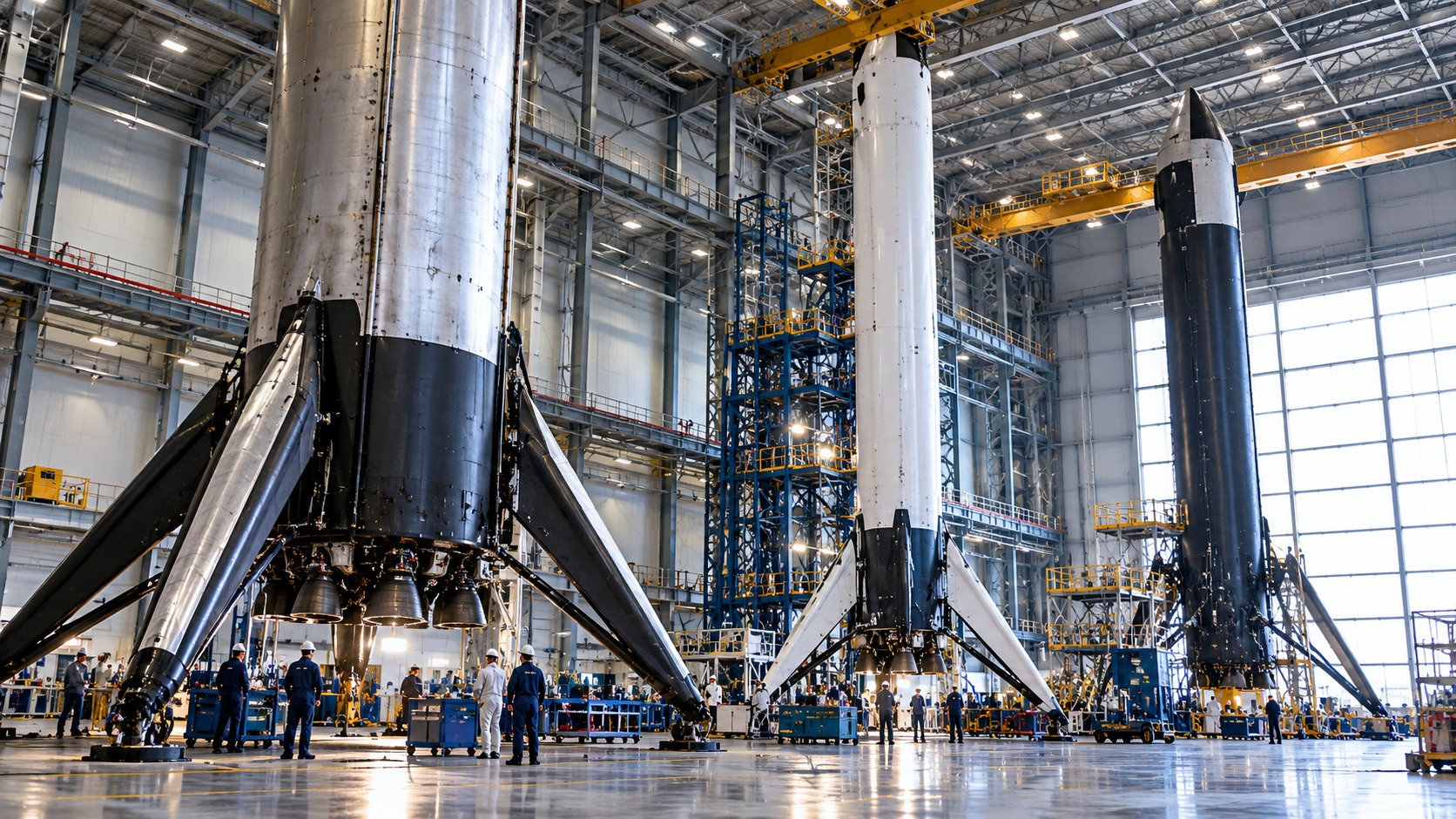
No company has yet demonstrated routine commercial operation of a fully reusable orbital rocket. SpaceX is the closest major developer with Starship, but its established Falcon 9 system remains partially reusable.
The United States leads in proven orbital rocket reuse. SpaceX routinely flies previously used Falcon 9 boosters, while Blue Origin has demonstrated recovery and reflight of its New Glenn first stage. China has also advanced orbital booster recovery, although establishing routine reflight remains a separate challenge.
The essential distinction is between landing a rocket, flying recovered hardware again, and operating a fully reusable launch system. These are different milestones, and they matter when comparing companies, countries, and investment opportunities.
Are There Any Fully Reusable Rockets Today?
No fully reusable orbital rocket has established routine commercial service.
Most orbital launch vehicles have two major stages. The first-stage booster provides the initial thrust, while the upper stage accelerates the payload to orbital velocity.
Full reusability requires both stages to return safely and fly again after servicing.
Recovering the upper stage is particularly difficult because it reaches orbital speeds and must withstand intense heating and aerodynamic forces during reentry. Recovery systems also add weight and complexity.
SpaceX's Starship is designed to address these challenges through a reusable Super Heavy booster and a reusable Starship upper stage.
The program has demonstrated important recovery and flight-test capabilities. However, individual demonstrations do not establish routine commercial reuse of the complete launch vehicle.
A fully reusable system must consistently complete missions, recover both stages, prepare them for another flight, and repeat the process economically.
Until that operating cycle is demonstrated, projections of extremely low launch costs remain targets rather than established commercial results.
Which Companies Actually Have Reusable Rockets?
Several companies have demonstrated recovery or reuse, but their operational achievements differ considerably.
| Company | Rocket | Country | Reusability status |
|---|---|---|---|
| SpaceX | Falcon 9 | United States | Routine orbital booster reuse |
| SpaceX | Falcon Heavy | United States | Reusable boosters; expendable upper stage |
| SpaceX | Starship | United States | Full-reusability development and testing |
| Blue Origin | New Glenn | United States | Orbital booster recovery and reflight demonstrated |
| Blue Origin | New Shepard | United States | Operational reusable suborbital system |
| Rocket Lab | Electron | United States / New Zealand | Booster recovery demonstrated; routine reflight not established |
| LandSpace | Zhuque-3 | China | Orbital-class booster recovery demonstrated |
| CASC | Long March 10B | China | Orbital-class booster recovery demonstrated |
The table illustrates why recovery and reuse should not be treated as interchangeable achievements.
Some operators have repeatedly flown recovered hardware. Others have demonstrated landings but still need to establish reliable reflight operations.
SpaceX: The Leader in Routine Orbital Reuse
SpaceX established the commercial viability of orbital booster reuse through its Falcon 9 program.
The first successful Falcon 9 booster landing occurred in December 2015, followed by the first reflight of an orbital-class booster in March 2017.
Since then, booster reuse has become a standard part of Falcon 9 operations.
This matters because repeated missions demonstrate operational capabilities that isolated landing tests cannot establish.
Falcon Heavy also incorporates reusable booster technology, although recovery configurations depend on mission requirements.
SpaceX's next major objective is Starship, which is designed to recover and reuse both stages.
If Starship achieves reliable, rapid turnaround, it could substantially change launch economics. However, its long-term operating costs and sustainable commercial flight rates remain uncertain.
Blue Origin: Reusable Rockets Beyond SpaceX
Blue Origin operates two different rocket programs with reusable technology.
New Shepard is a suborbital system used for research payloads and human spaceflight. Its booster can return to Earth and fly again, but the vehicle does not deliver payloads into orbit.
New Glenn is a much larger orbital rocket designed for commercial satellite launches and government missions.
It reached orbit on its inaugural flight in January 2025. Subsequent recovery and reflight milestones demonstrated progress toward reusable orbital operations.
However, Blue Origin still needs to establish the launch frequency, reliability, and operating efficiency required to compete consistently at commercial scale.
Successful individual missions are important, but they do not provide the same evidence as an extensive record of repeated booster flights.
Rocket Lab: Recovery Experience and Future Reusability
Rocket Lab operates Electron, a small orbital launch vehicle serving customers that need dedicated satellite missions.
The company has recovered Electron first stages from the ocean and investigated technologies intended to support reuse.
However, recovering hardware does not establish routine booster reflight.
Rocket Lab has also developed Neutron, a larger rocket designed around first-stage reusability.
Neutron could allow the company to compete for larger satellite launches and constellation deployment contracts.
For investors, Rocket Lab is particularly relevant because it is publicly traded and operates in both launch services and space systems.
Its financial performance therefore depends on more than one reusable rocket program.
How Many Countries Have Reusable Rockets?
The answer depends on whether the requirement is successful recovery, actual reflight, or routine commercial reuse.
By October 2026, the United States and China had demonstrated orbital-class booster recovery capabilities.
The United States remains the established leader in repeated orbital flights using previously flown booster hardware.
No country has yet established routine commercial operation of a fully reusable orbital launch system.
Countries conducting research or developing reusable designs should not automatically be counted alongside those operating recovered rockets.
United States
The United States has the strongest operational record in reusable orbital launches.
SpaceX established routine booster reuse with Falcon 9, while Blue Origin has demonstrated recovery and reflight capabilities with New Glenn.
Other American developers are pursuing additional reusable vehicles.
The country's advantages include launch infrastructure, private investment, engineering expertise, government contracts, and an established commercial satellite industry.
China
China has expanded its reusable launch programs through both state-backed organizations and commercial aerospace companies.
In 2026, Chinese programs reported important orbital-class booster recovery milestones, including developments involving Long March 10B and LandSpace's Zhuque-3.
These achievements indicate progress beyond experimental low-altitude landing tests.
However, successful recovery does not establish a repeatable commercial reuse cycle.
The next major challenge is demonstrating that recovered boosters can be inspected, refurbished, and launched again reliably and economically.
India
India is developing reusable launch technologies through the Indian Space Research Organisation.
Its Pushpak reusable launch vehicle demonstrator has completed landing experiments intended to support future reusable spacecraft and launch systems.
However, landing an experimental vehicle released from an aircraft is not equivalent to recovering a booster after an orbital launch.
India has not established routine reusable orbital booster operations.
Europe
European aerospace organizations are developing reusable launch technologies through projects such as Themis.
Themis is intended to demonstrate vertical takeoff and landing capabilities relevant to future reusable rocket stages.
Europe also has extensive orbital launch experience through Ariane and Vega programs, although its established launch systems have historically relied primarily on expendable hardware.
The challenge is converting reusable technology development into competitive operational launch services.
Japan and Other Countries
Japan has participated in reusable vehicle research and related technology development.
Other countries, including Russia, have explored reusable rocket concepts and proposed future systems.
However, research programs and announced designs should not be confused with demonstrated orbital booster reuse.
What Is the Difference Between Landing a Rocket and Reusing It?
Landing a rocket proves that engineers can control its return and recover the hardware. Reusing it requires that same hardware to complete another flight.
After landing, operators must inspect engines, structures, fuel systems, electronics, and other components.
Damaged or worn parts may require replacement, while the vehicle must undergo preparation and testing before another launch.
There are four useful stages of progress:
- Recovery attempt: The vehicle is designed to return, but successful recovery has not yet been demonstrated.
- Successful recovery: The vehicle lands or is captured after flight.
- Successful reflight: Previously flown hardware completes another mission.
- Routine reuse: Reflights occur regularly with predictable maintenance and operating procedures.
The fourth stage provides much stronger evidence of commercial readiness than an isolated landing.
It also demonstrates why booster lifespan, maintenance requirements, and launch reliability matter.
A rocket that lands successfully but requires extensive rebuilding after every flight may deliver limited economic savings.
For a detailed discussion of flight counts and failures, see SpaceX Rocket Reuse and Failure Rates: What Investors Should Know About Reliability.
Why Is Full Reusability So Difficult?
Full reusability requires solving several technical and operational challenges simultaneously.
Atmospheric reentry: Rocket stages returning from high-speed flight experience intense heating and aerodynamic forces. Upper stages face especially demanding conditions because they reach orbital velocity.
Landing precision: The vehicle must control its descent and reach a designated recovery location without unacceptable damage.
Hardware durability: Engines, structures, fuel systems, and electronics must survive repeated launch and recovery cycles.
Maintenance requirements: Recovered hardware must be inspected and prepared for another mission without excessive cost or delay.
Payload trade-offs: Recovery systems add weight and complexity, potentially reducing the payload capacity available to customers.
These challenges create an economic trade-off.
The savings from recovering expensive hardware must exceed the additional costs associated with recovery equipment, maintenance, and any reduction in payload capacity.
For investors, successful recovery is only one part of the equation. The more important question is whether the operator can complete missions repeatedly at a competitive total cost.
Does Reusability Actually Make Rocket Launches Cheaper?
Yes, reusability can reduce the manufacturing cost allocated to each launch, but the savings depend on how frequently the hardware flies and how much refurbishment it requires.
Consider an illustrative example.
Suppose a booster costs $40 million to manufacture.
If it flies once, the entire manufacturing cost is associated with that mission.
If it flies ten times, the original manufacturing cost averages $4 million per flight before maintenance, recovery, and other operating expenses.
The potential advantage is substantial, but the launch still requires propellant, ground operations, personnel, payload integration, and other hardware.
The greatest savings occur when an operator combines:
- High booster reuse rates.
- Limited refurbishment requirements.
- Reliable launch operations.
- Sufficient customer demand.
- Efficient launch infrastructure.
A booster designed for twenty flights may deliver limited savings if it only completes two.
Likewise, a company may demonstrate technically successful reuse but struggle financially if it lacks enough paying customers.
For a broader explanation of how reuse changes launch economics, see Reusable Rockets Explained: Who Builds Them, What They Cost, and Why They Matter for Investors.
Why Are So Many Companies Developing Reusable Rockets?
The main incentive is the possibility of lowering launch costs while increasing access to orbit.
Satellite operators require launch capacity to deploy, expand, and replace communications and Earth-observation spacecraft.
Government agencies, scientific organizations, and commercial space businesses also depend on reliable transportation services.
Reusable rockets could help launch providers serve this demand more efficiently and offer customers more frequent launch opportunities.
However, the opportunity does not guarantee that every developer will succeed.
Rocket development requires substantial capital, while competition can pressure launch prices and profit margins.
Companies with limited funding or insufficient launch demand may struggle even after demonstrating technically capable vehicles.
The industry could therefore experience consolidation as developers compete for contracts, investment capital, and operational scale.
How Close Is China to Competing With SpaceX?
China has made significant progress in reusable rocket development, but SpaceX retains a major advantage in demonstrated orbital booster reflight experience.
Chinese developers, including LandSpace and state-backed aerospace organizations, have pursued recovery technologies intended to support future reusable operations.
However, matching SpaceX requires more than landing a booster.
Competitors must demonstrate repeated flights, dependable launch schedules, efficient refurbishment, and competitive operating costs.
SpaceX's Falcon 9 program has accumulated extensive experience across commercial and government missions.
Chinese developers must build comparable operational capabilities while expanding their launch infrastructure.
China's domestic satellite programs could provide substantial demand for future reusable launch services.
Government support and strategic priorities may also accelerate development, although differences in funding and financial reporting make direct economic comparisons difficult.
For a closer examination of the technological and geopolitical competition, read China's Reusable Rocket Program: How Close Is It to SpaceX?.
What Should Investors Look for in Reusable Rocket Companies?
Investors should evaluate whether a company can turn reusable rocket technology into dependable commercial operations and sustainable financial performance.
The most useful indicators combine technical progress, customer demand, and financial discipline.
| Indicator | What it tells investors |
|---|---|
| Successful booster reflights | Whether recovery has become actual reuse |
| Launch frequency | Whether the company can operate at scale |
| Turnaround time | How quickly recovered hardware can return to service |
| Reliability record | Whether customers can depend on the launch service |
| Customer contracts | Whether demand supports future launches |
| Refurbishment requirements | Whether reuse can reduce operating costs |
| Capital spending | How much investment is needed to expand operations |
| Revenue and cash flow | Whether the business is becoming financially sustainable |
Investors should also distinguish between privately held rocket developers and publicly traded aerospace companies.
Some prominent reusable rocket businesses are not available through ordinary stock exchange purchases.
Publicly traded companies may provide exposure through launch services, propulsion systems, spacecraft manufacturing, or satellite infrastructure.
However, the degree of exposure varies considerably.
A component supplier may benefit from increasing launch activity without operating a reusable rocket. Conversely, a launch provider may demonstrate impressive technology while facing substantial capital requirements and uncertain profitability.
Understanding where a company generates revenue is therefore as important as understanding its technology.
What Comes Next for Fully Reusable Rockets?
The next phase of reusable rocket development will be defined less by individual landing demonstrations and more by consistent operations.
SpaceX must continue advancing Starship toward reliable recovery and reuse of both stages.
Blue Origin must expand New Glenn's operational experience and establish repeatable launch services.
Chinese developers must demonstrate reflight of recovered orbital boosters and build the infrastructure required for frequent missions.
Other emerging companies need to progress from development and testing toward dependable commercial launches.
The most important milestones will include faster turnaround, more successful reflights, lower refurbishment costs, and sufficient customer demand.
Fully reusable orbital rockets could eventually reduce the cost of reaching space and support new commercial activities.
However, lower costs and commercial success are not guaranteed.
Companies must combine engineering capability with reliable operations, manufacturing efficiency, adequate financing, and a durable customer base.
For investors, the distinction is clear: landing a rocket proves technical capability; flying it repeatedly demonstrates operational progress; doing so profitably establishes a sustainable commercial advantage.
Disclaimer: This article is for informational and educational purposes only and does not constitute investment advice. Aerospace and space-related investments involve substantial technological, operational, regulatory, and financial risks. Investors should conduct independent research before making investment decisions.