
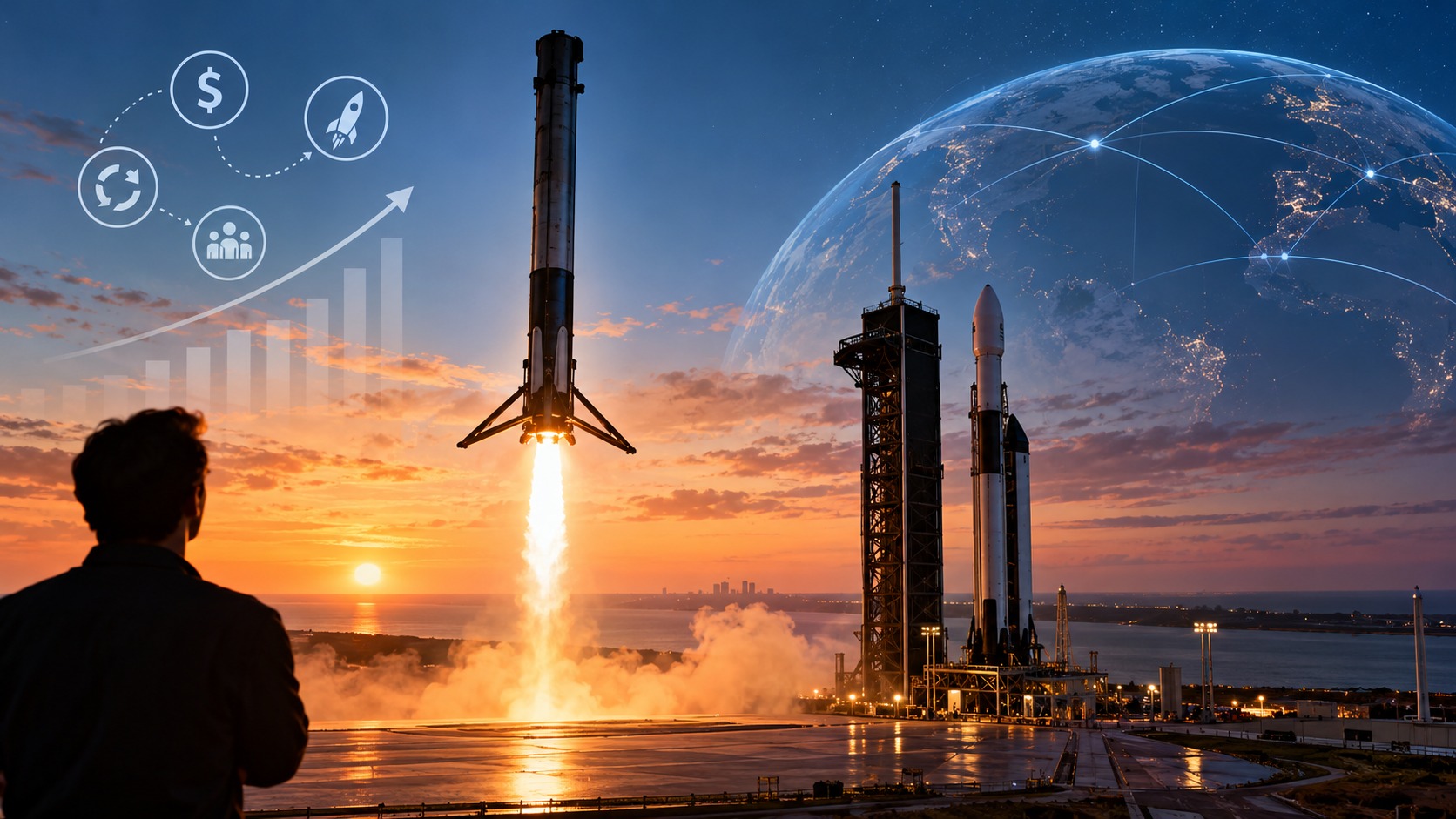
Reusable rockets are changing the economics of space launch by allowing companies to recover and fly expensive rocket components multiple times instead of building an entirely new vehicle for every mission. SpaceX has demonstrated this approach at commercial scale with Falcon 9, while Blue Origin and other competitors are developing their own reusable orbital launch systems.
For investors, the economic opportunity extends beyond cheaper launches. Reusability can improve capital efficiency, support more frequent missions, and reduce the cost of deploying satellite networks and other space infrastructure.
However, recovering a rocket does not automatically make a launch inexpensive or profitable. The financial advantage depends on manufacturing costs, refurbishment expenses, flight frequency, reliability, and customer demand.
What Makes a Rocket Reusable?
Traditional orbital rockets are largely expendable. After delivering their payloads toward orbit, major components are discarded rather than recovered for another mission.
A reusable rocket is designed to recover and fly at least some of those components again.
The most important component is usually the first-stage booster, which contains the engines that provide the initial thrust needed to lift the vehicle off the ground.
In a reusable system, the booster separates from the upper stage, returns toward Earth, and lands for inspection and another flight.
There are two main categories:
- Partially reusable rockets: Some components, usually the first-stage booster, can fly again, while others are discarded.
- Fully reusable rockets: Both the booster and upper stage are designed to be recovered and flown repeatedly.
SpaceX's Falcon 9 is partially reusable. Its first stage can land and fly again, while the upper stage is normally expended.
Starship, by contrast, is designed for full and rapid reusability. Achieving that capability consistently in commercial operations is considerably more demanding than recovering a booster.
For a comparison of existing systems and their development status, see Fully Reusable Rockets Today: Which Companies and Countries Actually Have Them.
Recovering more hardware creates the potential for additional savings, but also introduces engineering, maintenance, and operational requirements.
Why Are Reusable Rockets Economically Important?
Rockets are expensive to manufacture. When major components are discarded after one mission, each launch must absorb the cost of producing replacement hardware.
Reusability changes that equation by spreading manufacturing costs across multiple flights.
Consider a simplified example.
Suppose a rocket booster costs $40 million to manufacture.
If it flies once, the entire $40 million manufacturing cost is associated with that mission.
If the same booster flies ten times, its original manufacturing cost averages $4 million per flight before accounting for maintenance, recovery, financing, and other expenses.
That does not mean each launch costs only $4 million. The operator still pays for propellant, an upper stage, launch infrastructure, personnel, inspections, and refurbishment.
Nevertheless, repeated flights can substantially reduce the manufacturing cost allocated to each mission.
Three factors determine the economic advantage:
- Manufacturing cost: How expensive is the hardware being reused?
- Refurbishment cost: How much does preparing the rocket for another flight cost?
- Flight frequency: How many missions can the hardware complete during its useful life?
A booster completing twenty flights with modest maintenance expenses may generate substantial savings. A booster requiring extensive rebuilding after every landing may offer a much smaller advantage.
The critical measure is therefore not whether a rocket can land, but whether it can operate repeatedly at a lower total cost than an expendable alternative.
How Much Does It Cost to Launch a Rocket?
Rocket launch prices vary considerably depending on vehicle size, payload requirements, orbital destination, and the services included in a contract.
SpaceX has published standard Falcon 9 commercial launch prices around $70 million in recent pricing schedules. However, advertised prices can change, and individual contracts may have different terms.
More importantly, the price paid by a customer is not the same as the launch provider's operating cost.
- Launch price: The amount a customer pays for launch services.
- Launch cost: The amount the provider spends delivering those services.
- Profit margin: The portion of revenue remaining after the relevant expenses are deducted.
A reusable rocket can lower internal costs without passing all the savings to customers.
If demand is strong and competition is limited, the operator may retain some savings as higher margins. Alternatively, it may reduce prices to attract customers and expand market share.
Investors should therefore examine the economics of an entire launch program rather than comparing advertised prices alone.
Why Cost Per Kilogram Matters
One common industry metric is the price of transporting one kilogram of payload into orbit.
Consider two hypothetical launch services:
| Metric | Rocket A | Rocket B |
|---|---|---|
| Launch price | $60 million | $90 million |
| Payload delivered | 10,000 kg | 20,000 kg |
| Price per kilogram | $6,000 | $4,500 |
Rocket B costs more per launch but offers a lower price per kilogram because it carries twice as much payload.
These figures are illustrative, not actual prices for specific rockets.
Price per kilogram is useful for comparing launch systems, but it does not capture every customer requirement. Orbital destination, launch schedule, reliability, payload integration, and dedicated versus shared launches can all affect the final decision.
A lower price per kilogram is not necessarily the best option for every satellite operator.
For a detailed examination of commercial pricing, reusable launch savings, and government payments, read How Much Cheaper Are Reusable Rockets? SpaceX Launch Costs and NASA Contracts Explained.
Which Companies Are Building Reusable Rockets?
The reusable launch industry includes established operators, emerging competitors, and companies developing vehicles that have not yet demonstrated sustained commercial operations.
The distinction between proven capability and future plans is especially important for investors.
SpaceX: The Established Leader
SpaceX has accumulated extensive operational experience recovering and reusing orbital-class rocket boosters.
Its Falcon 9 program has demonstrated repeated booster flights across commercial satellite launches, government missions, and crew transportation.
This operating history matters because reusable rockets become more valuable when they can fly frequently and predictably.
SpaceX also operates Falcon Heavy, which incorporates reusable booster technology, and continues developing Starship as a much larger transportation system designed for full reusability.
Starship could eventually offer major improvements in payload capacity and transportation economics. However, its long-term commercial costs, turnaround times, and sustainable flight rates must be demonstrated rather than assumed.
Blue Origin: A Heavy-Lift Challenger
Blue Origin, founded by Jeff Bezos, has developed New Glenn, a large orbital rocket designed to recover and reuse its first-stage booster.
New Glenn reached orbit on its inaugural flight in January 2025, marking an important technical milestone for the company.
Its development program has focused on establishing booster recovery and repeatable launch operations.
However, achieving individual technical milestones is different from operating a high-frequency commercial launch service.
Blue Origin must translate its engineering capabilities, launch infrastructure, and customer commitments into dependable operations with competitive costs.
Rocket Lab: A Different Market Strategy
Rocket Lab has developed a business serving smaller satellite launches while expanding into spacecraft components and satellite systems.
Its Electron rocket serves the small-satellite market. The company has also pursued recovery technologies and developed the larger Neutron vehicle around reusable design principles.
Rocket Lab is particularly relevant to retail investors because it is publicly traded on Nasdaq under the ticker RKLB.
However, its investment case should not be evaluated solely through rocket launches. Space systems and related products also contribute to its business.
Other Reusable Rocket Developers
Other U.S. companies pursuing reusable launch technology include Stoke Space and Relativity Space.
Some developers focus on first-stage recovery, while others aim to recover more of the vehicle or reduce the maintenance required between flights.
Investors should distinguish between announced designs, successful technical demonstrations, and sustained commercial launch capability.
A promising engine test or prototype landing does not establish that a company can provide reliable, profitable launch services.
Why Is Launch Frequency So Important?
Reusability becomes more economically valuable when recovered hardware flies frequently enough to spread its manufacturing and infrastructure costs across many missions.
The principle is similar to operating an airline.
An aircraft that flies regularly can generate revenue across many trips. An expensive aircraft that operates only a few times annually must spread its fixed costs across far fewer flights.
Rocket companies face a comparable challenge.
Launch pads, manufacturing plants, engineering teams, testing facilities, and support infrastructure require substantial investment whether a company launches five rockets or fifty.
Higher launch frequency can improve economics through several mechanisms:
- Fixed operating costs can be distributed across more missions.
- Reusable boosters can complete more flights during their useful lives.
- Engineering teams can improve procedures through repeated operations.
- Customers may gain access to more launch opportunities.
- Manufacturing capacity can focus on additional vehicles and replacement components rather than producing a new booster for every mission.
However, more launches do not automatically produce more profit.
The additional missions must generate sufficient economic value to justify their costs.
This is one reason SpaceX's Starlink satellite network is strategically important.
Deploying and replenishing thousands of satellites creates recurring internal demand for launch services, helping support frequent Falcon 9 operations.
However, launches performed for Starlink should not be confused with independent third-party launch revenue. Their economic contribution must be assessed through the broader satellite business.
Does Reusing Rockets Make Them Less Reliable?
Reusing rocket hardware introduces additional engineering requirements, but reuse does not automatically make a vehicle less reliable.
Reliability depends on design, inspection procedures, maintenance standards, component life limits, and operational experience.
Reusable boosters must withstand extreme temperatures, vibration, acceleration, and aerodynamic forces.
After landing, engineers inspect the hardware and determine whether components require maintenance or replacement.
Repeated flights can also generate valuable performance data, helping operators understand how components behave over time and identify developing problems.
Nevertheless, previous successful flights do not guarantee future reliability.
A serious launch failure can result in:
- Loss of customer payloads.
- Regulatory investigations and operational delays.
- Additional engineering and testing expenses.
- Insurance complications.
- Customer uncertainty and potential contract disruption.
A prolonged interruption can also prevent a launch provider from generating expected revenue while fixed operating expenses continue.
For investors, the objective is not simply maximizing the number of flights. It is maintaining high flight activity without compromising reliability or creating unsustainable maintenance costs.
For a closer examination of booster lifetimes and launch failures, see SpaceX Rocket Reuse and Failure Rates: What Investors Should Know About Reliability.
Who Pays for Rocket Launches?
Rocket launch providers serve several customer groups, each with different requirements, contract structures, and economic priorities.
Commercial Satellite Companies
Commercial operators purchase launches to deploy communications, Earth-observation, navigation, and other satellites.
Some require dedicated launches, while others use rideshare services that allow multiple customers to share one rocket.
Rideshare can reduce launch expenses for smaller satellites, although customers may have less control over scheduling and orbital destination.
Government and Defense Agencies
NASA, the U.S. Space Force, and other government organizations purchase launch and transportation services.
Government contracts can provide significant revenue and support long-term investments in launch infrastructure.
However, these missions may involve additional certification, security, reliability, and operational requirements.
NASA also purchases services beyond the rocket launch itself, including spacecraft operations and crew transportation.
For example, a NASA Commercial Crew contract can include spacecraft services, astronaut transportation, mission support, and associated operations. Its total value should not be interpreted as the price of an ordinary satellite launch.
Satellite Constellation Operators
Large satellite networks require repeated launches for initial deployment, expansion, and replacement of aging spacecraft.
Starlink illustrates how a satellite operator can generate recurring demand for its own launch provider.
Other broadband constellations, including Amazon Leo, create potential business opportunities for competing launch companies.
This connection between satellite networks and launch services is one of the defining economic features of the modern space industry.
Why Does SpaceX Have Such a Strong Competitive Position?
SpaceX's competitive advantage comes from more than reusable rocket technology.
Its position combines extensive flight experience, frequent launches, manufacturing capabilities, launch infrastructure, and substantial internal demand from Starlink.
These advantages reinforce one another.
Frequent missions generate operational data, help maintain experienced teams, and improve the utilization of launch facilities.
Repeated booster flights also allow manufacturing resources to support additional capacity instead of replacing every rocket after one mission.
Competitors must therefore do more than demonstrate a successful landing.
They need reliable vehicles, paying customers, regulatory approvals, launch infrastructure, efficient maintenance, and sufficient financial resources to sustain operations.
Different competitors also serve different markets.
United Launch Alliance focuses heavily on government and national-security missions. Blue Origin is developing heavy-lift launch capacity, while Rocket Lab combines launch services with spacecraft manufacturing and related systems.
NASA plays a different role. It funds research, conducts missions, establishes requirements, and purchases services rather than competing as a conventional commercial rocket operator.
The distinction between market leadership, government spending, and corporate valuation is explored in Who Leads the Space Launch Industry? SpaceX, Its Rivals, and How NASA Fits In.
What Role Did Elon Musk Play in Reusable Rockets?
Elon Musk founded SpaceX in 2002 and played a central role in defining its ambitions, technology strategy, and development priorities.
However, reusable rocket technology was not invented by one person.
Earlier aerospace programs explored reusable spacecraft and vertical-landing technologies. SpaceX's achievements resulted from the combined work of engineering, manufacturing, testing, and operations teams.
For investors, the relevant issue is how leadership influences execution, capital allocation, and organizational resilience.
A company closely associated with a prominent founder may benefit from ambitious goals and decisive leadership, but it can also face key-person risk and succession challenges.
The more important long-term question is whether SpaceX has the institutional knowledge, management structure, and technical capabilities needed to sustain its advantages independently of any single executive.
These considerations are examined in Elon Musk and SpaceX: What He Actually Did (and Didn't) Build.
Could China Challenge the U.S. in Reusable Rockets?
China has made reusable launch technology a strategic priority, with state-backed organizations and commercial aerospace companies developing vehicles designed to recover and reuse rocket stages.
The motivation extends beyond commercial profitability.
Lower-cost launch capabilities could support satellite communications networks, scientific missions, commercial space businesses, and national-security objectives.
However, developing reusable rockets does not automatically establish technological or commercial parity with SpaceX.
A meaningful comparison requires evidence of successful orbital missions, booster recovery, repeated flights of the same hardware, launch frequency, and operating performance.
China's aerospace industry also operates within a different financial and regulatory environment.
Government funding, strategic objectives, domestic demand, and access to capital can influence launch prices and investment decisions, making direct cost comparisons difficult.
For American investors, Chinese competition matters even without direct ownership of Chinese rocket companies.
Additional international launch capacity could eventually influence pricing, satellite deployment costs, and the competitive position of U.S. aerospace businesses.
The status of Chinese programs and their implications are covered in China's Reusable Rocket Program: How Close Is It to SpaceX?.
How Do Reusable Rockets Affect the Broader Space Economy?
The economic benefits of reusable rockets extend beyond launch providers.
Lower transportation costs and more frequent access to orbit can improve the business case for companies that manufacture, operate, or depend on satellites and spacecraft.
Satellite Internet
Satellite broadband networks require substantial upfront investment in spacecraft, ground infrastructure, and launch services.
More affordable launches can reduce deployment expenses and make it easier to replace satellites as they reach the end of their operational lives.
However, lower launch costs do not guarantee profitability. Satellite manufacturing, customer acquisition, spectrum access, network operations, and financing remain major considerations.
Earth Observation
Earth-observation companies collect satellite imagery and data for agriculture, logistics, environmental monitoring, infrastructure, and defense.
More accessible launch services can help these businesses deploy and replenish satellite constellations.
Commercial success still depends on customer demand and the ability to convert collected data into valuable products or services.
Space Manufacturing and Research
Lower transportation expenses could improve the economics of scientific experiments and specialized manufacturing conducted in orbit.
These opportunities remain dependent on technical feasibility, customer demand, and the cost of returning materials or research results to Earth when necessary.
Space Infrastructure
A growing launch industry creates demand for propulsion systems, electronics, sensors, testing equipment, ground infrastructure, and launch facilities.
Companies supplying these products may benefit from expanding space activity without operating rockets themselves.
For investors, this broader supply chain offers exposure to the space economy through different business models and risk profiles.
Can Investors Buy Shares in Reusable Rocket Companies?
Investing directly in reusable rocket technology is more complicated than purchasing shares in a conventional publicly traded business.
SpaceX and Blue Origin have historically operated as privately held companies, meaning their shares have not generally been available to ordinary retail investors through standard stock exchanges.
Investors should verify the current ownership and listing status of any company before considering an investment.
Rocket Lab, traded on Nasdaq under the ticker RKLB, provides publicly traded exposure to launch services and space systems.
Other listed aerospace and defense companies participate through manufacturing, propulsion systems, partnerships, and related technologies.
However, purchasing an aerospace stock does not necessarily provide concentrated exposure to reusable rockets.
A large defense contractor may generate only a small portion of its revenue from launch-related activities.
Similarly, an aerospace or space-focused exchange-traded fund may hold satellite operators, defense contractors, communications companies, and industrial suppliers rather than primarily reusable rocket developers.
Direct Exposure Versus Indirect Exposure
| Investment exposure | Potential benefit | Main limitation |
|---|---|---|
| Publicly traded launch providers | More direct exposure to launch activity | Execution risk and potentially volatile valuations |
| Aerospace suppliers | Demand for engines, components, and systems | Launch may represent a small share of revenue |
| Satellite operators | Potentially lower deployment expenses | Profitability depends on the satellite business |
| Aerospace and space ETFs | Diversification across multiple companies | Holdings may have limited reusable-rocket exposure |
Investors should examine company revenue sources, business segments, fund holdings, and financial statements to understand their actual exposure.
Industry growth does not guarantee attractive shareholder returns. A company can increase revenue while remaining unprofitable, and a promising technology may already be reflected in an expensive stock valuation.
What Are the Biggest Financial Risks in Reusable Rocket Launches?
Reusable rockets offer potential economic advantages, but launch businesses remain capital-intensive, technically demanding, and exposed to several financial risks.
High Upfront Investment
Rocket development requires engineering teams, manufacturing facilities, engines, testing infrastructure, launch pads, and regulatory approvals.
Companies may spend heavily for years before achieving sustainable commercial revenue.
Launch Failures and Delays
A major failure can interrupt operations, trigger investigations, delay customer missions, and increase engineering expenses.
For companies with limited financial resources, prolonged delays can create serious liquidity pressure.
Insufficient Customer Demand
Reusable hardware becomes more economical when it flies frequently.
If customer demand falls short of expectations, expensive launch facilities and manufacturing capacity may remain underutilized.
Pricing Pressure
Greater competition could reduce commercial launch prices.
Lower prices may benefit satellite operators while reducing margins for launch providers unable to cut costs at a comparable rate.
Funding and Shareholder Dilution
Emerging aerospace companies may require additional financing before reaching sustainable operations.
Public companies can raise capital by issuing new shares, potentially reducing existing shareholders' percentage ownership.
Technology Execution
Engineering success does not always translate into commercial profitability.
A rocket may demonstrate successful recovery while still requiring expensive refurbishment, lengthy turnaround periods, or frequent component replacement.
Investors should distinguish between projected capabilities, demonstrated technical achievements, and proven operating economics.
What Metrics Should Investors Watch?
Investors evaluating reusable rocket businesses should focus on operational and financial indicators rather than launch announcements alone.
| Metric | Why it matters |
|---|---|
| Annual launch frequency | Indicates operational scale and launch activity |
| Successful booster re-flights | Demonstrates actual reuse rather than recovery alone |
| Turnaround time | Shows how quickly recovered hardware returns to service |
| Launch reliability | Affects customer confidence and business continuity |
| Contract backlog | Provides insight into potential future demand |
| Revenue and gross margins | Help evaluate commercial performance and profitability |
| Capital expenditure | Shows investment required to develop and expand operations |
| Cash flow and available funding | Indicate financial resilience and financing requirements |
Not every company reports these indicators in a comparable way.
Private operators may disclose limited financial information, while publicly traded companies generally face more extensive reporting requirements.
Contract backlog also requires careful interpretation.
A large announced backlog does not necessarily translate into immediate revenue. Contracts may extend over several years and contain milestones, options, cancellation provisions, or other conditions.
Investors should also distinguish total launch activity from revenue-generating third-party missions, particularly when an operator launches satellites for its own business.
The strongest commercial position combines proven technology, dependable operations, paying customers, and a credible path toward sustainable cash generation.
Will Fully Reusable Rockets Make Space Launch Dramatically Cheaper?
Fully reusable rockets could significantly reduce launch costs if both stages can be recovered, serviced economically, and flown again frequently.
The potential advantage comes from reducing the amount of expensive hardware manufactured and discarded for each mission.
However, full reusability does not eliminate operating expenses.
Companies must still pay for propellant, maintenance, ground operations, infrastructure, personnel, insurance, and eventual vehicle replacement.
Recovery systems can also add weight, potentially reducing the payload available for customers.
The most important uncertainty is whether full reusability can be combined with rapid, inexpensive turnaround.
A vehicle that requires months of refurbishment or extensive component replacement may deliver much smaller savings than its design initially suggests.
SpaceX's Starship program is particularly significant because it aims to combine very large payload capacity with full reusability.
If that combination becomes commercially reliable, it could change the economics of deploying large satellite networks and transporting substantial cargo to orbit.
However, future operating costs, commercial prices, profit margins, and achievable flight rates remain uncertain.
Investors should treat ambitious launch-cost projections as targets until supported by repeatable operational evidence.
Why Reusable Rockets Matter for Long-Term Investors
Reusable rockets have already changed the economics and operational expectations of the space launch industry.
SpaceX has demonstrated that orbital-class boosters can be recovered and flown repeatedly, while Blue Origin and other developers are pursuing competing capabilities.
The central economic advantage is the ability to spread expensive manufacturing costs across multiple missions rather than consuming major hardware components after a single flight.
That can improve capital efficiency, support higher launch frequency, and reduce transportation expenses for satellite operators and other space businesses.
However, successful technology does not automatically create a successful investment.
The companies that benefit most may not be those developing the largest or most ambitious rockets. They may be the businesses that combine reliable operations, sufficient customer demand, disciplined capital spending, and sustainable margins.
Other companies may benefit indirectly through satellite services, aerospace components, and supporting infrastructure.
For long-term investors, the most important question is not simply whether rockets can be reused.
It is whether reusability can become a repeatable, profitable business advantage, and which companies are best positioned to capture that value.
Disclaimer: This article is for informational and educational purposes only and does not constitute investment advice. Space-related investments involve significant technological, financial, regulatory, and market risks. Investors should conduct their own research before making investment decisions.