
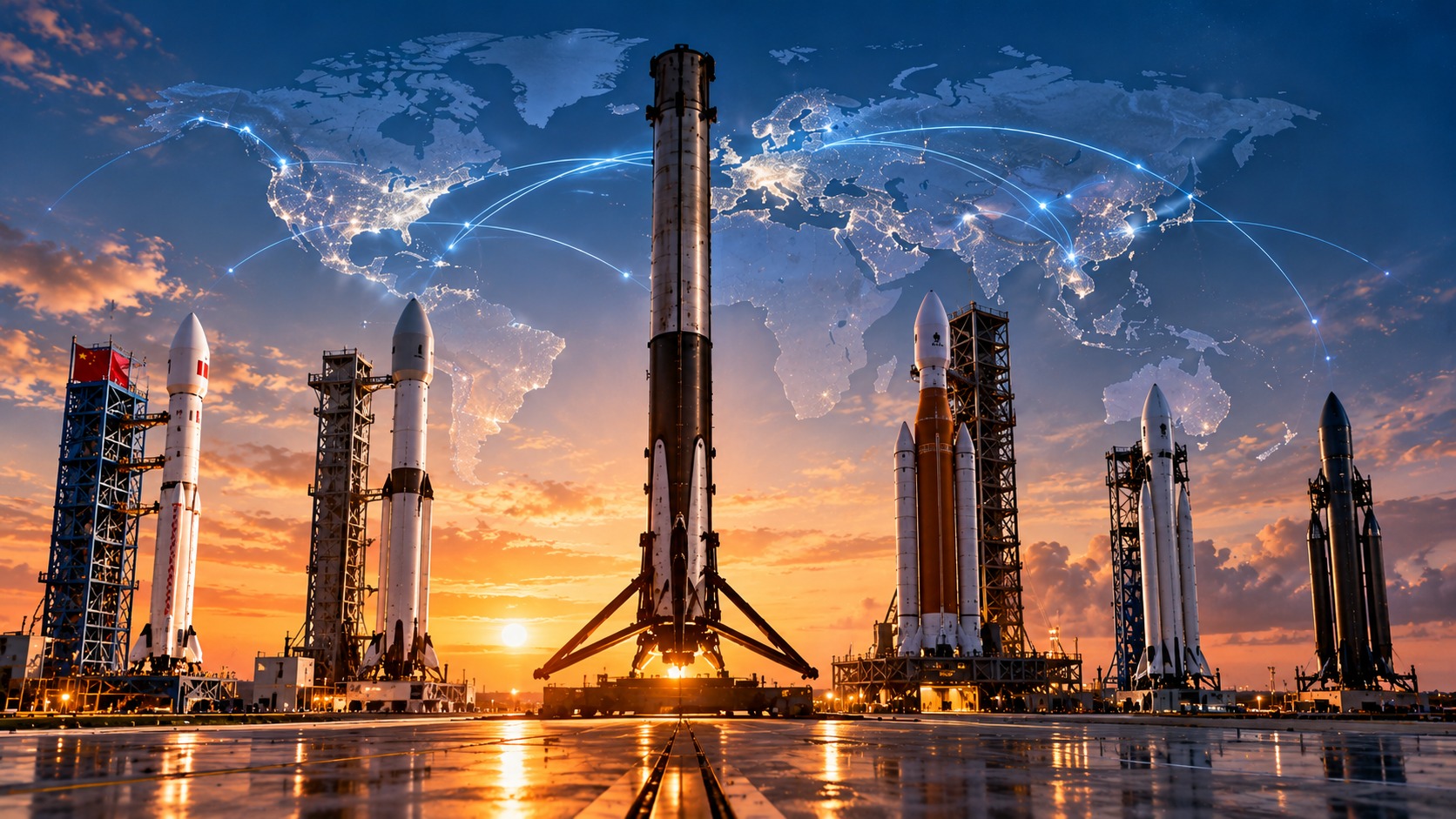
SpaceX leads the commercial orbital launch industry in flight frequency, proven booster reuse, and operational scale. Its Falcon 9 rocket has established a launch cadence that competitors have not matched, supported partly by recurring demand from its Starlink satellite network.
Blue Origin, United Launch Alliance (ULA), Rocket Lab, and China's expanding launch industry are important challengers. However, they operate different vehicles, serve different customers, and have different levels of commercial experience.
NASA plays a different role. It is a U.S. government agency that funds exploration, develops technology, establishes mission requirements, and purchases transportation services. It is not a conventional commercial competitor to SpaceX.
For investors, identifying the industry leader requires distinguishing launch activity, technical capability, customer demand, valuation, and financial performance.
Which Company Is Number One in Space Launches?
SpaceX is the leading commercial orbital launch provider by annual launch frequency and demonstrated reusable booster operations.
Its position is built around Falcon 9, a partially reusable rocket used for commercial satellites, government missions, and crew transportation.
By repeatedly flying recovered boosters, SpaceX reduces the need to manufacture a new first stage for every mission. This supports frequent launches and more efficient use of expensive hardware and infrastructure.
SpaceX also operates Falcon Heavy for missions requiring greater payload capability and continues developing Starship as a much larger system designed for full reusability.
However, leading in launch frequency does not automatically mean generating the highest profit margins or possessing the greatest overall company value.
SpaceX has historically been privately held, and its detailed launch operating costs and margins are not independently available through conventional public-company reporting.
Why Launch Frequency Matters
Launch frequency is one of the clearest indicators of operational scale.
A provider that launches regularly can spread some fixed costs across more missions, accumulate operating experience, and offer customers greater scheduling flexibility.
Frequent launches also create more opportunities to reuse expensive boosters.
However, not every mission produces the same revenue.
SpaceX launches satellites for external customers and deploys spacecraft for its own Starlink network.
Internal Starlink launches support a separate satellite communications business, but they should not be counted as independent third-party launch sales.
For investors, launch cadence is an important operating indicator, not a substitute for revenue or profitability.
Who Is SpaceX's Biggest Rival?
Blue Origin is one of SpaceX's most prominent long-term competitors, particularly in heavy-lift launch services and reusable rocket technology.
Founded by Jeff Bezos, Blue Origin has invested in propulsion systems, launch infrastructure, spacecraft, and the New Glenn orbital rocket.
New Glenn reached orbit on its inaugural flight in January 2025. Subsequent booster recovery and reflight milestones demonstrated progress toward reusable orbital operations.
Blue Origin also participates in NASA's lunar exploration program through its Blue Moon lander development.
These capabilities make it a significant challenger, although its operational launch history remains much smaller than SpaceX's.
Other competitors matter in different markets.
| Competitor | Main competitive area | Position relative to SpaceX |
|---|---|---|
| Blue Origin | Heavy-lift rockets, reusable launch systems, lunar programs | Major long-term challenger |
| United Launch Alliance | Government and national-security launches | Established competitor in specialized missions |
| Rocket Lab | Small satellite launches and space systems | Smaller-scale competitor with a diversified space business |
| Chinese launch providers | Domestic satellite deployment and strategic access to space | Growing technological and geopolitical challenge |
| Arianespace | European institutional and commercial launches | Established regional and commercial alternative |
No single competitor currently matches SpaceX across every dimension.
SpaceX vs. Blue Origin: Who Has the Advantage?
SpaceX has the stronger demonstrated orbital launch operating history.
Falcon 9 has accumulated extensive experience with booster recovery, reflight, and frequent commercial missions.
Blue Origin has substantial technical and financial resources, but New Glenn is at an earlier stage of commercial operations.
SpaceX
SpaceX combines launch services with satellite communications through Starlink.
Starlink requires regular launches to expand and maintain its constellation, creating internal demand for SpaceX's launch infrastructure.
The company also serves commercial satellite operators, NASA, and U.S. national-security customers.
This combination of launch operations and satellite services is an important competitive advantage, although internal Starlink deployments should not be confused with external launch revenue.
Blue Origin
Blue Origin operates across several areas of space transportation, including suborbital flights, orbital launches, propulsion systems, and lunar development.
Its BE-4 engines also power the first stage of ULA's Vulcan rocket, providing exposure to propulsion technology beyond Blue Origin's own launch vehicles.
However, Blue Origin's detailed financial performance is not publicly disclosed.
Its long-term competitiveness depends on converting technical achievements and development spending into reliable, recurring commercial operations.
What Matters for Investors?
The relevant question is not simply which company has the larger rocket or more ambitious development plans.
It is which provider can deliver missions consistently, control costs, and secure enough customer demand to support sustainable operations.
SpaceX has an established operating advantage. Blue Origin has resources and technologies that could support stronger competition over time.
Neither position guarantees attractive investment returns, especially when access to privately held companies is limited and valuations may be difficult to assess.
What About United Launch Alliance?
United Launch Alliance is a joint venture between Boeing and Lockheed Martin.
It has historically focused on reliable access to space for government, military, and commercial customers.
Its launch vehicles have included Atlas V, Delta IV, and the newer Vulcan system.
ULA is particularly important in U.S. national-security missions, where certification, specialized payload requirements, and mission assurance influence purchasing decisions.
Unlike Falcon 9, Vulcan was not introduced as a routinely reusable booster system.
ULA has explored recovering and reusing major engine components through its SMART Reuse concept, but this should not be confused with established full-booster reuse.
Its competitive position therefore depends on more than offering the lowest launch price.
Government customers may value specialized capabilities and maintaining multiple independent launch providers.
For investors, ULA also illustrates the difference between owning shares in a parent company and obtaining concentrated exposure to orbital launches.
Boeing and Lockheed Martin operate extensive businesses outside launch services, so ULA represents only part of their overall financial performance.
Is Rocket Lab a Serious SpaceX Competitor?
Rocket Lab is a meaningful competitor in selected space markets, although it operates at a different scale.
Its Electron rocket was developed primarily for dedicated small-satellite launches.
That market differs from Falcon 9's larger payload capabilities and rideshare services.
Rocket Lab has also developed Neutron, a larger launch vehicle designed around reusable first-stage technology.
Neutron is intended to expand the company's addressable market, but development objectives should not be treated as established commercial capabilities until demonstrated through operations.
Rocket Lab also manufactures spacecraft components and provides space systems services.
This diversification matters because its business is not entirely dependent on launch revenue.
Unlike SpaceX and Blue Origin, Rocket Lab is publicly traded on Nasdaq under the ticker RKLB.
That makes it one of the more direct publicly available investment exposures to launch services and related space infrastructure.
However, investors must evaluate the entire company's revenue, profitability, capital requirements, and valuation rather than assuming its stock price will track reusable rocket development directly.
Is NASA Bigger Than SpaceX?
NASA and SpaceX cannot be compared using a single financial measure because they are fundamentally different organizations.
NASA is a U.S. government agency funded through federal appropriations.
SpaceX is a commercial company providing launch services, spacecraft transportation, satellite communications, and related capabilities.
NASA's annual budget represents government funding authority for its programs.
SpaceX's revenue represents income generated through business activities, while its valuation reflects estimates of what investors believe the company's equity is worth.
These are different financial concepts.
| Measure | NASA | SpaceX |
|---|---|---|
| Organization type | U.S. government agency | Commercial company |
| Primary funding | Federal appropriations | Commercial revenue, government contracts, and private capital |
| Annual budget | Publicly reported | Not applicable in the same sense |
| Revenue | Not a conventional corporate revenue measure | Generated through business activities |
| Company valuation | Not applicable | Based on ownership transactions and valuation estimates |
| Publicly traded shares | No | Not generally available through public exchanges |
NASA's fiscal year 2026 budget request was approximately $18.8 billion, but a budget request is not the same as the final enacted appropriation.
Actual funding depends on congressional decisions.
SpaceX does not provide the same standardized financial disclosures as a conventional publicly traded company.
Comparing NASA's budget directly with SpaceX's estimated revenue or valuation can therefore produce misleading conclusions.
Who Is Richer, NASA or SpaceX?
The term "richer" does not provide a meaningful financial comparison between a government agency and a commercial company.
NASA does not have a stock-market valuation. It receives funding to carry out scientific, exploration, research, and public-service missions.
SpaceX's valuation reflects investor expectations, ownership transactions, and anticipated future business performance.
That valuation is not equivalent to cash available for spending.
A company valued at hundreds of billions of dollars does not necessarily hold that amount in cash.
Similarly, NASA's annual budget does not represent the total economic value of its facilities, expertise, or scientific programs.
A more useful comparison examines each organization's role.
NASA funds exploration, scientific missions, research infrastructure, and services purchased from contractors.
SpaceX develops and operates commercial space assets while generating revenue from customers.
Their relationship is therefore substantially collaborative rather than purely competitive.
Does NASA Own SpaceX?
No. NASA does not own SpaceX.
SpaceX was founded in 2002 as a private aerospace company.
NASA is an important government customer and has supported commercial transportation development through contracts and funding arrangements.
That relationship does not make SpaceX a NASA subsidiary.
Under commercial transportation programs, NASA establishes requirements and purchases services from private providers.
SpaceX develops and operates its vehicles while fulfilling contractual obligations.
NASA also works with other aerospace companies to support competition and maintain access to space.
Government contracts can nevertheless influence a provider's financial position by supporting development, generating revenue, and establishing operational credibility.
How Much Does NASA Pay SpaceX?
NASA's payments depend on the mission and contractual services involved.
Launching a commercial satellite is not equivalent to transporting astronauts or delivering cargo to the International Space Station.
In September 2026, NASA awarded SpaceX a $946 million contract modification for three additional Commercial Crew missions.
Dividing that amount equally produces approximately $315.3 million per mission package.
However, these contracts cover more than the rocket launch, including astronaut transportation, spacecraft operations, ground support, and other services.
The figure should not be described as NASA paying $315 million for an ordinary Falcon 9 launch.
NASA also purchases cargo transportation and other mission services from SpaceX.
For investors, these agreements illustrate the value of government customers and integrated transportation capabilities.
Contract awards also should not be confused with immediately recognized revenue or cash received. The financial impact depends on contractual terms and performance obligations.
For a detailed explanation of commercial launch pricing and NASA payments, see How Much Cheaper Are Reusable Rockets? SpaceX Launch Costs and NASA Contracts Explained.
Is SpaceX Worth More Than Tesla?
SpaceX and Tesla have different ownership structures, making valuation comparisons more complicated than they initially appear.
Tesla trades publicly on Nasdaq under the ticker TSLA.
Its market capitalization is calculated using its share price and outstanding shares, and changes continuously during trading.
SpaceX has historically been privately held, with reported valuations based on financing transactions, secondary share sales, and other estimates rather than a continuously traded public share price.
A private-company valuation may reflect the price paid for a limited number of shares under specific transaction conditions.
It does not necessarily mean every shareholder could sell at that price.
Whether SpaceX is worth more than Tesla therefore depends on the valuation date, available transaction evidence, and methodology used.
Investors should not treat private valuation estimates as directly interchangeable with public market capitalization.
Why the Comparison Matters
Both companies are associated with Elon Musk, but their underlying businesses differ substantially.
Tesla operates primarily in electric vehicles, energy storage, and related technologies.
SpaceX operates in launch services, satellite communications, and space transportation.
Their revenue models, capital requirements, competitive environments, and regulatory risks are different.
A higher valuation does not automatically indicate a stronger business or a better investment.
Why Does SpaceX Dominate Reusable Launches?
SpaceX's competitive advantage comes from several capabilities that reinforce one another.
- Operational experience: Falcon 9 has demonstrated repeated booster recovery and reuse across extensive commercial operations.
- Manufacturing and infrastructure: SpaceX has invested in launch facilities, production systems, engineering expertise, and recovery operations.
- Recurring demand: Starlink requires satellite deployment and replacement launches, supporting infrastructure utilization.
- Customer relationships: SpaceX serves commercial satellite operators, NASA, and U.S. national-security customers.
Together, these advantages create substantial barriers to entry.
A new competitor must do more than demonstrate a successful rocket landing.
It must establish reliability, secure regulatory approvals, build infrastructure, attract customers, and develop a sustainable operating model.
However, leadership is not permanent.
Competitors can improve their technology, government procurement priorities can change, and new launch systems may alter market economics.
For a broader explanation of the reusable rocket industry, see Reusable Rockets Explained: Who Builds Them, What They Cost, and Why They Matter for Investors.
Could China Become SpaceX's Biggest Competitor?
China is investing heavily in orbital launch systems, satellite networks, and reusable rocket technology.
Its aerospace industry includes state-backed organizations and commercial developers pursuing new vehicles and recovery systems.
Chinese programs have demonstrated important booster recovery milestones, although successful recovery should not be confused with routine commercial reflight.
China's launch capabilities are strategically important because they support communications, scientific research, national security, and independent access to space.
However, the country's aerospace industry operates under different financial, regulatory, and government-support structures.
Direct economic comparisons with SpaceX are therefore difficult.
Some Chinese providers may prioritize national strategic objectives alongside commercial profitability.
For American investors, competition could eventually affect launch pricing, satellite deployment costs, and the competitive position of U.S. aerospace businesses.
However, geopolitical restrictions and export controls limit direct competition for some customers and missions.
For a detailed examination of China's reusable launch progress, read China's Reusable Rocket Program: How Close Is It to SpaceX?.
Which Countries Lead the Space Launch Industry?
The United States and China are the most prominent countries in orbital launch activity, although several others maintain important independent capabilities.
The United States benefits from SpaceX's high launch frequency, established government customers, and commercial aerospace investment.
China operates a substantial national launch program and continues expanding its commercial aerospace sector.
Europe maintains access to space through institutional and commercial launch programs, including Ariane and Vega.
India has developed domestic launch capabilities through ISRO and is expanding its commercial space ambitions.
Japan also operates national launch systems and participates in international space programs.
However, leadership depends on the measure used.
A country may conduct numerous launches without operating reusable rockets.
Another may possess advanced technology but launch less frequently.
National launch totals also do not establish the profitability of individual companies.
For a focused comparison of reusable rocket capabilities by company and country, see Fully Reusable Rockets Today: Which Companies and Countries Actually Have Them.
Can Competitors Catch Up With SpaceX?
Yes, but catching up requires more than matching an individual technical milestone.
A competitor may successfully recover a booster while remaining far behind in launch frequency, refurbishment efficiency, or commercial experience.
SpaceX's advantage includes manufacturing capacity, launch infrastructure, reusable hardware operations, customer demand, and an established reliability record.
Competitors could narrow the gap by developing vehicles with greater payload capacity, achieving lower operating costs, securing specialized contracts, or serving different customer requirements.
They may also benefit from customers seeking alternative providers to reduce dependence on SpaceX.
However, developing a successful launch business requires substantial capital and time.
Even well-funded companies can experience technical failures, schedule delays, and unexpected expenses.
The market may eventually support several strong launch providers rather than one dominant company.
That outcome will depend on customer demand, competition, government policy, and the economics of future launch systems.
What Should Investors Compare Between Space Companies?
Investors should avoid ranking space companies solely by rocket size, launch announcements, or headline valuations.
A more useful comparison combines operational performance with financial results.
| Indicator | Why it matters |
|---|---|
| Annual launch frequency | Measures operational activity and scale |
| Successful missions | Demonstrates reliability |
| Reusable booster reflights | Indicates progress in reducing recurring hardware costs |
| Contract backlog | Provides insight into potential future demand |
| Revenue growth | Measures commercial expansion |
| Operating margins | Shows the relationship between revenue and operating costs |
| Capital expenditure | Indicates investment requirements |
| Cash flow | Helps assess financial sustainability |
| Customer concentration | Reveals dependence on major contracts |
| Valuation | Determines the price investors pay for expected future performance |
Not every company reports these indicators in the same way.
Private businesses may disclose limited financial information.
Publicly traded companies provide more standardized reporting, but their activities may extend well beyond launch services.
Investors should distinguish revenue generated by rocket launches from revenue earned through satellite communications, spacecraft manufacturing, or other operations.
A company can lead in launch frequency without leading in total aerospace revenue.
Likewise, a highly valued company may still face substantial execution and financing risks.
Who Is Best Positioned to Lead the Next Phase of Space Launch?
SpaceX enters the next phase of the industry with the strongest demonstrated commercial orbital launch operating position.
Its Falcon 9 operations, booster reuse experience, and recurring Starlink deployment requirements provide important advantages.
Blue Origin is a major challenger with substantial investment, heavy-lift technology, and growing operational experience.
United Launch Alliance remains important in government and national-security missions.
Rocket Lab offers a different combination of launch services and space systems, while Chinese developers continue advancing reusable technology within a distinct strategic and commercial environment.
NASA will continue shaping the industry through exploration programs, procurement contracts, technical requirements, and government funding.
However, the future competitive landscape remains uncertain.
New launch systems must demonstrate dependable operations, and growing competition could pressure launch prices.
For investors, the most important question is not simply which company launches the most rockets today.
It is which businesses can convert technological capabilities and customer demand into sustainable financial performance.
SpaceX leads the current commercial orbital launch market, but long-term investment outcomes will depend on profitability, reliable execution, competitive positioning, and the valuation investors pay for exposure to the industry.
Disclaimer: This article is for informational and educational purposes only and does not constitute investment advice. Aerospace and space-related investments involve significant technological, financial, regulatory, and competitive risks. Investors should conduct independent research before making investment decisions.