
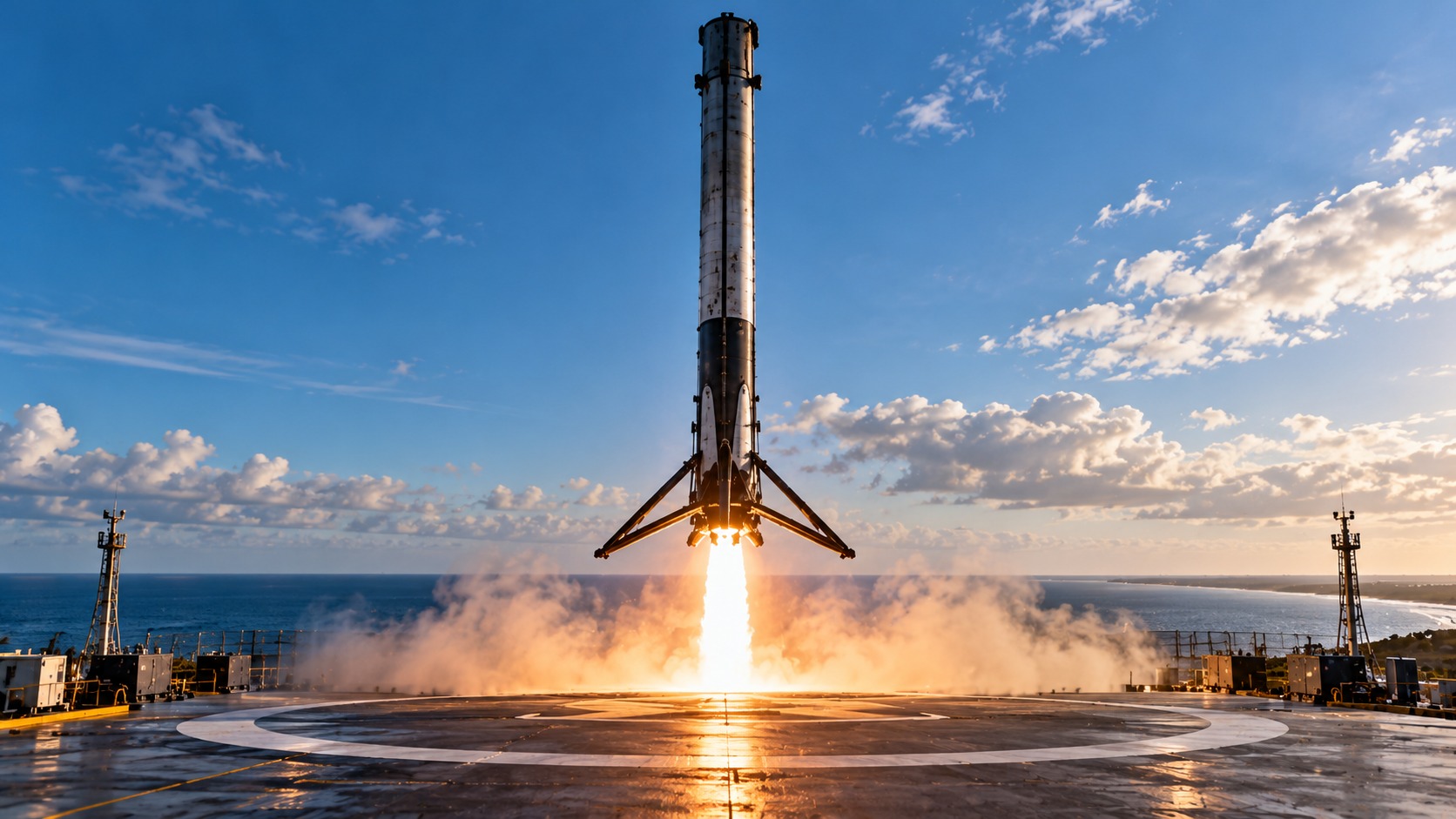
SpaceX has demonstrated that Falcon 9 boosters can fly more than 30 times, making rocket reuse an established commercial capability rather than an experimental concept. However, repeated flights do not eliminate the risk of launch failures, hardware damage, or costly maintenance.
Falcon 9 has accumulated an extensive record of successful orbital missions, but its history also includes launch failures, upper-stage anomalies, and unsuccessful booster landings. These events have different consequences and should not be combined into a single reliability figure without a clear definition.
For investors, two questions matter most: how many times can SpaceX reuse expensive rocket hardware, and how reliably can it deliver customer payloads?
The answers help explain SpaceX's competitive position, launch economics, and the financial risks facing reusable rocket companies.
How Many Times Can SpaceX Reuse a Falcon 9 Rocket?
Falcon 9 first-stage boosters have demonstrated more than 30 flights using the same hardware.
That represents a substantial improvement over traditional expendable rockets, which require a newly manufactured first stage for every mission.
However, there is no universal flight limit that applies to every Falcon 9 booster.
A booster's operating life depends on its condition, maintenance history, mission requirements, component durability, and the limits established by SpaceX.
Individual boosters may also be retired for economic or operational reasons before reaching their maximum potential lifespan.
SpaceX progressively increased booster reuse as its engineers accumulated experience with repeated launches, landings, inspections, and maintenance.
Earlier milestones included five, ten, fifteen, and twenty flights using the same booster.
Each milestone provided additional evidence that expensive rocket hardware could survive repeated missions without requiring complete replacement.
Does SpaceX Reuse the Entire Falcon 9 Rocket?
No. Falcon 9 is partially reusable.
Its first-stage booster returns to Earth and can fly again, while the upper stage is normally expended after delivering its payload.
SpaceX also recovers and reuses payload fairing components on suitable missions. These protective shells surround satellites during the initial phase of launch.
Consequently, Falcon 9 still requires newly manufactured hardware for each mission.
Booster reuse reduces recurring manufacturing requirements but does not eliminate the cost of the upper stage, propellant, ground operations, or maintenance.
SpaceX's Starship program aims to go further by recovering and reusing both major stages.
For a comparison of partial and full reusability, see Fully Reusable Rockets Today: Which Companies and Countries Actually Have Them.
What Happens to a Falcon 9 Booster After Landing?
A successful landing is only the first step toward another flight.
After returning to a landing zone or offshore recovery platform, the booster must be transported, inspected, and prepared for its next mission.
Engineers assess critical systems, including engines, structures, electronics, propulsion components, and landing equipment.
Some parts may require maintenance or replacement, while others can remain in service.
The amount of work depends on the booster's condition and previous mission requirements.
This creates an important economic distinction.
A booster that lands successfully but requires extensive rebuilding may provide limited financial savings.
A booster that can be inspected, serviced, and flown again with modest maintenance can spread its manufacturing cost across many missions.
The financial value of reuse therefore depends on both the number of flights completed and the cost of returning recovered hardware to service.
Does Reusing a Rocket Make It More Dangerous?
Not necessarily. A previously flown booster is not automatically less reliable than a new one.
Reusable rockets are designed to withstand repeated operating cycles, and their components must remain within acceptable engineering limits before another mission.
Repeated flights also generate performance data that can help operators understand component wear, identify developing problems, and improve maintenance procedures.
However, reusable hardware experiences repeated thermal stress, vibration, pressure changes, and mechanical loads.
These conditions can contribute to fatigue or deterioration over time.
Engineers must therefore assess the condition of engines, structures, and other critical systems before approving another flight.
The relevant question is not simply whether a booster is new or previously flown.
It is whether the vehicle has been properly inspected, maintained, tested, and cleared for its intended mission.
Likewise, a newly manufactured rocket is not automatically safer simply because its components have never flown.
Reliability should be evaluated using operational evidence rather than assumptions about hardware age.
What Is the Failure Rate of SpaceX Rockets?
There is no single failure rate that accurately describes every SpaceX rocket or mission.
Falcon 9, Falcon Heavy, and Starship have different designs, operating histories, and development stages.
Even within Falcon 9, the reported failure rate depends on what analysts count as a failure.
A booster can fail to land even though its payload reaches orbit successfully.
An upper-stage anomaly can occur after the primary mission has been completed.
A more serious failure can prevent a spacecraft from reaching its intended destination.
These outcomes have different implications for customers, launch costs, and future operations.
Falcon 9's Historical Launch Failures and Anomalies
June 2015 — CRS-7
A Falcon 9 carrying a Dragon cargo spacecraft broke apart during ascent, resulting in the loss of the mission.
The accident triggered an investigation and temporarily interrupted operations.
September 2016 — Amos-6
A Falcon 9 was destroyed during preparations for a static-fire test before its scheduled launch. The satellite was also lost.
This was a serious vehicle and payload loss, but it was not an in-flight launch failure.
July 2024 — Starlink Mission
A Falcon 9 upper-stage anomaly prevented Starlink satellites from reaching their intended operational orbit.
The incident interrupted a long sequence of successful Falcon 9 missions and led to an investigation.
September 2024 — Crew-9 Mission
After the crew spacecraft was deployed successfully, Falcon 9 experienced an upper-stage anomaly during its planned disposal sequence.
The primary crew transportation objective was achieved, but the anomaly still required investigation.
February 2025 — Starlink Mission
An upper-stage issue affected the planned disposal maneuver following payload deployment.
This illustrates how a launch vehicle can experience a technical anomaly even when the primary payload-delivery objective succeeds.
These incidents demonstrate why investors should distinguish mission failures, post-deployment anomalies, and booster recovery failures rather than combining them into one headline statistic.
How Should Investors Calculate Rocket Failure Rates?
The basic calculation is:
Failure rate = Failed missions / Total missions × 100
However, the result is meaningful only when the definition of failure is consistent.
Consider a hypothetical launch provider completing 200 missions:
- 197 missions achieve their primary objectives.
- Two missions fail to deliver their payloads.
- One mission experiences an anomaly after successful payload deployment.
If primary mission success is the standard, 198 missions succeeded and two failed, producing a 99% success rate and a 1% failure rate.
If every technical anomaly is counted as a failure, the total becomes three incidents, producing a 1.5% incident rate.
The same operating history therefore produces different statistics depending on the measurement used.
For investors, three reliability measures are particularly useful.
| Reliability measure | What it evaluates | Why it matters |
|---|---|---|
| Primary mission success rate | Whether the payload reaches its intended destination | Customer confidence and launch revenue |
| Booster recovery success rate | Whether the reusable stage returns successfully | Hardware replacement costs |
| Booster reflight success rate | Whether previously flown hardware performs reliably | Sustainability of the reuse model |
A failed booster landing may increase future manufacturing costs without causing a customer payload loss.
A payload-delivery failure can have broader consequences involving insurance, customer relationships, contracts, and regulatory approvals.
Keeping these measures separate provides a more accurate assessment of operational and financial risk.
Why Is Falcon 9's Reliability Record Important?
Falcon 9 has accumulated extensive operational experience across commercial satellite launches, government missions, and astronaut transportation.
That history provides evidence about the performance of the launch system under different operating conditions.
Reliability matters because customer payloads can be extremely expensive and may require years of development.
A launch failure can destroy a spacecraft, delay planned services, and create substantial replacement costs.
For launch providers, a strong reliability record supports customer confidence and helps secure future contracts.
Government missions may also require specific certifications and extensive technical reviews.
Operational reliability can therefore become a competitive advantage beyond launch pricing.
However, historical success does not eliminate future risk. Even mature aerospace systems can experience unexpected failures.
Investors should view reliability as an ongoing operational requirement rather than a permanent achievement.
What Happens Financially When a Rocket Fails?
A rocket failure can affect hardware costs, launch schedules, customer relationships, and future revenue.
Loss of Hardware
An unsuccessful launch or landing may destroy expensive equipment.
For reusable systems, losing a booster also eliminates its remaining potential flights.
The financial impact depends on manufacturing cost, previous use, remaining useful life, and insurance arrangements.
Launch Delays
Major failures can trigger investigations, corrective actions, and temporary restrictions on additional missions.
These interruptions may delay customer launches while fixed operating expenses continue.
Companies with limited financial resources can face significant pressure during prolonged suspensions.
Customer and Insurance Costs
Satellite operators may experience payload losses, delayed services, or additional expenses.
Insurance arrangements determine how some losses are allocated, while repeated failures may influence future premiums or customer decisions.
Contractual Consequences
Commercial and government contracts may contain performance requirements, delivery schedules, and other obligations.
Failures can create additional costs or commercial uncertainty depending on the specific contractual terms.
Reputation and Future Demand
Customers must trust launch providers to deliver valuable spacecraft reliably.
A serious failure can weaken confidence, particularly when alternative launch providers are available.
However, the long-term impact depends on how effectively the company identifies the cause, implements corrective measures, and returns to dependable operations.
How Many Flights Does a Booster Need to Become Economically Valuable?
Reusable boosters generally become more economically attractive as their manufacturing costs are spread across additional missions.
Consider an illustrative example.
Suppose a booster costs $40 million to manufacture and requires $2 million in recovery and refurbishment expenses after each flight except its final mission.
| Total flights | Manufacturing cost per flight | Average recovery and refurbishment cost per flight | Combined average |
|---|---|---|---|
| 1 | $40.0M | $0 | $40.0M |
| 5 | $8.0M | $1.6M | $9.6M |
| 10 | $4.0M | $1.8M | $5.8M |
| 20 | $2.0M | $1.9M | $3.9M |
| 30 | $1.33M | $1.93M | $3.27M |
These figures are hypothetical and do not represent SpaceX's actual costs.
They exclude upper stages, propellant, personnel, ground operations, infrastructure, and other launch expenses.
The example illustrates two important economic effects.
First, the manufacturing cost allocated to each flight declines as the booster completes more missions.
Second, the incremental savings from each additional flight become smaller over time.
Moving from one flight to five produces a much larger reduction in average manufacturing cost than moving from twenty flights to thirty.
Consequently, extremely high reuse counts are not the only source of economic value.
A company can achieve substantial savings with fewer flights if refurbishment expenses remain controlled.
The broader financial implications are explained in How Much Cheaper Are Reusable Rockets? SpaceX Launch Costs and NASA Contracts Explained.
Can Reusable Rockets Fly Too Many Times?
Yes. Every reusable rocket has practical operating limits determined by engineering design, component durability, maintenance requirements, and accumulated wear.
Over time, a booster may require increasingly expensive repairs or replacement of major components.
Eventually, maintaining the existing vehicle may become less economical than manufacturing and operating a replacement.
This creates an economic retirement decision.
The operator must compare the expected maintenance costs and risks of another flight with the cost of replacing the booster.
The financially optimal number of flights is therefore not necessarily the maximum number physically achievable.
A company may retire hardware while it remains technically capable of flying, or extend its operating life when inspections and maintenance economics support continued use.
For investors, lifetime cost per successful mission matters more than the highest flight count achieved by an individual booster.
How Does Starship Reliability Compare With Falcon 9?
Starship and Falcon 9 should not be compared without considering their different development stages.
Falcon 9 is an established commercial launch system with extensive operational experience.
Starship is a newer, substantially larger vehicle designed around different technologies and the objective of full reusability.
Its development program has included technical successes, experimental failures, and hardware losses.
During testing, individual flights may focus on evaluating specific systems rather than delivering commercial payloads.
An experimental flight can provide valuable engineering information even when it does not complete every planned objective.
However, technical learning is not equivalent to demonstrated commercial reliability.
Before Starship can establish an operational record comparable to Falcon 9, it must consistently complete intended missions and demonstrate dependable reuse of its major stages.
Investors should distinguish development progress from proven commercial service.
Does Elon Musk's Leadership Affect SpaceX Reliability?
SpaceX's engineering achievements depend on large teams responsible for design, testing, manufacturing, mission operations, and safety.
Elon Musk has played a significant role in establishing the company's strategy and ambitious development objectives.
However, rocket reliability depends on organizational processes and engineering execution rather than one individual's decisions alone.
A mature aerospace organization requires rigorous testing, technical review, experienced personnel, and effective procedures for identifying and correcting failures.
Leadership remains important because it influences development schedules, investment priorities, risk tolerance, and resource allocation.
Concentrated leadership may support rapid decision-making, but it can also introduce key-person and governance risks.
For a closer examination of Musk's role and SpaceX's engineering organization, see Elon Musk and SpaceX: What He Actually Did (and Didn't) Build.
What Reliability Metrics Should Space Investors Watch?
Investors should evaluate reusable rocket businesses through a combination of operational and financial indicators.
| Metric | Why it matters |
|---|---|
| Primary mission success rate | Measures successful delivery of customer payloads |
| Booster landing success rate | Indicates effectiveness of recovery operations |
| Booster reflight count | Demonstrates repeated use of expensive hardware |
| Refurbishment turnaround | Shows how quickly boosters return to service |
| Launch frequency | Reflects operating scale and customer demand |
| Fleet availability | Indicates how much reusable hardware is ready to fly |
| Failure-related downtime | Measures the operational impact of incidents |
| Replacement and maintenance costs | Determine the financial benefit of reuse |
No single indicator provides a complete assessment.
A company may have excellent booster recovery performance but experience problems with upper-stage reliability.
Another provider may achieve a strong mission success record while facing expensive refurbishment requirements.
The most attractive operating model combines reliable payload delivery, efficient hardware reuse, and sufficient customer demand.
Why Rocket Reliability Matters for Long-Term Investors
SpaceX has demonstrated that orbital-class boosters can complete many missions rather than being discarded after one flight.
This achievement changes launch economics by spreading manufacturing costs across repeated operations.
Higher reuse rates can reduce average hardware costs, support frequent launches, and strengthen competitive positioning.
However, reusability and reliability must work together.
A booster capable of flying thirty times provides limited financial value if repeated failures interrupt operations or maintenance becomes excessively expensive.
Similarly, a launch provider with an excellent reliability record must still attract enough customers to cover its development and operating costs.
For investors, the central question is not simply how many times a rocket can fly.
It is whether the company can deliver successful missions consistently while controlling the lifetime cost of maintaining and operating its fleet.
The strongest reusable rocket business is not necessarily the one with the highest booster flight count. It is the one that combines dependable launches, efficient reuse, and sustainable financial performance.
Disclaimer: This article is for informational and educational purposes only and does not constitute investment advice. Aerospace and space-related investments involve substantial technological, operational, regulatory, and financial risks. Investors should conduct independent research before making investment decisions.