
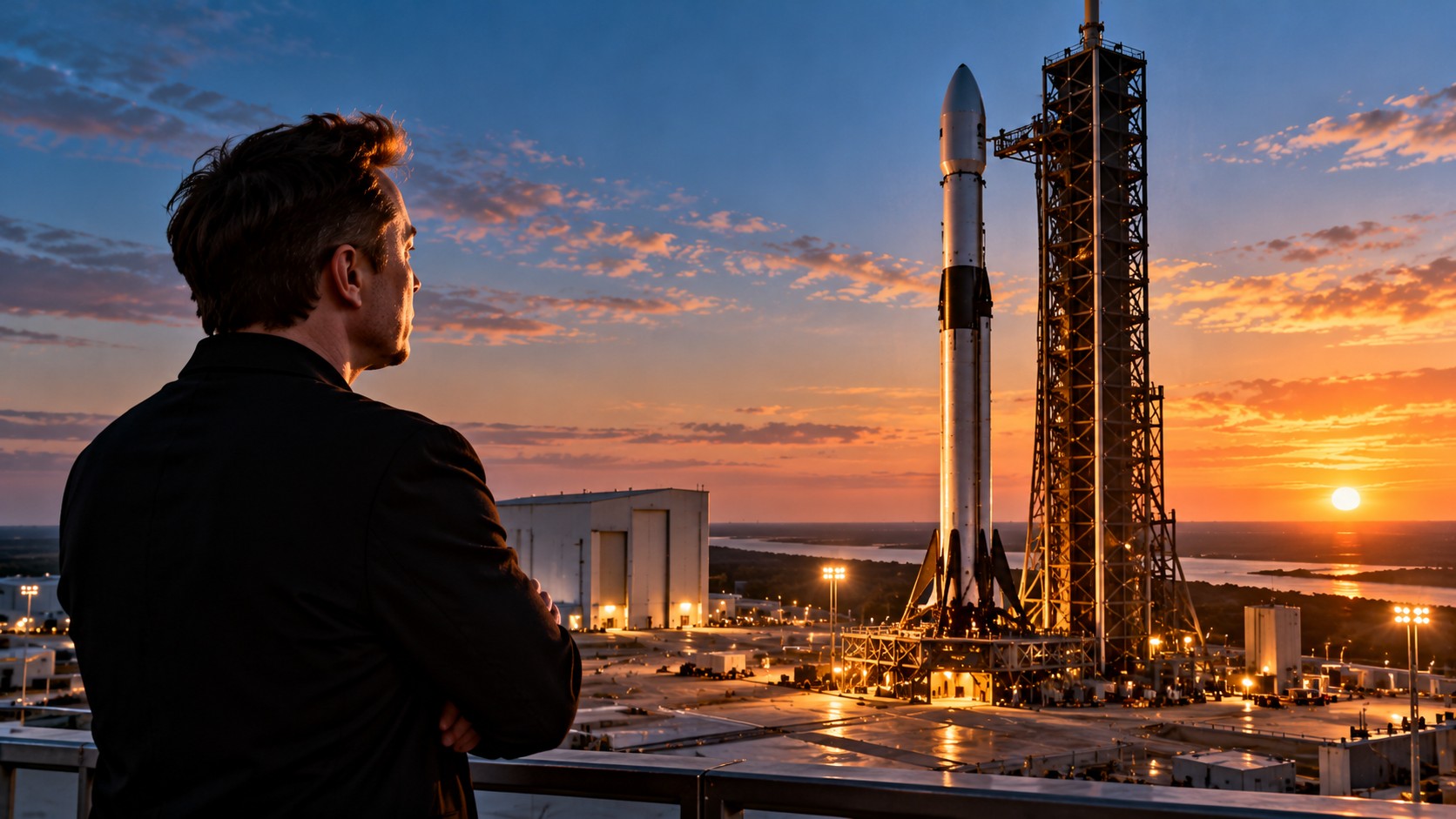
Elon Musk did not invent reusable rockets, nor did he personally design every rocket built by SpaceX. His contribution was founding the company in 2002, establishing ambitious technical and commercial goals, and helping build an organization that made reusable orbital rockets commercially operational.
SpaceX's achievements are the work of thousands of engineers, technicians, manufacturing specialists, and mission operators. Key figures such as Tom Mueller and Gwynne Shotwell have also played major roles in developing its technology and business.
For investors, the distinction matters. SpaceX's competitive position reflects both Musk's strategic leadership and the capabilities of an extensive engineering and operational organization.
Did Elon Musk Invent Reusable Rockets?
No. Reusable rocket technology existed long before SpaceX was founded.
NASA's Space Shuttle, which began orbital flights in 1981, demonstrated that spacecraft could return from orbit and fly again. Its orbiter was reusable, and its solid rocket boosters were recovered and refurbished, although the external fuel tank was discarded.
The Shuttle also demonstrated a major limitation: reusable hardware does not automatically make space transportation inexpensive. Maintenance and refurbishment remained costly.
In the 1990s, McDonnell Douglas developed the DC-X experimental vehicle, demonstrating controlled vertical takeoff and landing.
These programs established technical foundations for later reusable launch systems.
SpaceX's achievement was different. It demonstrated that an orbital-class rocket booster could return from a mission, land vertically, and fly again as part of regular commercial operations.
Its first successful Falcon 9 booster landing occurred in December 2015. In March 2017, SpaceX launched a Falcon 9 using a previously flown orbital-class booster.
That second milestone was particularly important: it demonstrated actual reuse rather than recovery alone.
SpaceX did not invent reusable rockets. It helped turn a long-standing engineering objective into a repeatable commercial capability.
What Did Elon Musk Actually Do at SpaceX?
Musk founded Space Exploration Technologies Corp., commonly known as SpaceX, in 2002.
He established the company's ambition to reduce space transportation costs and eventually make human settlement beyond Earth possible.
His contribution can be divided into three areas.
Founding and Financing the Company
Musk invested wealth from earlier business ventures to help finance SpaceX during its initial development.
Building orbital rockets required specialized employees, manufacturing facilities, testing infrastructure, and substantial spending before commercial operations could become sustainable.
The company also faced serious early setbacks. Falcon 1 failed during its first three launch attempts before successfully reaching orbit in September 2008.
That fourth flight established SpaceX's ability to develop an orbital launch vehicle.
NASA's commercial cargo development and transportation agreements subsequently played an important role in supporting the company's progress.
Musk's early financing was significant, but SpaceX's expansion was not funded exclusively by him. Government agreements, commercial contracts, outside investment, and operating revenue also contributed.
Establishing Technical Priorities
Musk has been closely involved in SpaceX's technical direction, advocating reusable rockets, lower manufacturing costs, rapid development, and vertical integration.
Vertical integration means developing and manufacturing important components internally rather than relying entirely on outside suppliers.
For SpaceX, this approach includes major propulsion, structural, electronic, and software systems.
It can improve control over design changes, production schedules, and costs, although it also requires substantial investment and specialized expertise.
Musk's influence on engineering priorities should not be confused with personally performing every engineering calculation or manufacturing task.
Driving the Reusability Strategy
One of SpaceX's defining strategic decisions was investing heavily in recovering and reusing rocket boosters.
Traditional orbital launch systems generally discarded major hardware after each mission.
SpaceX pursued an operating model in which expensive first-stage boosters could complete multiple flights.
That required years of testing, unsuccessful landing attempts, engineering improvements, and upfront investment before the potential economic benefits could be demonstrated.
For investors, Musk's role was important because he supported a technically difficult strategy whose commercial success was initially uncertain.
Does Elon Musk Actually Build Rockets?
Musk has participated in technical discussions and major design decisions, but SpaceX rockets are designed, manufactured, tested, and operated by large teams of specialists.
Orbital launch vehicles combine propulsion engineering, structural design, flight software, electronics, materials science, manufacturing, quality assurance, and mission operations.
No individual can perform all these functions.
A rocket engine alone requires expertise in combustion, fluid dynamics, thermal management, materials, and manufacturing.
The complete vehicle must integrate these systems while operating under extreme conditions.
SpaceX's achievements therefore depend on coordinated technical work across many departments.
Musk's involvement does not eliminate the contributions of the engineers who develop and validate the hardware.
Likewise, not personally manufacturing rocket components does not make his leadership irrelevant.
The distinction is between directing an engineering organization and personally carrying out its technical work.
Who Is the Real Engineer Behind SpaceX?
There is no single engineer responsible for all of SpaceX's achievements. However, several individuals have made particularly important contributions.
Tom Mueller: Rocket Propulsion
Tom Mueller was one of SpaceX's earliest employees and a founding member of its technical team.
He played a central role in developing the Merlin rocket engine used by Falcon vehicles.
Rocket propulsion requires engines to generate enormous thrust while operating reliably under extreme temperatures and pressures.
Mueller's expertise helped establish the technical foundation for SpaceX's early rockets. He later held senior propulsion leadership roles before leaving the company.
His contribution illustrates why the company's engineering achievements cannot reasonably be attributed to one person.
Gwynne Shotwell: Business and Operations
Gwynne Shotwell joined SpaceX in 2002 and became its president and chief operating officer.
Her responsibilities have included business development, customer relationships, commercial execution, and operations.
These functions are essential because developing a rocket is only one part of building a successful launch business.
SpaceX also needs customers, government contracts, manufacturing capacity, dependable launch schedules, and reliable mission delivery.
Shotwell has played an important role in turning technical capabilities into commercial services.
For investors, that operational leadership matters because advanced technology alone does not guarantee a sustainable business.
The Wider Engineering Organization
SpaceX also depends on teams responsible for flight software, avionics, structures, manufacturing, testing, recovery systems, and launch operations.
Many of these employees are not public figures, but their work is essential.
A reusable booster cannot land reliably through engine performance alone. It also requires navigation systems, control software, structural durability, and carefully coordinated operations.
Falcon 9's success reflects the integration of these disciplines.
For investors, this means SpaceX's technical knowledge is distributed across an organization rather than residing exclusively with its founder.
Has Elon Musk Ever Had a Successful Rocket Launch?
Yes. SpaceX has conducted numerous successful launches under Musk's leadership.
Its first successful orbital launch occurred in September 2008 with Falcon 1, following three unsuccessful attempts.
SpaceX subsequently developed Falcon 9, which became its primary orbital launch vehicle.
| Year | SpaceX milestone | Why it mattered |
|---|---|---|
| 2008 | Falcon 1 reaches orbit | Demonstrated independent orbital launch capability |
| 2010 | First successful Falcon 9 launch | Established the foundation for a larger launch business |
| 2012 | Dragon reaches the International Space Station | Demonstrated commercial cargo transportation capability |
| 2015 | Falcon 9 booster lands successfully | Major step toward orbital booster reuse |
| 2017 | Previously flown Falcon 9 booster launches again | Demonstrated practical orbital booster reflight |
| 2018 | Falcon Heavy completes its inaugural launch | Expanded heavy-lift launch capability |
| 2020 | Crew Dragon transports NASA astronauts to orbit | Restored U.S. crew launch capability from American soil |
These achievements occurred under Musk's leadership but were delivered by SpaceX's engineering and operations teams.
It is more accurate to say Musk led the company responsible for these missions than to describe the launches as his individual engineering accomplishments.
Why Did SpaceX Succeed Where Earlier Reusable Programs Struggled?
SpaceX combined several approaches that distinguished its development strategy from earlier reusable spacecraft programs.
Focusing on the First Stage
Rather than initially recovering every major component, Falcon 9 concentrated on returning its first-stage booster.
This provided a more focused technical objective while preserving the potential to reuse expensive propulsion hardware.
Iterative Development
SpaceX conducted repeated tests and used flight data to improve recovery systems and procedures.
Unsuccessful landing attempts provided engineering information that informed later designs.
Vertical Integration
Developing major systems internally gave SpaceX greater control over manufacturing and design changes.
This approach also required substantial investment in employees, equipment, and facilities.
Commercial Demand
SpaceX secured government and commercial contracts while expanding its launch capabilities.
Later, Starlink created recurring internal demand for satellite launches, supporting frequent operations and repeated use of Falcon 9 boosters.
These factors do not mean every SpaceX decision succeeded. The company experienced technical failures, delays, and expensive development challenges.
Its progress resulted from engineering improvements, financing, customer demand, and organizational execution over many years.
For a broader explanation of the industry's economic transformation, see Reusable Rockets Explained: Who Builds Them, What They Cost, and Why They Matter for Investors.
Did Musk's Decisions Make SpaceX More Competitive?
Several strategic decisions helped establish SpaceX's competitive position.
Pursuing reusable boosters created the potential to spread manufacturing costs across multiple launches.
Developing engines and other major systems internally improved control over production and technical development.
Combining launch services with Starlink created recurring demand for the company's launch infrastructure.
Together, these decisions supported advantages in operating scale, flexibility, and potentially lower costs.
However, their success was not guaranteed.
SpaceX required substantial capital, endured repeated technical setbacks, and benefited from government and commercial contracts.
Its competitive position reflects leadership decisions, engineering expertise, financing, and market opportunities working together.
For investors, the lesson is to evaluate business performance rather than relying exclusively on a founder's public reputation.
Could SpaceX Succeed Without Elon Musk?
SpaceX has developed an extensive engineering and operational organization that extends far beyond its founder.
Specialized teams operate its launch systems, while senior executives oversee important commercial and organizational responsibilities.
That provides a foundation for business continuity.
However, Musk remains closely associated with SpaceX's strategic direction, public identity, and long-term ambitions.
A departure or substantial reduction in his involvement could create uncertainty around leadership, capital allocation, development priorities, and investor expectations.
The impact would depend on succession planning, management responsibilities, and the strength of internal decision-making processes.
An established company can continue operating after a leadership transition, but the transition may still affect growth, financing, or valuation.
What Is Key-Person Risk at SpaceX?
Key-person risk is the possibility that a business could be negatively affected by the departure, reduced involvement, or changed circumstances of an important individual.
It can be especially relevant for founder-led companies.
Musk's association with SpaceX creates potential advantages, including public recognition, a clear long-term strategy, and the ability to attract employees, investors, and attention.
However, concentrated leadership can also create vulnerabilities.
- Dependence on one individual for major strategic decisions.
- Uncertainty surrounding leadership succession.
- Reputational exposure linked to the founder's public activities.
- Potential conflicts in the allocation of management attention.
- Changes in investor confidence if leadership responsibilities shift.
The significance of these risks depends on governance, management depth, and succession arrangements.
A strong executive team can reduce dependence on one individual, although it cannot eliminate every leadership-related uncertainty.
Does Musk's Involvement With Other Companies Create Risks?
Musk has held leadership or ownership roles in multiple businesses, including Tesla, SpaceX, and other technology ventures.
Managing several major interests can raise questions about executive attention, strategic priorities, and potential conflicts.
Investors may examine how leadership time is allocated and whether transactions involving related businesses receive appropriate oversight.
However, involvement in multiple companies does not automatically establish poor governance or operational weakness.
The relevant questions concern management responsibilities, independent decision-making, and the effectiveness of governance processes.
SpaceX's private ownership has historically limited the financial and governance information available to ordinary investors compared with publicly traded companies.
That makes independent assessment more difficult.
Why Does SpaceX's Engineering Team Matter to Investors?
A company's competitive advantage becomes more durable when its capabilities are embedded in teams, systems, and processes rather than depending entirely on one individual.
SpaceX's reusable rocket operations require expertise in manufacturing, propulsion, software, mission planning, recovery, and maintenance.
Those capabilities must be maintained and improved continuously.
Losing important technical personnel can create delays, higher costs, or reduced development capacity.
Retaining experienced employees can support reliability, efficiency, and innovation.
Investors can assess organizational strength through indicators such as:
- Successful execution of complex missions.
- Consistent launch operations.
- Ability to investigate and correct failures.
- Development of new vehicles and technologies.
- Retention and development of engineering expertise.
- Continuity of commercial operations.
These indicators are more useful than attributing every achievement to one executive.
The importance of engineering processes is particularly evident in rocket reliability.
For a detailed examination of repeated flights and failure risks, see SpaceX Rocket Reuse and Failure Rates: What Investors Should Know About Reliability.
How Does Musk's Leadership Compare With Other Space Company Founders?
SpaceX is not the only aerospace company associated with a prominent founder.
Blue Origin was founded by Jeff Bezos, while Rocket Lab was founded by Peter Beck.
These companies have different ownership structures, technical strategies, and management organizations.
Blue Origin has invested heavily in orbital launch vehicles, rocket engines, and lunar transportation systems.
Rocket Lab has developed launch services and expanded into spacecraft components and space systems.
Founder influence can take different forms. Some founders remain closely involved in technical development, while others focus more heavily on financing, strategy, or commercial leadership.
However, the prominence of a founder does not establish which company will generate the best investment returns.
Operational performance, customer demand, financing, and competitive positioning remain essential.
For a broader comparison of SpaceX and its main rivals, see Who Leads the Space Launch Industry? SpaceX, Its Rivals, and How NASA Fits In.
Did Musk Make Reusable Rockets Commercially Viable?
Musk played an important role in establishing and supporting SpaceX's reusable launch strategy.
However, commercial viability resulted from the combined work of engineering teams, operational management, customer relationships, and financing.
Falcon 9 demonstrated that recovered orbital boosters could fly repeatedly, reducing the need to manufacture a new first stage for every mission.
That created an opportunity to lower recurring hardware costs.
But commercial viability requires more than successful landings.
A launch provider must deliver payloads reliably, maintain its fleet, control operating expenses, and generate sufficient revenue.
SpaceX's government contracts, commercial customers, and Starlink deployment requirements have been important to its operating scale.
Its precise launch profitability remains difficult to evaluate independently because detailed financial information is not publicly available in the same way as for conventional listed companies.
The evidence supports the conclusion that SpaceX established routine commercial orbital booster reuse.
It does not support attributing the entire achievement to one individual or assuming that every reusable launch generates a particular profit margin.
What Should Investors Learn From Musk's Role at SpaceX?
SpaceX illustrates both the potential advantages and risks of founder-led technology companies.
Ambitious leadership can encourage investment in technologies that established competitors consider too difficult or expensive.
But delivering those ambitions requires engineering capability, capital, and disciplined execution.
| Factor | Potential advantage | Potential risk |
|---|---|---|
| Founder leadership | Clear long-term strategy | Concentrated decision-making |
| Engineering organization | Specialized technical expertise | Dependence on retaining key personnel |
| Rapid development | Faster technical learning | Cost overruns and execution setbacks |
| Vertical integration | Greater manufacturing control | High capital requirements |
| Strong public identity | Brand recognition and investor interest | Reputational exposure |
| Experienced management | Operational continuity | Succession and governance uncertainty |
Investors should also distinguish technological achievements from financial returns.
A company can develop exceptional technology while facing high valuations, financing requirements, or limited profitability.
Likewise, a founder's reputation should not replace analysis of contracts, revenue, operating costs, and cash flow.
The Real Story Behind Elon Musk and SpaceX
Elon Musk did not invent reusable rockets, and SpaceX's engineering achievements cannot be attributed to one person.
Reusable spacecraft concepts existed decades before the company was founded.
Musk established SpaceX, supported an ambitious technical strategy, and helped build an organization that demonstrated routine reuse of orbital-class rocket boosters.
Engineers such as Tom Mueller, executives such as Gwynne Shotwell, and thousands of other employees played essential roles in making that possible.
SpaceX's success reflects leadership, engineering, financing, and commercial execution working together.
For investors, the important lesson is that a founder's influence can be substantial without being the sole source of a company's value.
The company's long-term competitive position will depend on retaining technical expertise, delivering reliable missions, developing new systems, and sustaining customer demand.
Musk helped establish the direction. SpaceX's engineering and operations teams built the capabilities. Its future depends on whether that organization can continue delivering results beyond any single individual.
Disclaimer: This article is for informational and educational purposes only and does not constitute investment advice. Aerospace and space-related investments involve technological, operational, governance, regulatory, and financial risks. Investors should conduct independent research before making investment decisions.