
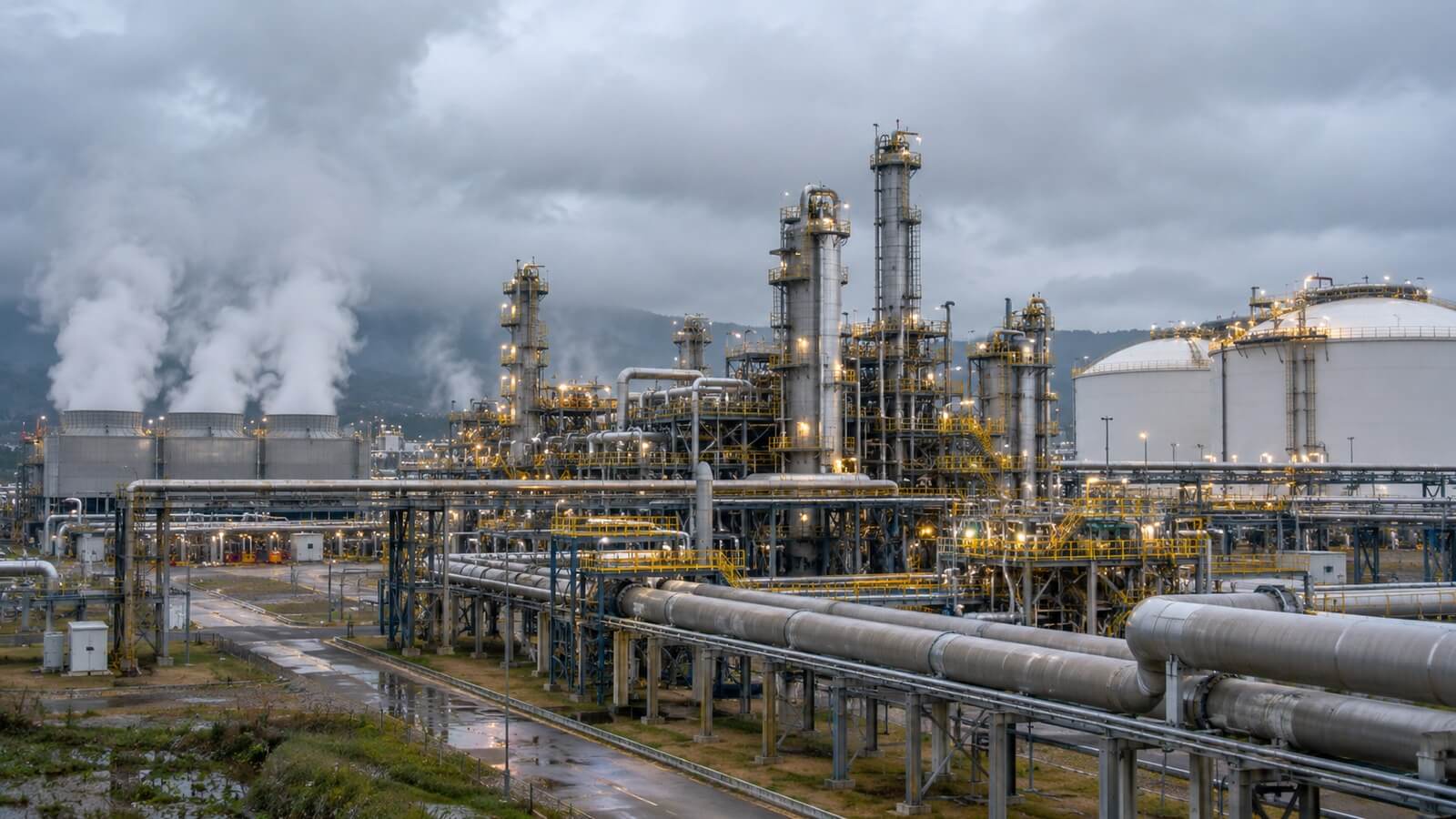
The world's proved natural gas reserves could support approximately 50 years of production at current rates. However, this does not mean the world will run out of natural gas in 50 years.
The estimate compares commercially recoverable natural gas reserves with annual global production. It assumes production remains constant and no additional reserves are added.
In practice, discoveries, extraction technology, natural gas prices, and changes in energy demand continuously affect both reserves and production.
For investors, the more useful question is whether future natural gas supplies can be developed economically and delivered to customers, rather than identifying a specific date when global resources might be exhausted.
How Much Natural Gas Is Left in the World?
Global proved natural gas reserves are estimated at approximately 200–220 trillion cubic meters, depending on the reporting organization and methodology.
The Oil & Gas Journal estimated global proved reserves at approximately 7,743 trillion cubic feet at the end of 2025, equivalent to roughly 219 trillion cubic meters.
Annual global natural gas production is approximately 4.1–4.3 trillion cubic meters.
Comparing these quantities suggests that currently reported proved reserves could support roughly five decades of production if output remained unchanged.
| Indicator | Approximate estimate |
|---|---|
| Global proved natural gas reserves | 200–220 trillion cubic meters |
| Annual global natural gas production | 4.1–4.3 trillion cubic meters |
| Estimated reserve life | Around 50 years |
| Main assumption | Constant production and unchanged reserves |
| Actual depletion date | Unknown |
These figures provide a useful measure of current supply relative to production, but they are not a forecast of when natural gas will disappear.
Reserve estimates also differ because reporting organizations use different methodologies, economic assumptions, and reporting periods.
What Does the 50-Year Natural Gas Estimate Actually Mean?
The estimate is based on the reserves-to-production ratio, commonly called the R/P ratio.
It measures how long currently reported proved reserves would last if annual production continued at the same rate.
Consider a simplified example:
- A country has 1,000 billion cubic meters of proved natural gas reserves.
- It produces 20 billion cubic meters annually.
- Dividing reserves by annual production gives an R/P ratio of 50 years.
This calculation allows comparisons between reserves and production, but it assumes neither quantity changes.
In reality, new discoveries can increase reserves, while higher production can reduce the ratio. Changes in natural gas prices may also affect how much gas qualifies as commercially recoverable.
The R/P ratio is therefore a snapshot of current conditions, not a countdown to depletion.
What Is the Difference Between Natural Gas Reserves and Resources?
Understanding long-term natural gas availability requires distinguishing between proved reserves and broader resource estimates.
Proved Natural Gas Reserves
Proved reserves are quantities of natural gas that geological and engineering evidence indicates can be recovered with reasonable certainty under defined economic and operating conditions.
They represent commercially recoverable gas, not every deposit that exists underground.
Additional resources may qualify as proved reserves when drilling confirms their characteristics and commercial development becomes sufficiently certain.
Technically Recoverable Resources
Technically recoverable resources include natural gas that could potentially be extracted using existing technology, regardless of whether production would be profitable.
This category can be substantially larger than proved reserves.
However, technical recoverability does not guarantee that companies will develop those resources.
Undiscovered Resources
Undiscovered resources are estimated gas accumulations that have not yet been confirmed through drilling.
Geological studies and exploration models help estimate their potential size and location.
Some may eventually become commercial discoveries, while others may never be economically developed.
These distinctions explain why global proved reserves do not represent the total quantity of natural gas that could potentially become available in the future.
Which Countries Have the Largest Remaining Natural Gas Reserves?
Russia, Iran, and Qatar hold the largest reported proved natural gas reserves.
Other major reserve holders include the United States, Turkmenistan, Saudi Arabia, and the United Arab Emirates.
| Country | Approximate proved reserves |
|---|---|
| Russia | 46.8 trillion m³ |
| Iran | 34.0 trillion m³ |
| Qatar | 23.8 trillion m³ |
| United States | 16–18 trillion m³ |
| Turkmenistan | 13.9 trillion m³ |
| Saudi Arabia | 9.5–9.7 trillion m³ |
| United Arab Emirates | 8.2 trillion m³ |
Figures are rounded estimates from international reserve compilations and may vary by reporting year and methodology.
Reserve size does not necessarily indicate how much natural gas a country can produce or export.
Russia and Iran face geopolitical and investment constraints, while Qatar has established extensive LNG export infrastructure.
The United States combines substantial reserves with large-scale production and established transportation networks. Turkmenistan has extensive resources but more limited export route diversification.
For a closer examination of undeveloped resources, see Which Countries Have the Largest Untapped Natural Gas Reserves?.
The commercial value of reserves depends on production costs, infrastructure access, and the ability to reach customers.
Why Do Some Countries Have More Years of Gas Remaining Than Others?
A country's reserve-to-production ratio depends on both its proved reserves and its annual production rate.
Two countries with similar reserves can have very different estimated reserve lives.
A country with substantial reserves but relatively low production may report a high R/P ratio. Another country producing gas rapidly may have a much lower ratio, even with extensive resources.
The United States provides an example.
It produces more natural gas annually than any other country, which reduces its reserve life when calculated using proved reserves alone.
However, producers continue developing new wells, evaluating additional resources, and revising reserve estimates.
A relatively low R/P ratio therefore does not automatically indicate an approaching supply shortage.
Why Has Natural Gas Not Run Out Despite Decades of Production?
Natural gas has been produced commercially for decades, but proved reserves have not declined in a simple, predictable pattern.
That is because proved reserves represent commercially recoverable quantities under current conditions rather than a fixed measurement of all gas underground.
New Natural Gas Discoveries
Exploration can identify previously unknown deposits.
When geological assessments and development plans demonstrate commercial recoverability, additional gas may qualify as proved reserves.
Improved Extraction Technology
Advances in drilling, well completion, and reservoir analysis can make previously inaccessible resources recoverable.
Horizontal drilling and hydraulic fracturing, for example, enabled large-scale production from U.S. shale formations.
Higher Natural Gas Prices
Higher selling prices can make expensive resources commercially viable.
A deposit that is uneconomic at low prices may qualify for development when expected revenue supports production costs.
Reserve estimates can therefore increase without any new geological discovery.
Reassessment of Existing Fields
As companies gather additional drilling and production data, they may revise estimates of recoverable gas.
These revisions can increase or decrease proved reserves.
Consequently, reserve estimates and the number of years implied by the R/P ratio can change substantially over time.
Could the World Run Out of Natural Gas Sooner Than Expected?
Natural gas is a finite fossil fuel, but the timing of future supply constraints cannot be determined from current proved reserves alone.
If global production increases while reported reserves remain unchanged, the R/P ratio declines.
However, geological depletion is not the only possible source of supply constraints.
Some natural gas deposits may become increasingly expensive to develop. Others may remain inaccessible because of infrastructure limitations, geopolitical restrictions, or regulatory conditions.
These factors can create regional shortages or higher production costs long before the world's geological resources are exhausted.
For investors, the availability and cost of commercially accessible gas are generally more relevant than a theoretical global depletion date.
What Happens If Global Natural Gas Demand Keeps Increasing?
Higher natural gas demand can accelerate production and encourage investment in additional resources.
Major sources of demand include electricity generation, industrial activity, residential heating, and petrochemical manufacturing.
International LNG trade also connects producers with customers across different regions.
If demand grows faster than available production capacity, natural gas prices may rise, encouraging investment in new wells, processing facilities, and transportation infrastructure.
Higher prices can make additional resources commercially recoverable, potentially increasing proved reserves.
However, developing new production capacity takes time and capital.
When demand increases faster than infrastructure can expand, markets may experience tighter supply and price volatility.
Conversely, production growth that exceeds demand can weaken prices and reduce incentives for further development.
How Could Renewable Energy Affect Natural Gas Reserves?
The expansion of alternative energy sources can influence how quickly natural gas is consumed.
Wind, solar, hydropower, nuclear generation, battery storage, and improvements in energy efficiency may reduce natural gas demand in some applications.
However, the impact varies by region and industry.
Natural gas remains important for electricity generation, industrial processes, heating, and chemical production. Some power systems also rely on gas-fired generation to provide flexibility when renewable output is limited.
If global gas consumption grows more slowly than expected, current reserves could support production for longer in a simple R/P calculation.
If demand declines substantially, some resources may remain undeveloped because their production would no longer be economically attractive.
Natural gas could therefore lose commercial importance in certain markets before geological resources are exhausted.
Does LNG Production Make Natural Gas Reserves Run Out Faster?
LNG production does not create or destroy additional underground natural gas resources. It converts extracted natural gas into a liquid suitable for long-distance transportation.
Gas is produced, processed, liquefied, transported, and eventually converted back into gaseous form for consumption.
The complete supply chain is explained in LNG Production and Infrastructure: From Natural Gas to Global Supply.
Expanding LNG exports can increase natural gas production in exporting countries by creating access to additional customers.
For example, new U.S. LNG export capacity can increase demand for domestically produced natural gas.
However, LNG exports do not automatically accelerate global reserve depletion.
The overall effect depends on whether LNG increases total natural gas consumption or replaces gas supplied through other routes.
For investors, the important consideration is whether LNG demand supports commercially sustainable production over the operating lives of export facilities.
How Long Could U.S. Natural Gas Resources Last?
The United States has substantial natural gas resources, but estimates of remaining supply vary depending on whether they use proved reserves or broader technically recoverable resources.
The U.S. Energy Information Administration previously estimated approximately 2,973 trillion cubic feet of technically recoverable dry natural gas resources as of January 2021.
At the 2021 production rate of approximately 34.5 trillion cubic feet annually, that quantity represented roughly 86 years of potential production.
However, this was a historical comparison using technically recoverable resources, not a current depletion forecast or a calculation based exclusively on proved reserves.
The amount that can ultimately be produced economically depends on drilling technology, natural gas prices, infrastructure, and future resource assessments.
Major U.S. production regions include the Appalachian Basin, Permian Basin, and Haynesville Shale.
For a closer examination of American natural gas production, see Who Produces the Most Natural Gas in the United States?.
For investors, long-term U.S. gas supply depends on whether producers can develop resources profitably and deliver them to customers at competitive costs.
Could Natural Gas Become More Expensive as Reserves Decline?
Declining reserves do not automatically lead to higher natural gas prices.
Prices depend on current supply and demand, production costs, storage levels, transportation capacity, and market expectations.
If easily accessible deposits become depleted, producers may need to develop more expensive resources, potentially increasing future supply costs.
However, technological improvements, new discoveries, and additional production capacity can offset some of these pressures.
At the same time, weaker demand or greater competition from other energy sources may reduce prices.
Natural gas prices can therefore decline even when remaining resources are finite.
Investors should avoid assuming that long-term resource depletion guarantees higher commodity prices or stronger energy company earnings.
What Does Natural Gas Depletion Mean for Energy Investors?
Long-term natural gas availability affects different parts of the energy industry in different ways.
Natural gas producers need commercially recoverable resources and sufficient cash flow to support continued drilling.
Pipeline operators depend on production and demand volumes that support transportation infrastructure.
LNG developers require reliable natural gas supplies to operate liquefaction facilities over many years.
Utilities and industrial customers depend on affordable, dependable natural gas deliveries.
These businesses do not face identical risks.
A producer may benefit from higher gas prices while facing rising development costs. A pipeline operator may receive contracted fees but remain exposed to long-term volume changes.
An LNG operator may benefit from long-term customer agreements while still facing construction, operating, and financing risks.
Investors should evaluate reserve replacement, production costs, capital spending, infrastructure access, debt levels, and expected market demand.
The central question is whether each business can generate sustainable returns under changing supply conditions.
Will the World Actually Run Out of Natural Gas in 50 Years?
No reliable forecast establishes that global natural gas resources will be exhausted in exactly 50 years.
The estimate reflects the relationship between currently reported proved reserves and annual production.
Both quantities can change as discoveries, extraction technology, economic conditions, and energy demand evolve.
Some regions may experience supply constraints while others continue producing substantial quantities of natural gas.
For investors, the most meaningful considerations are the accessibility, development costs, and commercial value of future supply.
The world has substantial natural gas resources, but the ability to develop and deliver them economically matters more than any single depletion countdown.
Disclaimer: This article is for informational and educational purposes only and does not constitute financial or investment advice. Natural gas investments involve commodity-price volatility, operational risks, regulatory uncertainty, and potential financial losses.