
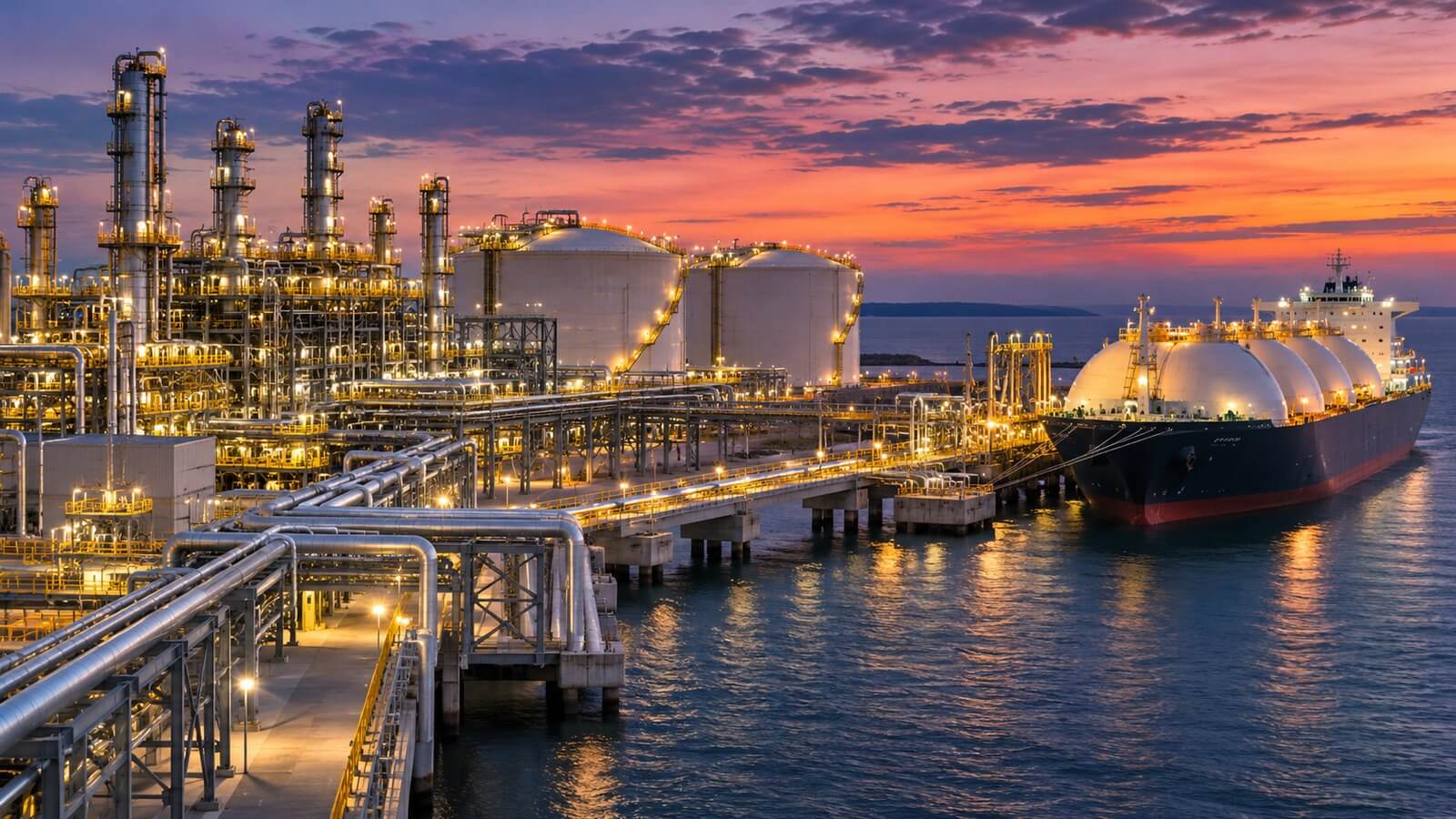
LNG infrastructure is the network of natural gas production fields, pipelines, processing plants, liquefaction facilities, storage tanks, export terminals, and transportation systems that makes global liquefied natural gas (LNG) trade possible.
Natural gas is extracted, treated to remove impurities, and cooled to approximately -260°F (-162°C). At this temperature, it becomes a liquid occupying roughly 1/600 of its original gaseous volume, making large-scale ocean transportation practical.
For investors, understanding LNG infrastructure means identifying how each part of the supply chain generates revenue, what determines project costs, and which operational risks can affect profitability.
What Is LNG Infrastructure?
LNG infrastructure includes the interconnected facilities and equipment needed to produce, process, liquefy, store, transport, and deliver natural gas to customers.
Its main components are:
- Natural gas wells and production fields.
- Gathering pipelines connecting wells to processing facilities.
- Gas processing plants that remove water and impurities.
- Transmission pipelines supplying LNG facilities.
- Liquefaction plants that convert natural gas into liquid form.
- Cryogenic storage tanks designed for extremely low temperatures.
- Export terminals and marine loading facilities.
- Specialized LNG carriers and smaller transportation systems.
- Import terminals that receive LNG and convert it back into gas.
These assets operate as a connected supply chain. A liquefaction terminal, for example, cannot operate at full capacity if pipeline constraints prevent sufficient natural gas from reaching the facility.
Investors therefore need to consider the entire system rather than evaluating export capacity in isolation.
How Does Natural Gas Become LNG?
LNG production involves five main stages, from extracting natural gas to preparing the finished liquid for shipment.
1. Natural Gas Extraction
Natural gas is extracted from underground geological formations through production wells. Some fields primarily produce gas, while others produce natural gas alongside crude oil.
Major U.S. production regions include the Appalachian Basin, Permian Basin, and Haynesville Shale. Their production costs, resource characteristics, and access to pipelines differ considerably.
These differences matter because LNG export facilities need reliable natural gas supplies at competitive prices throughout their operating lives.
The companies extracting natural gas are not necessarily the companies operating LNG terminals. For a closer look at the upstream industry, see Who Produces the Most Natural Gas in the United States?.
2. Natural Gas Gathering and Processing
Gas arriving from production wells may contain water, carbon dioxide, hydrogen sulfide, and other substances that must be removed before liquefaction.
Gathering pipelines transport the gas to processing facilities, where operators remove impurities and may recover valuable natural gas liquids such as propane and butane.
This preparation is essential because water and certain contaminants can freeze or interfere with equipment at LNG operating temperatures.
3. Pipeline Transportation
Processed natural gas travels through transmission pipelines to liquefaction facilities, many of which are located near coastal shipping routes.
Pipeline capacity and access influence where terminals can be developed and how efficiently they operate.
For example, an export facility may have available liquefaction capacity but be unable to increase production without additional pipeline deliveries.
Pipeline constraints can therefore increase costs, delay expansions, or limit terminal utilization.
4. Liquefaction
Liquefaction converts natural gas into LNG by cooling it to approximately -260°F (-162°C) at near-atmospheric pressure.
The process uses refrigeration systems, compressors, heat exchangers, and specialized industrial equipment.
Large LNG terminals typically operate multiple liquefaction units called trains. Each train processes a defined quantity of natural gas, allowing operators to increase production capacity through additional units.
Liquefaction requires substantial energy and capital investment. Equipment efficiency, maintenance requirements, and operating reliability directly influence production costs.
5. LNG Storage and Loading
After liquefaction, LNG enters insulated cryogenic storage tanks designed to maintain extremely low temperatures and manage vapor generated by heat entering the system.
Marine loading equipment then transfers LNG to specialized carriers equipped with insulated cargo tanks.
Storage capacity helps terminals manage differences between production schedules and ship arrivals. Insufficient storage or loading capacity can restrict operations even when liquefaction equipment is functioning normally.
Why Is LNG Infrastructure Important to Global Energy Supply?
LNG infrastructure allows natural gas to reach markets that cannot be connected economically through pipelines, particularly when producers and consumers are separated by oceans.
This creates three important advantages:
- Greater market access: Producers can sell natural gas to customers beyond their regional pipeline networks.
- Supply diversification: Importing countries can purchase gas from multiple exporting regions instead of relying exclusively on domestic production or pipeline suppliers.
- Commercial opportunities: Infrastructure operators can earn revenue from transportation, liquefaction, storage, and delivery services.
For example, U.S. Gulf Coast LNG terminals connect domestic natural gas production with overseas buyers in Europe and Asia.
LNG also increases competition between natural gas suppliers, although shipping expenses, contract terms, and infrastructure limitations mean regional gas prices can remain substantially different.
The availability of LNG infrastructure consequently affects energy security, international trade, and the commercial value of natural gas resources.
How Do Natural Gas Reserves Support LNG Production?
LNG facilities are long-lived assets that depend on access to commercially available natural gas.
Natural gas reserves represent quantities considered commercially recoverable under defined technical and economic conditions. However, substantial underground resources do not automatically support LNG exports.
Countries also need producing wells, gathering systems, pipelines, financing, regulatory approvals, and access to international customers.
Some resource-rich countries face significant challenges developing these facilities. The distinction between underground resources and commercially accessible supply is explored in Which Countries Have the Largest Untapped Natural Gas Reserves?.
Reserve estimates can also change as technology, discoveries, production costs, and commodity prices evolve.
For broader context on long-term resource availability, see How Long Will Global Natural Gas Reserves Last?.
For an LNG project, the essential question is whether enough natural gas can reach the facility at a competitive cost throughout its expected operating life.
What Infrastructure Is Needed at an LNG Export Terminal?
An LNG export terminal combines several industrial systems. Liquefaction equipment is only one part of the facility.
| Infrastructure component | Main purpose |
|---|---|
| Gas receiving facilities | Receive natural gas from transmission pipelines |
| Pretreatment equipment | Remove substances that interfere with liquefaction |
| Liquefaction trains | Cool natural gas into liquid form |
| Cryogenic storage tanks | Store LNG before shipment |
| Marine loading systems | Transfer LNG to specialized vessels |
| Power and utility systems | Provide energy and essential operating services |
| Safety and monitoring systems | Detect hazards and support safe operations |
Some projects are constructed as entirely new terminals, while others expand existing facilities by adding liquefaction trains.
For example, Cheniere Energy's Sabine Pass facility in Louisiana has developed additional liquefaction capacity through multiple trains, illustrating how large terminals can expand in stages.
Expanding an existing terminal may reduce certain development costs because pipelines, storage tanks, or marine facilities are already available. However, additional capacity can still require major investments in utilities, feed-gas connections, and supporting infrastructure.
Investors should distinguish between new terminal developments and expansions when assessing capital requirements, construction timelines, and execution risks.
How Does LNG Infrastructure Generate Revenue?
Companies operating across the LNG supply chain earn revenue through different business models.
Natural gas producers sell the gas they extract. Their earnings are generally sensitive to production costs, sales volumes, and natural gas prices.
Pipeline operators can receive transportation fees for moving gas between production areas and processing or export facilities. Long-term capacity agreements may provide relatively predictable revenue.
Liquefaction operators may earn contracted fees for making processing capacity available or receive payments linked to LNG deliveries.
LNG marketers and integrated operators may purchase natural gas, arrange liquefaction and shipping, and sell LNG internationally. Their profitability can depend more heavily on commodity prices, transportation expenses, and contractual arrangements.
Cheniere Energy is an example of a major U.S. LNG exporter with substantial long-term contractual commitments supporting its operations.
However, contracted revenue is not risk-free. Counterparty defaults, operational disruptions, construction delays, and financing costs can still affect financial results.
Investors should examine each company's contracts, operating responsibilities, and exposure to commodity prices rather than assuming that higher LNG demand produces the same financial benefits for every participant.
What Are the Main Costs of LNG Production and Infrastructure?
LNG projects require substantial upfront capital and ongoing operating expenditures.
Major cost categories include:
- Natural gas production and gathering infrastructure.
- Pipeline construction and transportation capacity.
- Liquefaction equipment and refrigeration systems.
- Cryogenic storage tanks and marine loading facilities.
- Energy consumed during gas processing and liquefaction.
- Equipment maintenance and terminal operations.
- Shipping and delivery to customers.
Liquefaction is particularly energy intensive. Depending on the technology and facility configuration, part of the incoming natural gas may be consumed to power liquefaction-related operations.
This makes energy efficiency an important factor in operating economics.
Construction costs also vary by location, labor availability, equipment requirements, and regulatory conditions.
Existing terminals may benefit from shared infrastructure when adding capacity, while entirely new projects must develop most supporting systems from the beginning.
Investors should distinguish the cost of producing and delivering LNG from the market price received for the finished product.
For a more detailed breakdown, read How Much Does LNG Cost? Understanding Production and Supply Costs.
What Are the Main Disadvantages of LNG Infrastructure?
LNG infrastructure expands access to international markets but introduces costs and operational challenges beyond those associated with conventional pipeline transportation.
The main disadvantages include high construction costs, energy-intensive liquefaction, complex logistics, and lengthy development schedules.
Projects can face permitting delays, financing difficulties, equipment shortages, and changes in expected demand before becoming operational.
Environmental impacts are another consideration. Methane emissions during production, processing, and transportation can affect the overall greenhouse gas footprint of LNG supply.
Project economics can also weaken when international LNG prices decline relative to natural gas procurement, liquefaction, and shipping costs, particularly for businesses exposed to commodity price differences.
These issues are examined in What Are the Main Disadvantages of LNG Production?.
For investors, the important distinction is between a project's potential production capacity and its ability to generate attractive returns after construction, operating, financing, and environmental compliance costs.
Can LNG Be Transported Without Large Ships?
Yes. Although large LNG carriers dominate intercontinental transportation, smaller quantities of LNG can move by road or through other specialized distribution systems.
Cryogenic tanker trucks can deliver LNG to industrial facilities, vehicle fueling stations, and customers without pipeline connections.
These arrangements are sometimes called virtual pipelines because they provide gas deliveries without constructing a permanent pipeline to the customer.
However, trucking costs depend heavily on delivery distance, shipment volume, fuel expenses, and equipment utilization.
Small-scale transportation can be practical for remote or specialized customers but generally cannot match the scale of large LNG export shipping operations.
For a closer examination, see Can LNG Be Transported by Truck? Infrastructure and Economics.
How Is LNG Stored and Handled Safely?
LNG requires specialized storage and handling because of its extremely low temperature and the hazards associated with natural gas vapor.
LNG itself is not flammable as a liquid. However, released LNG can vaporize, and the resulting natural gas may ignite when mixed with air within its flammable range and exposed to an ignition source.
Direct contact with LNG can also cause severe cold injuries, while cryogenic temperatures can damage unsuitable materials.
Facilities manage these risks through insulated tanks, vapor management equipment, gas detection systems, emergency shutdown systems, and operating procedures.
Safety performance matters financially because serious incidents can interrupt production, damage assets, create liabilities, and affect regulatory approvals.
For additional details, see LNG Safety Risks: What Investors Should Know About Infrastructure.
What Should Investors Evaluate in LNG Infrastructure Companies?
Investors should evaluate LNG infrastructure companies according to their specific business models, project maturity, financial obligations, and operating performance.
Project Development and Construction Risk
Large LNG projects can require years of planning and construction.
Important milestones include regulatory approvals, financing commitments, engineering and construction agreements, and long-term customer contracts.
Investors should distinguish between proposed projects, projects under construction, and facilities already generating revenue.
Contract Quality
Long-term agreements can improve revenue visibility and support project financing.
However, investors should examine customer creditworthiness, pricing formulas, fixed payment obligations, contract duration, and termination provisions.
A long contract is valuable only when its terms and counterparties provide dependable economic benefits.
Feed-Gas Availability
Liquefaction facilities need reliable natural gas deliveries at competitive costs.
Pipeline capacity, regional production trends, and feed-gas pricing can influence terminal utilization and profitability.
Operating Efficiency
Equipment reliability, energy consumption, maintenance schedules, and actual production volumes help determine operating performance.
Investors can compare a facility's reported LNG production with its available capacity while accounting for maintenance and operating conditions.
Capital Requirements and Debt
Construction spending, borrowing costs, refinancing obligations, and maintenance expenditures can affect cash flow available to shareholders.
Investors should examine whether expected operating cash flows can support debt obligations and future investment requirements.
Long-Term Market Demand
LNG demand depends on electricity generation, industrial activity, energy security policies, competing fuels, and economic growth.
However, growing demand does not guarantee higher profits if new liquefaction capacity expands supply faster than consumption.
A useful investment assessment combines industry demand expectations with company-specific contracts, financial performance, and operating risks.
Why LNG Infrastructure Matters Beyond Export Volumes
LNG production and infrastructure make international natural gas trade possible by connecting production fields with customers across different regions.
Each stage, from extraction and processing to liquefaction, storage, and transportation, contributes to the final cost and reliability of supply.
For investors, export volume alone does not explain a company's financial prospects. Natural gas producers, pipeline operators, liquefaction companies, and LNG marketers face different costs, revenue structures, and risks.
Understanding those differences helps investors evaluate LNG infrastructure projects based on their actual economics rather than relying exclusively on industry growth forecasts or announced production capacity.
Disclaimer: This article is for informational and educational purposes only and does not constitute financial or investment advice. Energy investments involve market, operational, regulatory, and financial risks.