
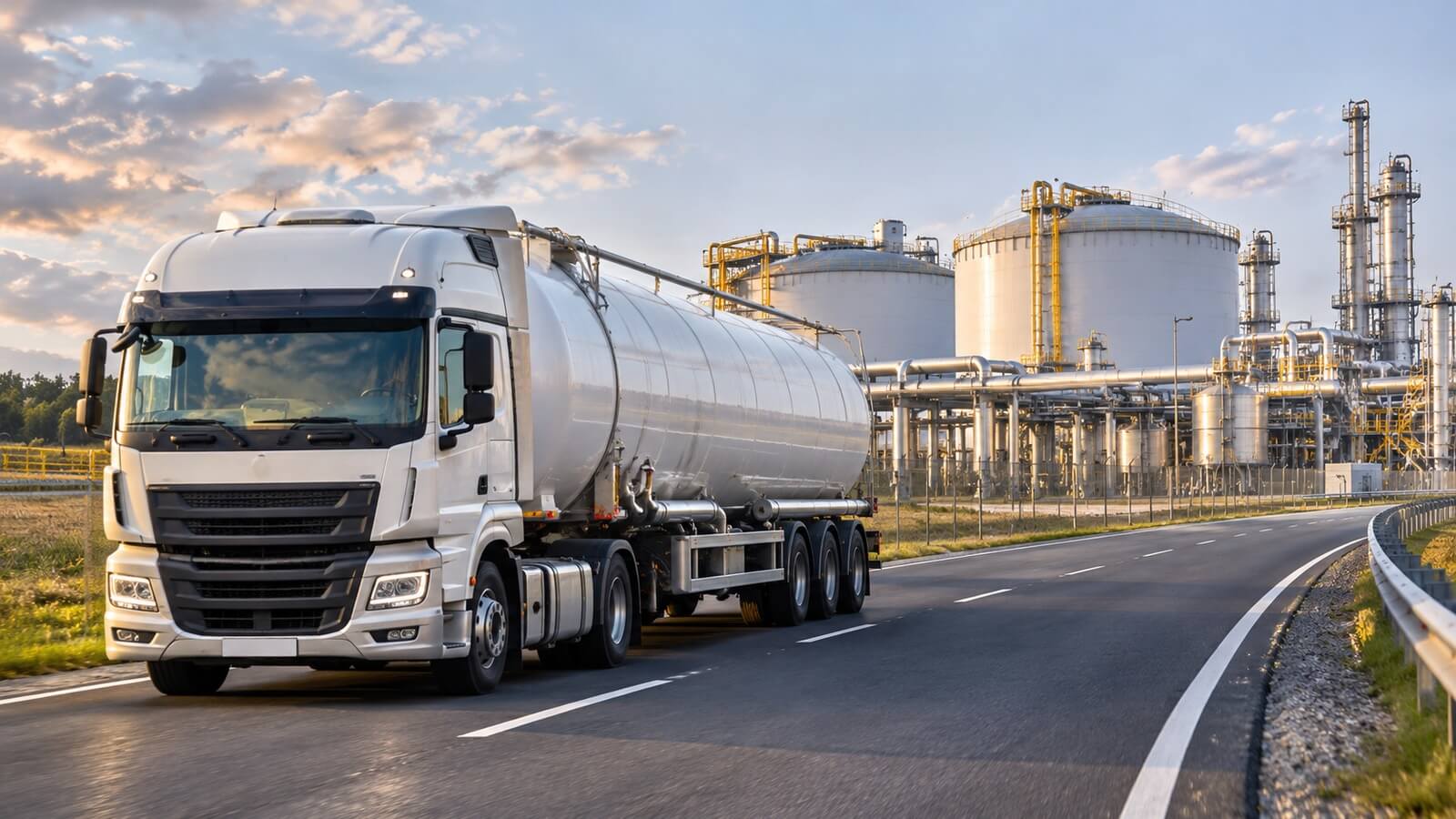
Yes, liquefied natural gas (LNG) can be transported by truck using specialized cryogenic tank trailers. These vehicles carry LNG at approximately -260°F (-162°C), allowing natural gas to reach industrial facilities, remote communities, power generation sites, and refueling stations without pipeline connections.
LNG trucking is particularly useful when building a dedicated natural gas pipeline would be too expensive or impractical for the volume required.
However, road transportation involves specialized equipment, safety requirements, and recurring logistics costs that generally increase with distance.
For investors, LNG trucking represents a specialized segment of natural gas infrastructure where commercial success depends on customer demand, delivery efficiency, and the cost of competing energy supplies.
How Is LNG Transported by Truck?
LNG is transported in insulated tank trailers designed to carry cryogenic liquids.
Cooling natural gas into liquid form reduces its volume by approximately 600 times, making transportation and storage more practical than moving equivalent quantities in an uncompressed gaseous state.
A typical delivery involves five stages:
- Natural gas is liquefied at a production or distribution facility.
- LNG is loaded into a specialized cryogenic tank trailer.
- The truck transports the LNG to the customer.
- LNG is unloaded into an insulated storage tank or receiving system.
- The customer uses the LNG directly or converts it back into natural gas.
This process allows customers to receive substantial quantities of natural gas without constructing a permanent pipeline connection.
However, transportation equipment must safely manage cryogenic temperatures, heat transfer, and changes in tank pressure.
The broader infrastructure chain is explained in LNG Production and Infrastructure: From Natural Gas to Global Supply.
What Kind of Trucks Are Used to Transport LNG?
LNG is generally transported using heavy-duty trucks pulling specialized cryogenic tank trailers.
Unlike conventional fuel tankers, these trailers are engineered to limit heat transfer and manage extremely cold liquids.
Cryogenic Tank Construction
LNG tank trailers typically use double-wall construction.
An inner vessel contains the LNG, while an outer shell provides protection and supports the insulation system.
Vacuum insulation or other high-performance materials reduce heat entering the tank.
This helps limit evaporation during transportation, although insulation cannot eliminate heat transfer completely.
Pressure Management
As LNG absorbs heat, some of the liquid can vaporize into natural gas. This process is called boil-off.
Tank systems must manage the resulting pressure changes through suitable equipment and operating procedures.
Pressure-relief devices provide protection against excessive internal pressure, while operators must comply with applicable transportation and safety requirements.
Loading and Unloading Equipment
LNG trucks require specialized transfer connections, valves, hoses, and monitoring equipment.
Loading and unloading procedures must account for cryogenic temperatures, pressure management, and potential gas releases.
Personnel require appropriate training and protective equipment.
These requirements make LNG trucking more technically demanding than transporting many conventional liquid fuels.
How Much LNG Can a Truck Carry?
LNG truck capacity depends on tank design, vehicle weight limits, LNG density, and transportation regulations.
A large LNG road tanker may carry approximately 10,000 to 13,000 U.S. gallons, although actual payloads vary by vehicle and jurisdiction.
For illustration, assume a truck carries 12,000 gallons of LNG.
Using an approximate energy content of 0.075 MMBtu per physical gallon:
12,000 gallons × 0.075 MMBtu per gallon = 900 MMBtu.
That represents approximately 900 million British thermal units of energy.
This is an illustrative calculation rather than a guaranteed legal payload. Actual delivered energy depends on LNG composition, density, loading conditions, and the quantity transferred.
For investors, payload capacity matters because it determines how many deliveries are required to meet customer demand.
Larger payloads can reduce transportation costs per unit of energy, provided the vehicle remains within applicable weight and road restrictions.
Why Is LNG Transported by Truck Instead of Pipeline?
Natural gas pipelines are generally efficient for transporting large, continuous volumes.
However, constructing a pipeline requires significant capital investment, regulatory approvals, and suitable rights of way.
For smaller or remote customers, a dedicated pipeline may not be economically justified.
LNG trucking offers an alternative by delivering natural gas periodically without a permanent connection to the transmission network.
This arrangement is often described as a virtual pipeline.
What Is an LNG Virtual Pipeline?
An LNG virtual pipeline uses trucks or other transportation equipment to deliver natural gas in liquid form instead of moving it continuously through a physical pipeline.
The LNG is delivered to a receiving facility, stored, and often regasified for local consumption.
Virtual pipelines can serve industrial plants, remote communities, mines, temporary projects, and customers awaiting permanent pipeline infrastructure.
However, their delivery capacity is limited by fleet size, storage, and road logistics.
As demand increases, additional truck movements may become expensive or operationally difficult.
At sufficiently high and stable volumes, a conventional pipeline may provide lower long-term transportation costs.
Where Is LNG Trucking Most Commonly Used?
LNG trucking supports several commercial applications where direct pipeline access is unavailable or uneconomic.
Industrial Facilities
Factories and industrial plants may use natural gas for boilers, heating, manufacturing processes, and other energy requirements.
Delivered LNG can provide an alternative when pipeline connections are unavailable.
Customers generally require storage and, when using gaseous natural gas, regasification equipment.
The economics depend on consumption volume, delivery distance, and competing fuel costs.
Remote Power Generation
Remote communities and industrial operations may rely on diesel or other transported fuels for electricity generation.
LNG can sometimes provide a competitive alternative.
However, potential savings depend on delivered LNG prices, generator efficiency, storage investment, and operating conditions.
LNG Vehicle Refueling Stations
Some heavy-duty commercial vehicles use LNG as transportation fuel.
Cryogenic tankers can supply specialized refueling stations serving these vehicles.
Commercial viability depends on vehicle adoption, station utilization, and competition from diesel, compressed natural gas, and other technologies.
Mining and Remote Industrial Operations
Mining sites often operate far from existing natural gas pipelines.
LNG trucking can supply fuel for power generation and industrial equipment where suitable receiving infrastructure is available.
However, difficult roads, long delivery distances, and limited local services can increase logistics costs.
Temporary and Backup Energy Supply
LNG trucking can support temporary facilities or provide additional fuel during infrastructure maintenance and supply interruptions.
Its flexibility is valuable when permanent infrastructure is unavailable or demand is temporary.
How Much Does It Cost to Transport LNG by Truck?
LNG trucking costs depend on delivery distance, payload, driver expenses, fuel consumption, equipment investment, and delivery frequency.
There is no universal transportation cost per gallon or per MMBtu.
| Cost component | Economic impact |
|---|---|
| Truck and cryogenic trailer | Capital investment or leasing expense |
| Driver and labor | Personnel costs for transportation and delivery |
| Fuel | Cost of operating the delivery vehicle |
| Maintenance | Servicing trucks and cryogenic equipment |
| Insurance and compliance | Coverage, inspections, and regulatory obligations |
| Loading and unloading | Equipment use and terminal handling |
| Delivery distance | Travel time and operating expenses |
| Return journey | Potential empty mileage after unloading |
| Customer storage | Receiving tanks and related infrastructure |
Distance is a major cost driver.
Longer routes require more fuel and driver time while reducing the number of deliveries a vehicle can complete.
As a result, transportation expenses per unit of LNG can increase substantially with distance.
Example of LNG Trucking Economics
Consider a hypothetical delivery with the following assumptions:
| Variable | Illustrative value |
|---|---|
| LNG delivered | 12,000 gallons |
| Energy delivered | 900 MMBtu |
| Round-trip distance | 300 miles |
| Total transportation cost | $1,800 |
| Transportation cost per gallon | $0.15 |
| Transportation cost per MMBtu | $2.00 |
These figures are hypothetical and demonstrate the calculation only. They are not current market rates.
In this example, transportation adds $2.00 per MMBtu to the LNG cost before additional customer-side expenses.
A longer route could increase the total expense, while smaller deliveries could raise unit costs because some operating expenses remain relatively fixed.
For investors, route efficiency, payload utilization, and consistent customer demand are important profitability drivers.
Is LNG Trucking Cheaper Than Building a Pipeline?
The answer depends on gas demand, transportation distance, and how long the customer expects to require the supply.
Trucking generally involves lower upfront infrastructure investment than constructing a new long-distance pipeline, but each delivery creates recurring logistics costs.
A pipeline requires substantial initial capital but can transport large volumes efficiently once operational.
| Factor | LNG trucking | Natural gas pipeline |
|---|---|---|
| Initial infrastructure investment | Often lower | Often higher |
| Recurring transportation expense | Depends on each delivery | Depends on system operations and tariffs |
| Flexibility | High | Limited to fixed route |
| Suitable demand | Small, remote, variable, or temporary | Large, stable, long-term |
| Expansion | Additional trucks and storage | Additional pipeline capacity |
| Main constraint | Road logistics and delivery capacity | Construction, permits, and capacity |
The comparison is not universal.
A short pipeline connection may cost less than establishing an LNG storage and regasification system.
Conversely, a remote customer with modest demand may find trucking more practical than financing a permanent pipeline.
The correct comparison considers total lifecycle costs, not initial investment alone.
How Far Can LNG Be Transported by Truck?
LNG can travel substantial road distances, but there is no single maximum distance applicable to every shipment.
The practical range depends on equipment design, road conditions, regulations, delivery economics, and cryogenic pressure management.
Modern insulated tanks limit heat transfer, but longer journeys can increase operational complexity.
Drivers must also comply with applicable hours-of-service rules, hazardous materials requirements, and vehicle restrictions.
From a commercial perspective, transportation costs generally increase with distance.
For investors, the relevant question is how far LNG can be delivered while remaining competitive with pipelines and other energy supply options.
What Infrastructure Is Needed for LNG Truck Deliveries?
An LNG trucking operation requires a coordinated distribution network, not just trucks and trailers.
LNG Supply Facility
Operators need access to LNG produced at a liquefaction plant or obtained through a distribution terminal.
Its location directly influences delivery distance and transportation costs.
Truck Loading Terminal
Loading facilities require cryogenic transfer equipment, safety systems, and suitable operating procedures.
Loading capacity affects how efficiently trucks can be dispatched.
Road Transportation Fleet
Operators need specialized vehicles, trained drivers, maintenance services, and compliance systems.
Fleet availability and reliability influence delivery performance.
Customer Storage Tanks
Customers typically require insulated LNG storage tanks sized according to consumption, delivery frequency, and supply security needs.
Regasification Equipment
Customers requiring gaseous natural gas need vaporizers and related equipment to convert LNG back into gas.
The resulting gas can supply boilers, turbines, industrial processes, or local distribution networks.
Monitoring and Safety Systems
Facilities require pressure management, gas detection, instrumentation, and emergency procedures.
These systems increase costs but are essential for reliable operations.
Is LNG Truck Transportation Safe?
LNG trucking is a regulated industrial activity involving extremely cold liquids and potentially flammable natural gas vapor.
Unlike compressed natural gas, LNG is transported primarily as a cryogenic liquid rather than a high-pressure gas.
However, direct contact with LNG can cause severe cold injuries, and spills can damage materials not designed for cryogenic exposure.
When LNG warms and vaporizes, the resulting natural gas can form a flammable mixture with air under certain conditions.
Specialized equipment, operating procedures, and personnel training are therefore essential.
What Safety Systems Do LNG Trucks Use?
Typical safeguards include:
- Insulated cryogenic tanks.
- Pressure-relief devices.
- Suitable valves and transfer connections.
- Emergency shutdown procedures.
- Vehicle inspections and maintenance.
- Driver training.
- Appropriate loading and unloading practices.
In the United States, LNG road transportation is subject to applicable hazardous materials transportation requirements, including relevant provisions of Title 49 of the Code of Federal Regulations.
Specific requirements depend on the equipment and transportation activity.
For a broader examination of LNG infrastructure hazards and their financial implications, see LNG Safety Risks: What Investors Should Know About Infrastructure.
For investors, safety performance matters because serious incidents can cause operational interruptions, financial liabilities, and reputational damage.
Does LNG Evaporate During Truck Transportation?
Yes. LNG gradually absorbs heat from its surroundings, even inside insulated tanks.
As heat enters the liquid, some LNG may vaporize into natural gas, creating boil-off gas.
The rate depends on insulation performance, tank design, pressure conditions, and transportation duration.
Cryogenic systems are designed to limit heat transfer and manage pressure safely.
Depending on the equipment and operating arrangement, vapor may be managed through pressure control, recovery, or other permitted systems.
Boil-off should not be assumed to be routinely released into the atmosphere.
For investors, effective boil-off management can reduce product losses, improve efficiency, and support regulatory compliance.
What Is the Difference Between LNG and CNG Truck Transportation?
Both LNG and compressed natural gas (CNG) can transport natural gas without a conventional pipeline connection, but they use different storage methods.
LNG is cooled into liquid form and stored in insulated cryogenic tanks.
CNG remains gaseous and is stored under high pressure.
| Feature | LNG | CNG |
|---|---|---|
| Physical state | Liquid | Gas |
| Storage method | Cryogenic cooling | High-pressure compression |
| Typical temperature | Approximately -162°C | Usually near ambient temperature |
| Main equipment | Insulated cryogenic tanks | High-pressure cylinders |
| Energy density by volume | Generally higher | Generally lower |
| Typical applications | Larger deliveries and certain heavy-duty uses | Smaller distribution systems and vehicle fueling |
LNG's higher volumetric energy density can make it attractive for transporting larger quantities of gas.
However, LNG requires liquefaction and cryogenic infrastructure.
CNG avoids liquefaction but requires high-pressure equipment and generally carries less energy per unit of storage volume.
The better option depends on customer demand, distance, infrastructure, and the intended application.
How Do LNG Prices Affect Trucking Economics?
LNG trucking profitability depends partly on the price of the fuel being delivered.
Competitive LNG procurement costs can improve the economics of road distribution, but transportation expenses may offset that advantage.
For example, a customer purchasing relatively inexpensive LNG from a distant terminal may still face high delivered costs because of long routes and frequent shipments.
Conversely, customers near reliable LNG distribution facilities may benefit from lower logistics expenses.
Investors should distinguish between the LNG commodity price and the complete delivered cost.
A detailed explanation is available in How Much Does LNG Cost? Understanding Production and Supply Costs.
For LNG trucking businesses, sustainable margins depend on efficient procurement, transportation, and reliable customer service.
Can LNG Trucking Support Renewable Energy and Remote Power Systems?
LNG can supply fuel to remote energy systems without direct pipeline access.
For example, natural gas engines or turbines may generate electricity alongside solar or wind installations.
Gas-fired equipment can provide additional generation when renewable output is insufficient.
However, LNG remains a fossil fuel.
Its environmental performance depends on extraction emissions, methane leakage, transportation, and the efficiency of the equipment consuming the gas.
LNG trucking should therefore be evaluated as one possible energy supply option rather than automatically classified as a low-carbon solution.
What Are the Main Disadvantages of LNG Trucking?
LNG trucking provides flexibility but also introduces several limitations.
- High costs over long distances: Fuel, labor, and equipment expenses increase with route length.
- Limited delivery capacity: Each vehicle can transport only a finite quantity of LNG.
- Specialized equipment: Cryogenic tanks and transfer systems require dedicated investment and maintenance.
- Customer infrastructure: Storage and regasification facilities may be expensive.
- Road dependence: Weather, traffic, restrictions, and vehicle availability can disrupt deliveries.
- Safety requirements: Operators must maintain appropriate training, equipment, and compliance procedures.
- Emissions: Truck operation and methane management affect the environmental footprint.
These limitations mean LNG trucking is not a universal replacement for pipelines.
Its strongest applications are generally those where flexibility and access justify additional logistics costs.
Is LNG Trucking a Good Business Opportunity for Investors?
LNG trucking can create opportunities for companies involved in fuel distribution, cryogenic equipment, industrial gas supply, and infrastructure services.
However, its economics differ from large-scale LNG exports.
Local customer demand, route density, fleet utilization, and equipment costs are particularly important.
A company serving multiple customers near a supply terminal may use its fleet more efficiently than one operating long, irregular delivery routes.
Long-term customer agreements can support more predictable revenue, although they do not eliminate operating risks.
Investors should examine:
- Customer demand and contract duration.
- Average delivery distance.
- Fleet utilization and payload efficiency.
- Capital spending on trucks and storage.
- LNG procurement costs.
- Safety and regulatory compliance.
- Competition from pipeline gas, CNG, diesel, and alternative energy sources.
The most attractive operator is not necessarily the one transporting the greatest volume.
It is the business capable of generating sustainable margins while maintaining reliable service.
When Does LNG Truck Transportation Make Economic Sense?
LNG trucking is most attractive when customers require natural gas but lack an economical pipeline connection.
It can supply industrial facilities, remote power systems, refueling stations, and temporary operations without extensive permanent pipeline construction.
However, the economics weaken when transportation distances become excessive or demand grows enough to justify dedicated pipeline infrastructure.
For investors, the key conclusion is that LNG trucking is a specialized infrastructure solution whose commercial value depends on delivery distance, customer demand, fleet utilization, and the total cost of supplying natural gas.
It can remain an important distribution option for customers whose energy needs cannot be served efficiently through conventional pipelines.
Disclaimer: This article is for informational and educational purposes only and does not constitute financial or investment advice. LNG transportation and infrastructure investments involve operational risks, commodity-price volatility, regulatory uncertainty, and potential financial losses.