
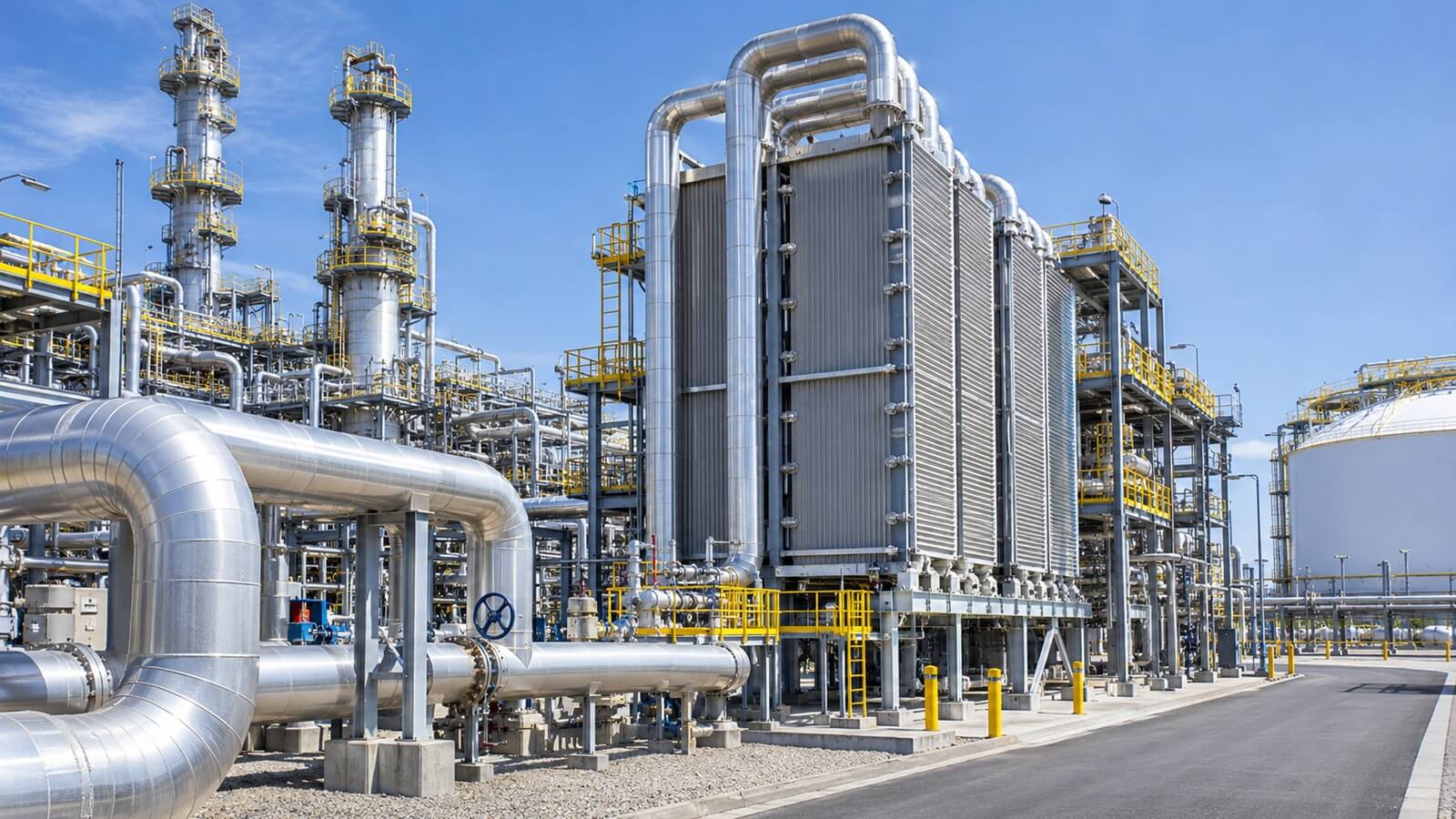
One physical gallon of liquefied natural gas (LNG) does not have a universal price. Its cost depends on whether it is purchased as transportation fuel, sold at an export terminal, or delivered to an international customer.
For a U.S. retail example, the Department of Energy's July 2026 alternative fuel survey reported an average LNG price of $4.78 per diesel gallon equivalent (DGE). Using the survey's energy-conversion basis, that corresponds to approximately $2.86 per physical gallon of LNG.
However, international LNG is generally priced in dollars per million British thermal units ($/MMBtu), not per gallon.
The total cost of LNG depends on natural gas procurement, processing, liquefaction, transportation, and any additional services required before delivery.
For investors, separating these expenses is essential when evaluating LNG producers, export terminals, and infrastructure businesses.
How Much Does One Gallon of LNG Cost?
LNG prices vary according to the market, delivery location, and quantity purchased.
Retail LNG used as vehicle fuel is priced differently from LNG sold through international wholesale contracts.
The U.S. Department of Energy's July 2026 alternative fuel survey reported the following average retail prices:
| Fuel | Average U.S. retail price |
|---|---|
| LNG | $4.78 per diesel gallon equivalent |
| Diesel | $4.86 per physical gallon |
| LNG, converted to physical gallons | Approximately $2.86 per gallon |
The physical-gallon conversion is approximate and depends on the energy-content assumptions used.
A diesel gallon equivalent represents the quantity of an alternative fuel containing approximately the same energy as one gallon of diesel.
Because a physical gallon of LNG contains less energy than a gallon of diesel, the two measurements are not interchangeable.
A lower price per physical gallon therefore does not necessarily mean lower fuel costs for the same amount of energy.
These retail prices should not be confused with wholesale LNG export prices, which reflect different markets and contractual arrangements.
Why Is LNG Usually Priced in MMBtu Instead of Gallons?
International LNG buyers generally purchase energy rather than a fixed physical volume.
A million British thermal units (MMBtu) is a standard energy measurement used in natural gas markets.
Pricing LNG in $/MMBtu allows comparisons across natural gas production, liquefaction, shipping, and international trading.
One physical gallon of LNG contains approximately 0.075 MMBtu, although actual energy content varies with composition and density.
That means one MMBtu represents roughly 13–14 physical gallons of LNG.
For example, assume LNG is priced at $10 per MMBtu:
- Wholesale LNG price: $10 per MMBtu.
- Assumed energy content: 0.075 MMBtu per physical gallon.
- Equivalent price: $0.75 per physical gallon.
This is a unit conversion, not a retail LNG price quotation.
It excludes any additional expenses that may apply after the quoted point of sale.
For investors, understanding pricing units prevents misleading comparisons between retail transportation fuel and international LNG contracts.
What Determines the Total Cost of LNG?
The cost of LNG depends on the expenses incurred throughout its supply chain.
| Cost component | What it covers |
|---|---|
| Natural gas procurement | Purchasing or producing the original natural gas |
| Gas processing | Removing impurities before liquefaction |
| Pipeline transportation | Delivering natural gas to the LNG facility |
| Liquefaction | Cooling natural gas into liquid form |
| Storage and loading | Maintaining LNG in cryogenic tanks and loading transport equipment |
| Shipping | Transporting LNG to its destination |
| Regasification | Converting LNG back into gaseous form when required |
Not every transaction includes every expense.
For example, LNG sold at an export terminal may exclude ocean transportation and regasification. A delivered cargo may include shipping but exclude costs incurred after unloading.
The complete infrastructure chain is explained in LNG Production and Infrastructure: From Natural Gas to Global Supply.
Investors should identify which costs are included in a quoted LNG price and which remain the responsibility of the buyer.
How Much Does Natural Gas Cost Before Liquefaction?
Natural gas procurement is a major variable cost for many LNG projects.
In the United States, Henry Hub is a widely used benchmark for natural gas pricing.
However, LNG exporters do not necessarily purchase feed gas at the exact Henry Hub price. Regional market conditions, transportation charges, and contract terms can affect procurement costs.
Consider an illustrative natural gas price of $3.50 per MMBtu.
Purchasing 1 million MMBtu would cost approximately $3.5 million before pipeline transportation, liquefaction, and other adjustments.
The feed-gas cost per MMBtu of LNG output would be higher if some incoming gas were consumed during liquefaction.
Low domestic natural gas prices can improve U.S. LNG competitiveness, but they do not eliminate the cost of converting gas into LNG and delivering it to customers.
How Much Does It Cost to Liquefy Natural Gas?
Liquefaction requires specialized refrigeration equipment and substantial energy.
Natural gas is cooled to approximately -260°F (-162°C), reducing its volume by roughly 600 times.
Large LNG facilities use compressors, heat exchangers, refrigeration systems, and supporting industrial equipment.
Liquefaction costs depend on plant design, energy efficiency, utilization, financing, and commercial arrangements.
Some LNG contracts include fixed liquefaction or capacity fees. Other companies purchase natural gas and sell LNG as an integrated product.
For illustration, assume a liquefaction charge of $2.50 per MMBtu.
This charge should not automatically be interpreted as the operator's marginal processing cost. It may also help recover construction investment, financing expenses, and fixed operating costs.
Investors should distinguish between the price customers pay for liquefaction services and the actual costs incurred by the operator.
Why Does Energy Consumption Matter?
Liquefaction consumes energy, reducing the amount available as saleable LNG.
Assume a facility uses 10% of incoming gas energy during processing.
To produce 1 MMBtu of LNG output, it would need approximately 1.11 MMBtu of feed gas under that simplified assumption.
At a natural gas price of $3.50 per MMBtu, feed-gas procurement would cost approximately $3.89 per MMBtu of LNG output.
Actual facilities have different efficiencies and may use natural gas, electricity, or combinations of energy sources.
This is why liquefaction efficiency directly affects LNG production economics.
How Much Does LNG Cost at an Export Terminal?
LNG export prices generally reflect the value of the gas and the costs incurred before the cargo leaves the export terminal.
The U.S. Department of Energy reported an average LNG export price of approximately $7.98 per MMBtu for vessel shipments in July 2026.
In August 2026, the reported average was approximately $7.63 per MMBtu.
These figures were reported on a free-on-board (FOB) basis, meaning they did not represent the full cost of delivering LNG to the importing country.
Prices can vary between terminals because of contract structures, market conditions, and shipment timing.
For investors, an average LNG export price is not the same as a liquefaction operator's profit margin.
Actual profitability depends on feed-gas costs, operating expenses, contractual obligations, and the company's business model.
How Much Does It Cost to Ship LNG Overseas?
Ocean transportation adds another expense to LNG delivered to international markets.
LNG carriers are specialized vessels with insulated tanks designed to transport gas at cryogenic temperatures.
Shipping costs depend on:
- Distance between export and import terminals.
- Vessel availability and charter rates.
- Fuel consumption and voyage duration.
- Port and canal charges.
- Boil-off gas management.
- Waiting times and shipping disruptions.
Longer voyages generally require more vessel time and fuel, although the final cost also depends on charter agreements and operating conditions.
Shipping expenses can rise when vessel availability tightens or major trade routes experience disruption.
Consequently, two buyers purchasing LNG from the same terminal may face different delivered costs.
Transportation economics are especially important when comparing suppliers in different exporting regions.
How Much Does LNG Cost After Regasification?
Many importing countries convert LNG back into gaseous form before distributing it through pipelines.
This process, called regasification, requires facilities that warm LNG and manage the resulting gas flow.
Costs may include terminal usage fees, energy consumption, maintenance, storage, and pipeline connections.
Regasification facilities can be located onshore or aboard floating storage and regasification units.
The cost structure depends on terminal design, utilization, financing, and commercial agreements.
For investors, regasification represents a separate infrastructure business from LNG production.
Import terminal operators may earn contracted fees without taking the same commodity-price exposure as companies that purchase and resell LNG.
How Is the Delivered Cost of LNG Calculated?
A simplified delivered LNG cost can be estimated by adding the expenses incurred from natural gas procurement through delivery.
Consider the following hypothetical example:
| Cost component | Illustrative cost per MMBtu |
|---|---|
| Feed gas, including liquefaction fuel adjustment | $3.90 |
| Pipeline and gas processing | $0.40 |
| Liquefaction charge | $2.50 |
| Shipping | $1.50 |
| Regasification | $0.40 |
| Total | $8.70 |
These are hypothetical assumptions, not current market quotations or a universal LNG production cost.
The estimated total is $8.70 per MMBtu.
Using an illustrative energy content of 0.075 MMBtu per physical gallon, this equals approximately $0.65 per gallon on an energy-equivalent basis.
However, this is not necessarily the final price paid by consumers.
Taxes, local distribution charges, commercial margins, and other expenses may apply after delivery.
The calculation also assumes the listed costs are separate and do not overlap. Actual contracts may bundle multiple services into a single fee.
For investors, this example illustrates why a quoted LNG selling price must be compared with the specific costs borne by the company.
Why Do LNG Prices Differ Between Countries?
LNG prices differ across international markets because of regional supply, demand, transportation costs, and contract structures.
Three natural gas benchmarks are particularly relevant.
Henry Hub
Henry Hub is a major U.S. natural gas benchmark.
It reflects domestic market conditions rather than the full delivered cost of LNG overseas.
Title Transfer Facility (TTF)
TTF is a widely used European natural gas benchmark.
It reflects European gas market conditions and is frequently used when evaluating LNG economics in the region.
Japan-Korea Marker (JKM)
JKM is a major benchmark for spot LNG delivered to Northeast Asia.
It reflects regional LNG supply and demand and is particularly relevant to Asian importers.
These benchmarks can trade at different prices because of differences in demand, infrastructure, inventories, and available supplies.
During the first half of 2026, the U.S. Energy Information Administration reported average prices of approximately $14.74 per MMBtu for European TTF and $15.56 per MMBtu for JKM.
These prices illustrate how international gas markets can trade substantially above U.S. domestic natural gas benchmarks.
However, the price difference is not automatically profit for LNG exporters.
Liquefaction, shipping, contractual obligations, and other expenses must be deducted before evaluating potential margins.
Is LNG More Expensive Than Pipeline Natural Gas?
LNG generally involves more processing and transportation costs than natural gas delivered through an existing, relatively short pipeline network.
Liquefaction requires specialized equipment and energy, while international LNG trade adds cryogenic storage and shipping.
Regasification may create another expense before imported gas enters a domestic pipeline system.
However, LNG can be economically competitive when pipelines are unavailable, expensive, or impractical.
For example, island nations may depend on LNG imports because they lack pipeline connections to major producing regions.
Other countries may accept higher LNG costs to diversify suppliers and improve energy security.
The comparison therefore depends on geography, infrastructure, contractual terms, and the availability of alternative supplies.
Can LNG Be Transported by Truck, and How Does That Affect Cost?
LNG can be transported by road in specialized cryogenic tank trucks.
This approach can serve industrial facilities, remote energy systems, and vehicle refueling stations without direct natural gas pipeline access.
However, trucking adds expenses for vehicles, drivers, fuel, maintenance, loading equipment, and cryogenic handling.
Distance and delivery volume strongly influence the economics.
Shorter routes with consistent demand may be more attractive than transporting relatively small quantities over long distances.
For a detailed examination, see Can LNG Be Transported by Truck? Infrastructure and Economics.
For investors, LNG trucking is a different commercial opportunity from large-scale ocean shipping, with economics driven primarily by local demand and transportation alternatives.
Why Can LNG Production Costs Increase?
Several factors can increase LNG production expenses and reduce project profitability.
Higher Natural Gas Prices
Rising feed-gas prices increase procurement costs for companies exposed to natural gas markets.
The effect depends on pricing formulas and contractual arrangements.
Construction Cost Overruns
Unexpected increases in labor, equipment, materials, and financing expenses can reduce returns on large LNG investments.
Lower Facility Utilization
A facility operating below expected capacity may spread fixed costs across fewer units of LNG, increasing its effective unit cost.
Higher Energy Consumption
Less efficient refrigeration systems can increase natural gas fuel or electricity expenses.
Maintenance and Operational Interruptions
Equipment failures and unplanned shutdowns can reduce production and create additional costs.
Regulatory Requirements
Environmental, safety, and emissions requirements may require additional monitoring, equipment, and operating procedures.
These issues are examined further in What Are the Main Disadvantages of LNG Production?.
High LNG selling prices do not necessarily guarantee strong financial returns when production and capital costs are also increasing.
How Do LNG Companies Make Money?
LNG businesses earn revenue through different activities along the supply chain.
Natural gas producers sell the gas they extract, while pipeline operators may receive transportation fees.
Liquefaction operators can earn contracted capacity payments or processing fees.
Integrated LNG companies may purchase natural gas, liquefy it, and sell LNG directly to international customers.
These models create different financial exposures.
A company receiving fixed capacity payments may have relatively predictable revenue, provided customers meet their contractual obligations.
By contrast, a company purchasing and reselling LNG may benefit from favorable international price differences but face greater commodity-price volatility.
For investors, the important question is how much revenue remains after each company's specific operating costs, capital requirements, and contractual obligations.
What Should Investors Watch When Evaluating LNG Costs?
Investors comparing LNG projects should examine the relationship between operating expenses, revenue, and required investment.
- Feed-gas cost: Can the company obtain natural gas at competitive prices?
- Liquefaction efficiency: How much energy is consumed during production?
- Infrastructure investment: How much capital is required to build or expand the facility?
- Utilization: Is the plant operating close to its intended capacity?
- Contract structure: Are revenues supported by long-term agreements or exposed to market prices?
- Transportation access: Can LNG reach customers efficiently and reliably?
- Debt and financing: How do borrowing costs affect project returns?
- Operating reliability: Can the facility maintain production without frequent interruptions?
A facility with low operating costs may still generate disappointing investment returns if construction expenses are excessive.
Conversely, a higher-cost project may remain commercially viable with reliable customers, favorable contracts, and efficient infrastructure.
What Is the Most Important Factor in LNG Pricing?
There is no single LNG price because the product is sold through different markets, delivery arrangements, and contract structures.
Retail LNG purchased by the physical gallon is not directly comparable with wholesale LNG priced per MMBtu.
The total cost also changes as gas moves through production, liquefaction, transportation, and regasification.
For investors, the most useful approach is to separate the price of the original natural gas from the cost of converting and delivering it as LNG.
The commercial value of an LNG project depends not only on the selling price, but on whether the operator can produce and deliver LNG competitively while earning an adequate return on its investment.
Disclaimer: This article is for informational and educational purposes only and does not constitute financial or investment advice. LNG and natural gas investments involve commodity-price volatility, construction risks, operational uncertainty, regulatory changes, and potential financial losses.