
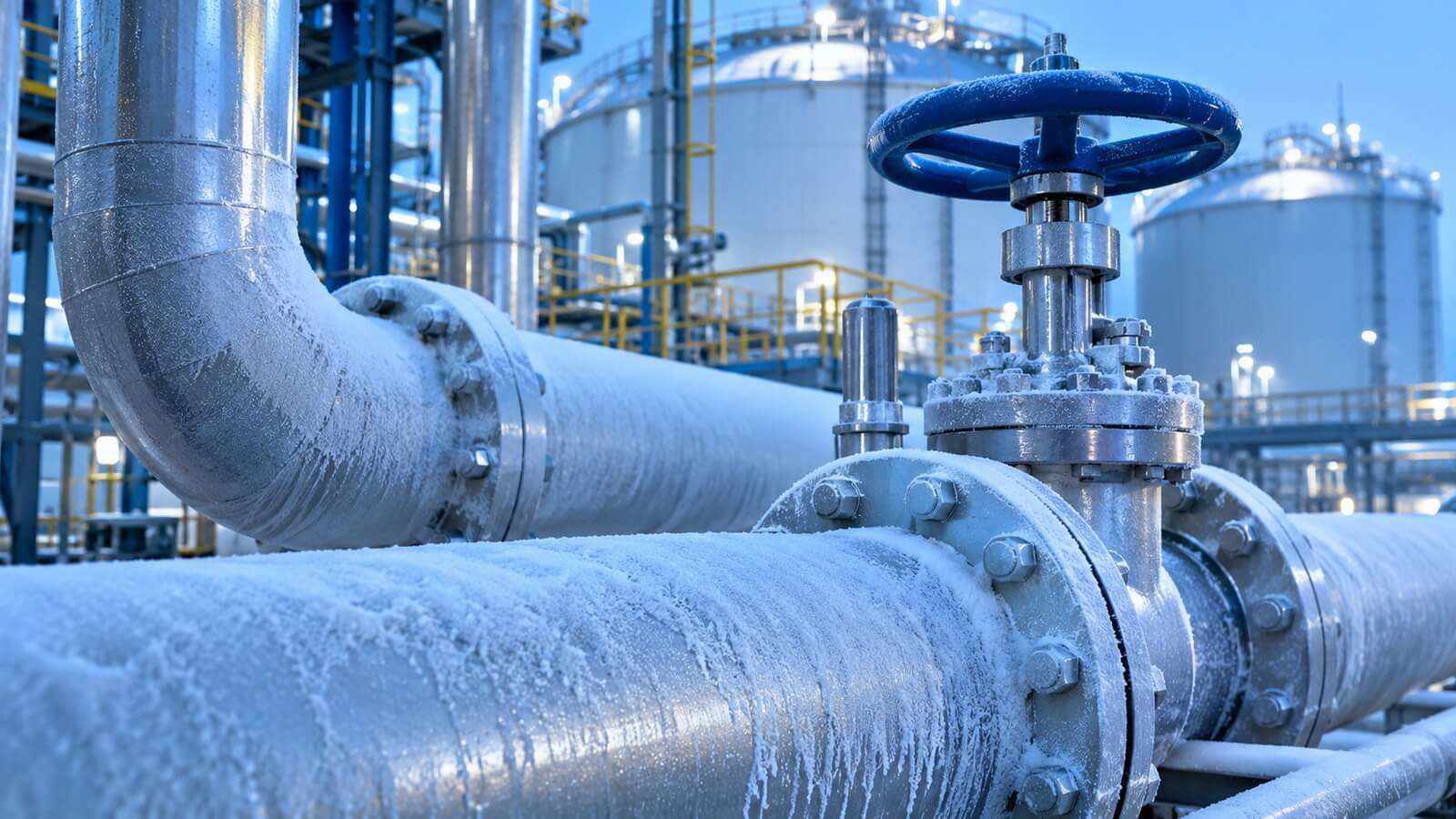
The main safety risks associated with liquefied natural gas (LNG) are extreme cold, flammable vapor releases, fires, pressure buildup, and failures involving storage or handling equipment. Managing these hazards requires specialized infrastructure, trained personnel, and multiple layers of protection.
LNG is natural gas cooled to approximately -260°F (-162°C), reducing its volume by roughly 600 times.
This makes long-distance transportation and storage practical, but introduces cryogenic hazards that differ from those associated with conventional natural gas pipelines.
LNG is not inherently explosive as a liquid. The primary fire and explosion risks arise when released LNG vaporizes, forms a flammable mixture with air, and encounters an ignition source.
For investors, LNG safety matters because incidents can cause extended shutdowns, regulatory investigations, expensive repairs, contractual disruptions, and financial liabilities.
What Are the Main Dangers Associated With LNG?
LNG facilities handle large quantities of cryogenic liquid and combustible natural gas.
The most important hazards involve temperature, vapor behavior, equipment integrity, and operating procedures.
| Safety risk | Potential consequence |
|---|---|
| Cryogenic exposure | Severe cold injuries and material damage |
| LNG spills | Rapid vaporization and formation of cold gas clouds |
| Flammable vapor | Fire or explosion under certain conditions |
| Pressure buildup | Equipment damage if pressure is not properly controlled |
| Storage tank failure | Major LNG releases and operational disruption |
| Equipment malfunction | Leaks, shutdowns, or process instability |
| Transportation accidents | Product releases and potential ignition |
| Human error | Increased likelihood of operational incidents |
These hazards do not mean LNG infrastructure is inherently unsafe.
Modern facilities incorporate engineering controls, monitoring equipment, and emergency procedures designed to reduce the probability and consequences of incidents.
However, no industrial system is entirely risk-free.
The severity of an incident depends on the amount released, surrounding conditions, ignition sources, facility design, and emergency response effectiveness.
Is LNG More Dangerous Than Regular Natural Gas?
LNG and conventional natural gas contain broadly similar combustible components, primarily methane.
The main difference is their physical state and the equipment used to transport and store them.
Pipeline natural gas is transported in gaseous form, often under pressure.
LNG is stored as an extremely cold liquid in insulated tanks, creating additional cryogenic hazards.
Direct LNG exposure can injure people and damage materials not designed for very low temperatures.
However, LNG storage generally does not require the extremely high pressures associated with compressed natural gas storage.
Each system has a different risk profile.
LNG safety depends on cryogenic containment, vapor management, fire protection, and controlled handling procedures.
Pipeline safety depends on pressure control, infrastructure integrity, leak detection, and protection from external damage.
Neither system is universally safer without considering its specific operating conditions.
Can LNG Explode?
LNG does not explode simply because it is stored as a liquid.
An explosion hazard can develop when LNG escapes, vaporizes, and forms a flammable gas-air mixture.
Methane is generally flammable in air at concentrations of approximately 5% to 15% by volume.
Outside this range, mixtures are typically too lean or too rich to sustain flame propagation under ordinary conditions.
However, actual behavior depends on gas composition, temperature, confinement, and surrounding conditions.
What Happens During an LNG Release?
When LNG escapes containment, it absorbs heat and begins vaporizing.
Initially, the cold vapor may remain near ground level because its low temperature increases its density.
As it warms, methane-rich gas generally becomes lighter than air and tends to rise and disperse.
If a flammable vapor cloud encounters an ignition source, a flash fire may occur.
Under certain conditions, particularly in confined or congested areas, ignition can generate damaging overpressure.
An unconfined vapor cloud does not automatically produce an explosion.
The consequences depend heavily on the release environment.
What Is a Pool Fire?
A pool fire can occur when spilled LNG accumulates and vapor above the liquid ignites.
The resulting fire can generate substantial thermal radiation.
LNG facilities use separation distances, containment structures, and fire protection systems to limit potential consequences.
The effectiveness of these protections depends on facility design and operating conditions.
Why Are LNG's Extremely Low Temperatures Dangerous?
LNG is stored at approximately -162°C.
Direct exposure can cause severe cryogenic injuries.
Extreme cold can also damage equipment and surrounding structures.
Some metals and construction materials become brittle when exposed to temperatures below their intended operating range, increasing the risk of cracking or failure.
For this reason, LNG facilities use materials specifically selected for cryogenic service, including suitable stainless steels and aluminum alloys.
Insulation helps protect surrounding structures and limits heat transfer into storage equipment.
How Do Workers Protect Themselves?
LNG handling requires specialized training, engineering controls, and appropriate protective equipment.
Depending on the task, workers may use cryogenic gloves, face protection, and protective clothing.
Facilities also establish procedures for loading, unloading, maintenance, and emergency response.
Protective equipment alone is insufficient. Safe operations depend on equipment design, controlled procedures, and effective supervision.
What Are the Safety Risks of LNG Storage Tanks?
Large storage tanks are essential components of LNG export and import facilities.
They must maintain cryogenic temperatures while managing liquid levels, vapor pressure, and structural loads.
Modern LNG tanks may use full-containment designs with an inner liquid-containing structure and an outer containment system.
Other approved configurations also exist, depending on applicable standards and project requirements.
Potential Storage Tank Hazards
Important hazards include:
- Loss of containment caused by equipment or structural failure.
- Excessive pressure if vapor management systems malfunction.
- Overfilling during loading operations.
- Failure of valves, piping, or transfer connections.
- Damage caused by external events.
- Operational errors during maintenance or transfer activities.
Storage facilities use level instrumentation, pressure monitoring, emergency shutdown equipment, and containment systems to reduce these risks.
What Is LNG Rollover?
LNG rollover is a storage phenomenon that can occur when layers of LNG with different densities develop inside a tank.
Changes in temperature and composition may eventually cause these layers to mix, producing a rapid increase in vapor generation.
If not properly managed, this can challenge tank pressure-control systems.
Operators reduce rollover risks through inventory management, monitoring, and appropriate operating procedures.
For investors, storage reliability matters because a major tank problem can interrupt operations and require expensive repairs.
What Is Boil-Off Gas, and Is It Dangerous?
Even well-insulated LNG tanks absorb some heat from their surroundings.
As LNG warms, a portion vaporizes into natural gas, creating boil-off gas.
Boil-off is a normal physical process rather than automatically a safety incident.
However, vapor generation must be controlled to prevent excessive pressure buildup.
Facilities may use compressors, vapor recovery systems, reliquefaction equipment, or other approved pressure-management arrangements.
The appropriate approach depends on facility design and purpose.
Poorly managed boil-off can increase operating costs, create safety concerns, and contribute to methane emissions if gas is released.
Effective vapor management supports both reliability and environmental performance.
How Do LNG Facilities Prevent Fires and Major Accidents?
LNG facilities use multiple layers of protection to prevent releases, detect abnormal conditions, limit escalation, and protect personnel.
Gas and Fire Detection
Gas detection systems monitor areas where flammable vapors could accumulate.
Fire detection equipment can identify certain fire conditions and initiate protective actions.
These systems support early intervention.
Emergency Shutdown Systems
Emergency shutdown systems isolate equipment or stop selected operations when hazardous conditions occur.
Depending on facility design, they may close valves, stop pumps, or shut down processing equipment.
Reliable design must also consider sensor, control, and power failures.
Spill Containment
Containment structures limit the spread of spilled LNG and help reduce the consequences of vapor generation and potential fires.
Requirements depend on facility design and applicable regulations.
Fire Protection
LNG facilities may use water spray systems to protect exposed equipment, dry chemical systems for certain fires, and other specialized protective measures.
The appropriate response depends on the incident.
Applying water directly to an LNG spill can increase vaporization, so emergency procedures must address cryogenic hazards specifically.
Inspection and Maintenance
Regular inspections help identify leaks, equipment deterioration, instrumentation problems, and other safety concerns.
Preventive maintenance is particularly important for valves, compressors, transfer systems, and protective equipment.
For investors, effective maintenance can reduce the likelihood of expensive interruptions.
Are LNG Export Terminals Safe?
LNG export terminals are complex industrial facilities designed to operate under technical standards and regulatory requirements.
Their safety depends on engineering quality, maintenance, operating procedures, emergency preparedness, and oversight.
Terminals typically include gas processing systems, liquefaction trains, cryogenic storage tanks, pipelines, and marine loading facilities.
Each component introduces different hazards.
The complete infrastructure chain is explained in LNG Production and Infrastructure: From Natural Gas to Global Supply.
Modern facilities use risk assessments and engineering standards to evaluate potential accident scenarios.
However, protective systems cannot eliminate every possibility of equipment failure, human error, or external disruption.
Investors should evaluate actual operating performance rather than relying exclusively on certifications or regulatory approvals.
What Happened at the Freeport LNG Facility?
The Freeport LNG incident in Texas demonstrates how safety failures can disrupt a major export terminal.
On June 8, 2022, an explosion and fire occurred at the Freeport LNG facility.
The incident caused a prolonged interruption in operations.
Investigations identified deficiencies involving operating procedures, pressure protection, and safety management.
The facility subsequently underwent repairs, regulatory reviews, and a phased return to service.
The consequences extended beyond physical damage.
The shutdown reduced LNG exports, disrupted expected deliveries, and created financial uncertainty.
It also affected natural gas markets by temporarily reducing demand from the export facility.
For investors, Freeport illustrates why operational reliability and safety management matter alongside production capacity and customer contracts.
What Regulations Apply to LNG Facilities in the United States?
U.S. LNG facilities operate under several regulatory frameworks.
The applicable requirements depend on facility type, location, and activities.
PHMSA and Federal Pipeline Safety Requirements
The Pipeline and Hazardous Materials Safety Administration (PHMSA) administers federal safety regulations covering certain LNG facilities.
Title 49 of the Code of Federal Regulations, Part 193, establishes requirements involving facility design, construction, operation, maintenance, and fire protection.
Not every LNG-related activity is regulated identically under Part 193.
Federal Energy Regulatory Commission
The Federal Energy Regulatory Commission (FERC) authorizes and oversees certain LNG facilities within its jurisdiction.
Its review processes may address facility design, environmental impacts, and safety-related considerations.
U.S. Coast Guard
The U.S. Coast Guard has responsibilities involving maritime safety and security at LNG waterfront facilities.
These include aspects of vessel operations, waterfront safety, and facility security.
Industry Standards
Technical standards such as NFPA 59A address LNG production, storage, and handling.
Applicable editions and requirements depend on how standards are incorporated into regulations, permits, and project specifications.
For investors, regulatory compliance is a financial consideration because findings can require corrective actions, additional spending, or operating restrictions.
What Are the Safety Risks of Transporting LNG by Truck?
LNG can be transported by road using specialized cryogenic tank trailers.
These vehicles are designed to limit heat transfer and manage LNG during transportation.
However, road transport introduces risks involving vehicle collisions, equipment damage, transfer connection failures, and potential product releases.
Loading and unloading also require controlled procedures.
Operators must comply with applicable hazardous materials requirements and maintain suitable equipment.
Driver training, inspections, route planning, and emergency preparedness are important safeguards.
The commercial and technical aspects of road distribution are examined in Can LNG Be Transported by Truck? Infrastructure and Economics.
For investors, transportation safety influences insurance costs, regulatory exposure, operating expenses, and service reliability.
Are LNG Carriers Dangerous?
LNG carriers are specialized ships designed to transport large quantities of LNG across international waters.
Their cargo containment systems use insulation and materials suitable for cryogenic conditions.
Vessels also incorporate monitoring, pressure management, and emergency protection systems.
Potential hazards include cargo leaks, fires, collisions, grounding, and equipment failures.
The consequences of an incident depend on its circumstances and the effectiveness of protective measures.
LNG carriers operate under maritime regulations and technical standards addressing vessel design, cargo handling, crew training, and emergency procedures.
For investors, shipping safety matters because incidents can disrupt deliveries, increase costs, and affect commercial relationships.
Can LNG Facilities Affect Nearby Communities?
LNG infrastructure can create concerns for nearby communities, especially where facilities are close to populated or environmentally sensitive areas.
Potential issues include industrial accidents, air emissions, construction activity, noise, and changes in transportation patterns.
Regulatory reviews may assess credible accident scenarios and establish requirements to protect surrounding areas.
The level of risk depends on facility design, location, operating conditions, and protective measures.
Community opposition can also affect project development through additional reviews, legal challenges, or construction delays.
For investors, permitting requirements and community relationships can influence project schedules and costs.
How Much Can an LNG Safety Incident Cost?
The financial consequences of an LNG incident depend on its severity and the facility involved.
Potential expenses include equipment repairs, lost production, emergency response, environmental remediation, regulatory penalties, and legal costs.
Indirect effects may also be significant.
A prolonged shutdown can interrupt contracted deliveries, potentially requiring replacement LNG purchases or alternative arrangements with customers.
Insurance may cover certain losses, but policies can include exclusions, deductibles, and coverage limits.
Insurance therefore does not eliminate financial risk.
Why Downtime Matters
Consider a hypothetical LNG facility with annual production capacity of 10 million tonnes.
A complete shutdown lasting one month would make approximately 833,000 tonnes of potential production capacity unavailable, assuming an even annual production profile.
This does not mean the operator automatically loses the market value of that entire quantity.
The actual financial impact depends on contracts, operating margins, insurance, inventory, and the possibility of recovering production later.
Nevertheless, the example illustrates the substantial volumes affected by major operational interruptions.
For investors, actual facility availability can be as important as nameplate capacity.
Does Improving LNG Safety Increase Production Costs?
Safety infrastructure requires investment in suitable materials, containment systems, instrumentation, emergency equipment, and trained personnel.
These requirements contribute to construction and operating expenses.
However, safety investment can also reduce the probability and severity of incidents.
Effective systems may improve operational reliability and limit the risk of extended shutdowns.
The economic value of a safety improvement depends on its cost and the risks it controls.
For a broader examination of operating expenses and production challenges, see What Are the Main Disadvantages of LNG Production?.
A lower-cost facility is not necessarily a better investment if savings compromise reliability or increase exposure to operational failures.
How Does LNG Safety Affect Company Valuations?
Safety performance can influence company valuations through operating reliability, capital requirements, financing, and regulatory exposure.
Cash Flow Reliability
Facilities with consistent operations may generate more predictable cash flows.
Major incidents can interrupt production and delay expected revenue.
Capital Expenditure
Repairs, equipment upgrades, and regulatory requirements can increase capital spending.
Unexpected expenses may reduce cash available for debt repayment or shareholder returns.
Financing and Insurance
Lenders and insurers may consider operational risks when evaluating projects.
Poor safety performance can increase uncertainty surrounding financing costs and insurance arrangements.
Regulatory Exposure
Incidents can trigger inspections, investigations, corrective actions, or operating restrictions.
These events may delay projects or reduce production.
Reputation and Customer Confidence
Large LNG developments depend on long-term commercial relationships.
Repeated operational problems may weaken confidence among customers, investors, and other stakeholders.
Safety performance should therefore be evaluated alongside production capacity, contracts, and operating costs.
What Should Investors Examine When Evaluating LNG Safety?
Investors can assess infrastructure safety and operating quality through several indicators.
| Indicator | Why it matters |
|---|---|
| Historical incidents | Reveals previous operational and safety problems |
| Facility availability | Shows how consistently infrastructure operates |
| Regulatory findings | Identifies compliance concerns and corrective actions |
| Maintenance spending | Indicates investment in equipment reliability |
| Project age and design | Helps assess technology and maintenance requirements |
| Insurance arrangements | Shows how certain financial risks may be covered |
| Emergency preparedness | Supports response to abnormal operating conditions |
| Management disclosures | Provides information about operational risks and mitigation |
Investors should distinguish between established facilities and projects still under construction.
Operating facilities provide historical performance data, while new projects may use modern designs but lack a commercial operating record.
A diversified operator with multiple facilities may also have a different risk profile from a company dependent on a single terminal.
Can Technology Make LNG Infrastructure Safer?
Modern technology helps operators monitor temperatures, pressure, gas concentrations, and equipment performance.
Predictive maintenance systems may identify deterioration before equipment fails.
Automated shutdown equipment can reduce response times when abnormal conditions occur.
Advanced inspection methods can also help detect problems in tanks, piping, and other infrastructure.
However, technology cannot guarantee safety.
Sensors can malfunction, software can fail, and automated systems require proper design, testing, and maintenance.
Human training and organizational safety practices remain essential.
For investors, effective risk management combines reliable engineering, operating discipline, and continuous improvement.
Are LNG Safety Risks a Reason to Avoid the Industry?
LNG involves significant industrial hazards, but these risks do not automatically make every investment unattractive.
Many energy infrastructure businesses operate equipment requiring specialized safety systems.
The important question is whether risks are properly identified, controlled, and reflected in project economics.
Companies with reliable operations, experienced management, effective maintenance, and appropriate financial protection may be better positioned to manage uncertainty.
However, historical reliability does not guarantee future performance.
Safety should be assessed alongside costs, contracts, financing, regulation, and market demand.
What Is the Biggest LNG Safety Risk for Investors?
For investors, the most significant LNG safety concern is often the potential for a major incident to interrupt operations and create substantial financial consequences.
A release, fire, or equipment failure can affect production, customer contracts, insurance, and regulatory approvals.
Its impact may extend beyond the affected facility, particularly when export disruptions influence regional gas demand and international LNG supply.
Modern LNG infrastructure incorporates multiple layers of protection, but their effectiveness depends on design, maintenance, and operating discipline.
LNG safety is directly connected to financial performance. Reliable infrastructure, preventive maintenance, regulatory compliance, and effective risk management are essential to the long-term economics of LNG production, storage, and transportation.
Disclaimer: This article is for informational and educational purposes only and does not constitute financial or investment advice. LNG infrastructure investments involve operational hazards, regulatory uncertainty, commodity-price volatility, potential liabilities, and financial losses.