
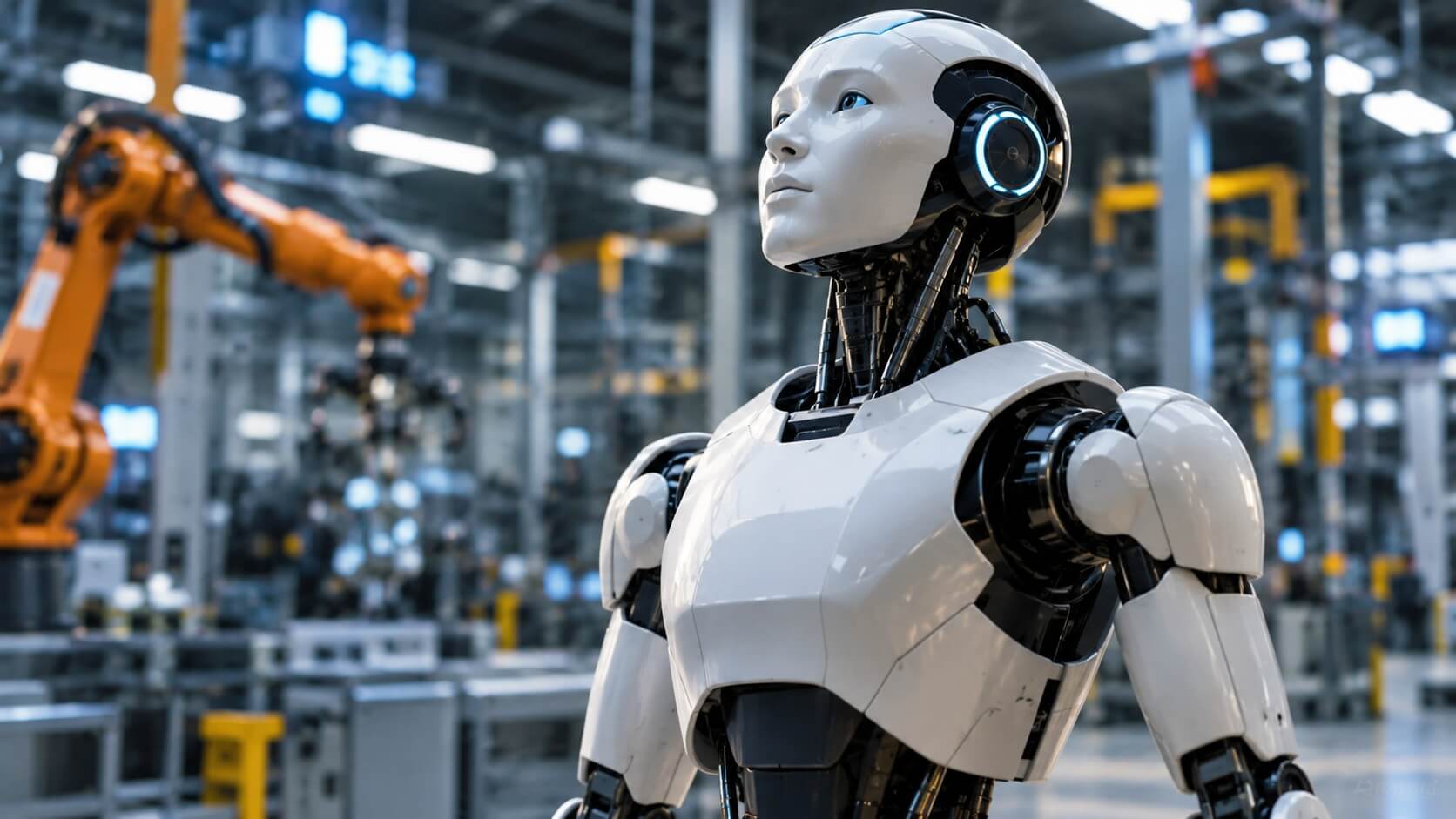
Humanoid robots are machines designed to resemble the human body and perform tasks in environments originally built for people. They typically have a torso, arms, hands, and legs, allowing them to interact with tools, equipment, and workplaces without requiring every environment to be redesigned.
The humanoid robotics market is attracting attention because advances in artificial intelligence, sensors, batteries, and robotic hardware are making these machines increasingly capable.
Companies including Tesla, Figure AI, Agility Robotics, Boston Dynamics, and Unitree are developing humanoid systems for industrial operations, logistics, research, and potentially everyday services.
However, the industry remains at an early stage of commercial adoption. Demonstrations of impressive robotic capabilities do not necessarily mean those capabilities can be delivered reliably, economically, and independently across thousands of real-world workplaces.
For investors, the opportunity extends beyond companies building complete robots. It also includes businesses supplying computing hardware, motion components, sensors, batteries, and software.
Understanding where the industry stands today—and what must happen before humanoid robots become commercially widespread—is essential when evaluating its long-term potential.
What Is a Humanoid Robot?
A humanoid robot is a robotic system designed around some of the physical characteristics of a human.
Unlike traditional industrial robots, which are often fixed in place and programmed to perform repetitive movements, humanoid robots aim to operate in environments where people already work.
A typical humanoid robot may include:
- Two legs for walking and navigating human-designed spaces.
- Arms and hands for handling objects and using tools.
- Cameras and other sensors for understanding its surroundings.
- Electric motors and mechanical systems for movement.
- Artificial intelligence software for interpreting information and selecting actions.
- Batteries and power management systems for mobile operation.
Not every humanoid robot includes all these features. Some systems have simplified hands, limited mobility, or specialized designs intended for particular tasks.
The defining idea is that the machine can perform useful activities within environments originally designed for humans.
This matters economically because factories, warehouses, hospitals, and commercial buildings already contain equipment, doorways, shelves, and workstations built around human movement.
A sufficiently capable humanoid robot could potentially use some of that infrastructure without requiring extensive physical modifications.
That possibility is one of the main reasons companies are investing in the technology.
How Do Humanoid Robots Work?
Humanoid robots combine mechanical engineering, computing, artificial intelligence, and automated control systems.
Although their appearance may resemble a person, their movements depend on complex coordination between hardware and software.
Sensors Help Robots Understand Their Surroundings
Humanoid robots use cameras, depth sensors, and other instruments to collect information about the environment.
These systems help identify objects, estimate distances, recognize obstacles, and determine where the robot should move.
For example, a robot operating in a warehouse must recognize a package, estimate its position, and determine how to approach it.
The information gathered by sensors becomes the input for the robot's decision-making software.
Artificial Intelligence Helps Robots Perform Tasks
Artificial intelligence allows robotic systems to interpret visual information, recognize objects, and plan actions.
Some developers use machine learning models trained on demonstrations, simulated environments, and data collected from physical robots.
These models can help robots learn movements and adapt to variations in their surroundings.
However, AI does not automatically make a robot fully autonomous.
Many systems still require carefully defined operating conditions, human supervision, remote assistance, or additional training before performing unfamiliar tasks reliably.
Motors and Mechanical Systems Produce Movement
Electric motors, gears, joints, and other mechanical components allow humanoid robots to walk, lift objects, and manipulate tools.
A robot must coordinate these components while maintaining balance.
Even an apparently simple activity, such as picking up a box, involves several connected actions:
- Identifying the box and its position.
- Moving into the correct location.
- Positioning the arms and hands.
- Applying sufficient gripping force.
- Maintaining balance while lifting.
- Moving the object to its destination.
Performing these movements once in a controlled demonstration is different from repeating them thousands of times in a busy workplace.
That distinction is central to understanding the industry's commercial development.
Who Are the Leading Humanoid Robot Companies?
The humanoid robotics industry includes established technology companies, specialized robotics developers, and emerging startups.
Several companies have attracted particular attention because of their technology, financial backing, or industrial ambitions.
| Company | Humanoid platform | Main area of development |
|---|---|---|
| Tesla | Optimus | General-purpose humanoid robotics and potential industrial applications |
| Figure AI | Figure humanoid platforms | AI-enabled robots for commercial and industrial tasks |
| Agility Robotics | Digit | Warehouse and logistics operations |
| Boston Dynamics | Electric Atlas | Advanced mobility and industrial robotics |
| Unitree Robotics | G1 and H1 | Humanoid hardware, research, and robotic development |
| Apptronik | Apollo | Humanoid robotics for industrial applications |
These companies do not all pursue the same commercial strategy.
Some focus on building robots capable of performing useful work in controlled industrial environments.
Others emphasize advanced movement, general-purpose intelligence, research platforms, or affordable hardware.
A company demonstrating impressive mobility is not necessarily ahead in commercial deployment.
Similarly, a robot that performs relatively simple warehouse tasks reliably may offer greater near-term business value than a more sophisticated machine that remains experimental.
The distinction between technological capability and commercial usefulness is particularly important for investors.
For a closer examination of competing platforms, their capabilities, and the differences between leading developers, see The Leading Humanoid Robots Today: A Practical Comparison.
Where Are Humanoid Robots Being Used?
Humanoid robots are being developed for several industries, but their adoption is not equally advanced across all applications.
Industrial and logistics environments are among the most promising early markets because they contain repetitive tasks and relatively structured working conditions.
Manufacturing
Factories are a natural testing environment for humanoid robotics.
Potential activities include moving components, delivering materials between workstations, handling containers, and supporting repetitive production processes.
The attraction is flexibility.
A traditional industrial robot may be designed around a specific production task. A general-purpose humanoid could eventually perform several different activities using the same physical platform.
However, traditional industrial automation often remains faster, cheaper, and more reliable for highly repetitive tasks.
Humanoid robots must therefore demonstrate value in situations where flexibility matters enough to justify their additional complexity.
Warehousing and Logistics
Warehouses contain numerous tasks involving moving goods, handling packages, and transporting materials.
Some activities are already performed efficiently by conveyor systems, autonomous mobile robots, and specialized robotic arms.
Humanoid robots could potentially complement these systems by operating at workstations designed for human workers.
The economic opportunity depends on whether they can perform useful work consistently over long operating periods.
A robot that requires frequent intervention or moves significantly slower than a human employee may struggle to justify its cost.
Healthcare and Assistance
Healthcare is another potential application, particularly for transporting supplies, supporting hospital logistics, and assisting with physically demanding nonclinical activities.
More advanced applications, such as helping elderly people with daily routines, would require much higher levels of safety, reliability, and physical interaction.
These applications are considerably more difficult than operating in a controlled factory.
Human environments are unpredictable, and errors can have serious consequences.
For that reason, widespread personal-care humanoid robots should not be treated as an immediate commercial reality.
Retail and Hospitality
Humanoid robots could eventually support customer service, inventory handling, cleaning, and routine operational tasks.
However, a human-shaped robot is not automatically the most efficient solution.
For many commercial applications, simpler robotic systems may remain more economical.
The strongest opportunities are likely to emerge where humanoid movement provides a genuine advantage over specialized machines.
How Much Do Humanoid Robots Cost?
Humanoid robot prices vary considerably depending on size, capabilities, hardware, and intended use.
Smaller research and development platforms can cost substantially less than sophisticated industrial humanoids.
Advanced systems may require significant investment not only in the robot itself but also in software, integration, maintenance, training, and technical support.
The purchase price is only one part of the economic equation.
Businesses evaluating humanoid robots must also consider:
- How many hours the robot can operate productively.
- How often it requires maintenance or human assistance.
- The cost of electricity and replacement components.
- Whether additional safety equipment is necessary.
- How easily the robot can learn or switch tasks.
- How much useful work it performs compared with existing alternatives.
A relatively inexpensive robot may deliver poor economic value if it cannot perform commercially useful work.
Conversely, a more expensive system could become attractive if it operates reliably and reduces the total cost of completing specific tasks.
Developers frequently discuss the possibility of lower prices as production scales.
However, projected future manufacturing costs should not be confused with verified commercial selling prices.
For a detailed look at purchase prices, availability, and what buyers actually receive, read How Much Does a Humanoid Robot Cost? Prices and What You Get.
Why Is Tesla Investing in Humanoid Robots?
Tesla has become one of the most closely watched companies in humanoid robotics through its Optimus program.
The company's ambition is to develop a general-purpose humanoid robot capable of performing physical tasks in workplaces and potentially other environments.
Tesla believes that some of its experience in artificial intelligence, computer vision, electronics, and large-scale manufacturing could be relevant to humanoid robotics.
There are potential connections between autonomous vehicle technology and robotic systems.
Both require machines to interpret their surroundings and make decisions based on sensor information.
However, controlling a humanoid robot presents different challenges from operating a vehicle.
Walking, maintaining balance, manipulating unfamiliar objects, and interacting safely with people require additional capabilities.
Tesla's existing manufacturing infrastructure could become an advantage if Optimus reaches the point where large-scale production is commercially justified.
But production scale alone would not establish the robot's economic value.
The company would still need to demonstrate reliable performance, competitive operating costs, and sustained customer demand.
For Tesla investors, Optimus represents a potential long-term business opportunity rather than a source of guaranteed future revenue.
Its ultimate financial significance will depend on technological progress, commercialization, manufacturing economics, and adoption.
For a focused analysis of the project, see Tesla's Optimus Robot: What It Can Do and What It Means for Investors.
How Big Could the Humanoid Robotics Market Become?
The potential size of the humanoid robotics market is one of the industry's biggest attractions.
If humanoid robots eventually perform economically valuable tasks across manufacturing, logistics, healthcare, and services, the addressable market could become substantial.
However, market forecasts vary widely because they depend on assumptions that remain uncertain.
These include:
- How quickly robotic capabilities improve.
- Whether manufacturing costs decline.
- How much human supervision remains necessary.
- Which industries adopt the technology.
- How many tasks humanoid robots can perform economically.
- Whether businesses prefer humanoids or specialized automation.
- How regulations and safety requirements evolve.
A forecast describing a very large future market is not evidence that such demand already exists.
Investors should distinguish between three different concepts.
Potential market: The theoretical value of tasks that humanoid robots might eventually perform.
Commercially addressable market: The portion of those tasks where robots could realistically compete with existing alternatives.
Actual market revenue: Money customers are currently paying for robots, software, services, and related products.
The difference can be enormous.
A robot might theoretically replace part of a human task, but that does not mean the robot can perform it at an acceptable cost or reliability level.
Market projections are therefore best treated as scenarios rather than dependable predictions.
What Could Drive Growth in Humanoid Robotics?
Several technological and economic developments could support industry growth.
Better Artificial Intelligence
Improvements in AI could help robots understand unfamiliar environments and perform more varied tasks.
This would reduce the need to program every movement individually.
The commercial benefit would be greater flexibility and potentially lower deployment costs.
Lower Hardware Costs
Motors, actuators, sensors, computing systems, and batteries represent important components of humanoid robots.
As production volumes increase and designs improve, some hardware costs could decline.
However, achieving lower costs depends on engineering improvements, supply chains, manufacturing yields, and sufficient demand.
Labor Availability and Productivity
Some industries face challenges recruiting workers for repetitive, physically demanding, or difficult-to-staff activities.
Robots could potentially support productivity by handling selected tasks.
The economic case is strongest where a robot can deliver consistent output at a competitive total cost.
This does not mean every human job is suitable for robotic replacement.
Many roles involve judgment, adaptability, interpersonal interaction, or fine manipulation that remain difficult to automate.
Improved Batteries and Power Efficiency
Mobile humanoid robots require sufficient energy to operate without constant recharging.
Better batteries and more efficient mechanical systems could extend operating time.
This matters because charging, maintenance, and downtime reduce productive hours.
A robot's commercial value depends on how much useful work it completes, not simply how impressive its movements appear.
What Are the Biggest Challenges Facing Humanoid Robots?
Despite rapid technological progress, humanoid robotics faces substantial obstacles.
Reliability Outside Controlled Demonstrations
Robots can perform impressive actions in prepared environments.
Real workplaces introduce unpredictable objects, changing layouts, human movement, and unexpected situations.
A commercially useful robot must handle these conditions repeatedly.
The challenge is not simply performing a task once but performing it safely and consistently.
Dexterity and Object Manipulation
Human hands are exceptionally versatile.
People can grasp objects of different shapes, adjust pressure, manipulate tools, and respond quickly when something slips.
Reproducing these capabilities mechanically is difficult.
Robotic hands may struggle with delicate, irregular, flexible, or unfamiliar objects.
Safety Around People
Humanoid robots are mobile machines with motors, joints, and potentially significant weight.
They can create risks through collisions, falling, unexpected movements, or incorrect handling of objects.
Safe operation requires suitable hardware, software, testing, monitoring, and workplace procedures.
Economic Competitiveness
Even if a robot can complete a task, it may not be the cheapest way to do so.
A company must compare humanoid robotics with human labor, fixed automation, mobile robots, and other available technologies.
The relevant question is not whether the robot can work.
It is whether the robot can deliver sufficient value relative to its full cost.
Maintenance and Operational Support
Commercial robots require maintenance, software updates, repairs, and technical support.
Unexpected downtime can disrupt operations and increase costs.
Reliable service networks and replacement components may therefore become important competitive advantages.
These issues also influence how quickly the technology can expand beyond pilot projects.
For a deeper examination of physical limitations, operational failures, and safety concerns, see The Limits of Humanoid Robots: Safety, Reliability and Risks.
When Will Humanoid Robots Become Common?
Humanoid robots are unlikely to enter every industry or household at the same time.
Adoption will probably develop in stages.
Early commercial opportunities are more likely in structured environments where tasks can be defined, monitored, and repeated.
Factories and warehouses may provide opportunities for gradual deployment as reliability improves.
More complex settings, such as hospitals, public spaces, and private homes, introduce additional safety and operational challenges.
The speed of adoption will depend on measurable progress rather than promotional demonstrations.
Important indicators include the number of robots performing paid commercial work, the range of tasks they can complete independently, operating costs, and reliability over extended periods.
There is also a major difference between a robot being available for purchase and being practical for widespread use.
A company may sell a humanoid platform to researchers long before similar machines become economically useful to ordinary businesses or households.
Long-term predictions extending to 2040 or 2050 should be approached with caution because technological progress rarely follows a perfectly predictable path.
For a more detailed discussion of adoption timelines and future scenarios, see When Will Humanoid Robots Be Widely Available? What to Expect.
How Can Investors Gain Exposure to Humanoid Robotics?
Investors interested in humanoid robotics can examine several parts of the industry.
The most visible companies are robot developers, but the broader supply chain may offer additional forms of exposure.
Companies Building Complete Robots
Humanoid robot manufacturers develop the integrated systems that combine mechanical hardware, artificial intelligence, sensors, and control software.
Their long-term opportunity depends on selling or deploying robots at commercially sustainable margins.
However, many specialized developers are privately held.
That means ordinary retail investors cannot necessarily purchase their shares through public stock exchanges.
Public companies involved in humanoid robotics may also generate most of their revenue from unrelated businesses.
As a result, owning their shares does not always provide concentrated exposure to the humanoid robotics market.
Semiconductor and Computing Companies
Advanced robotic systems require computing hardware for AI processing, perception, and control.
Semiconductor companies could benefit from increasing demand for robotic computing systems.
However, their revenue may depend much more heavily on data centers, consumer electronics, or other established markets.
Investors should therefore evaluate how meaningful robotics-related demand actually is to each company's business.
Component and Industrial Technology Suppliers
Humanoid robots require mechanical and electronic components, including actuators, motors, sensors, power systems, and precision equipment.
Suppliers may benefit if the industry expands across multiple robot manufacturers.
This creates a potential opportunity to participate in broader industry growth without depending entirely on one robot design.
But component suppliers also face competition, pricing pressure, and the possibility that robot manufacturers develop more hardware internally.
Robotics and Automation ETFs
Some exchange-traded funds provide exposure to robotics, artificial intelligence, and industrial automation.
These funds may hold companies involved in manufacturing equipment, software, semiconductors, and robotic technologies.
However, a robotics ETF is not necessarily a humanoid robotics ETF.
Its largest holdings may have limited direct exposure to humanoid robots.
Investors should examine fund holdings, concentration, expenses, and investment strategy before assuming that a fund closely tracks this emerging industry.
What Should Investors Watch Before Investing?
The most useful indicators of industry progress are often operational rather than promotional.
| Indicator | Why it matters |
|---|---|
| Commercial deployments | Shows whether robots are moving beyond demonstrations |
| Paid customer contracts | Provides evidence of real market demand |
| Autonomous task completion | Indicates how much work robots can perform without assistance |
| Operating reliability | Helps determine whether robots are practical for everyday use |
| Total operating cost | Reveals whether the technology can compete economically |
| Manufacturing scale | Indicates whether developers can produce robots consistently |
| Repeat customer orders | Suggests customers are finding ongoing value |
| Revenue and margins | Helps establish whether the business model can become sustainable |
Investors should also consider company valuation.
A business can develop impressive technology and still be a poor investment if its stock price already assumes exceptionally successful future commercialization.
The opposite is also possible: a company with less publicity may provide important components or infrastructure to several participants in the industry.
The key is to separate technological excitement from measurable business performance.
Could Humanoid Robots Become a Major Industry?
Humanoid robots could eventually become an important category within the broader robotics and automation industry.
The underlying economic idea is compelling: machines capable of performing different physical tasks in environments already designed for humans.
If developers achieve sufficient reliability, flexibility, safety, and cost efficiency, the technology could create opportunities across several industries.
But substantial uncertainty remains.
Some applications may become commercially attractive much earlier than others. Specialized robots may continue to outperform humanoids in many tasks, and the companies leading today's demonstrations may not necessarily become the long-term market leaders.
For retail investors, humanoid robotics is best understood as an emerging industry with meaningful technological potential and significant commercialization risk.
The most important question is not how humanlike a robot appears, but whether it can perform valuable work safely, reliably, and at an economically competitive cost.
That is ultimately what will determine whether humanoid robotics becomes a sustainable business rather than simply an impressive technological achievement.
Disclaimer: This article is for informational and educational purposes only and does not constitute financial or investment advice. Investing in emerging technologies involves substantial risks, including the potential loss of capital. Investors should conduct independent research and consider their financial circumstances before making investment decisions.