
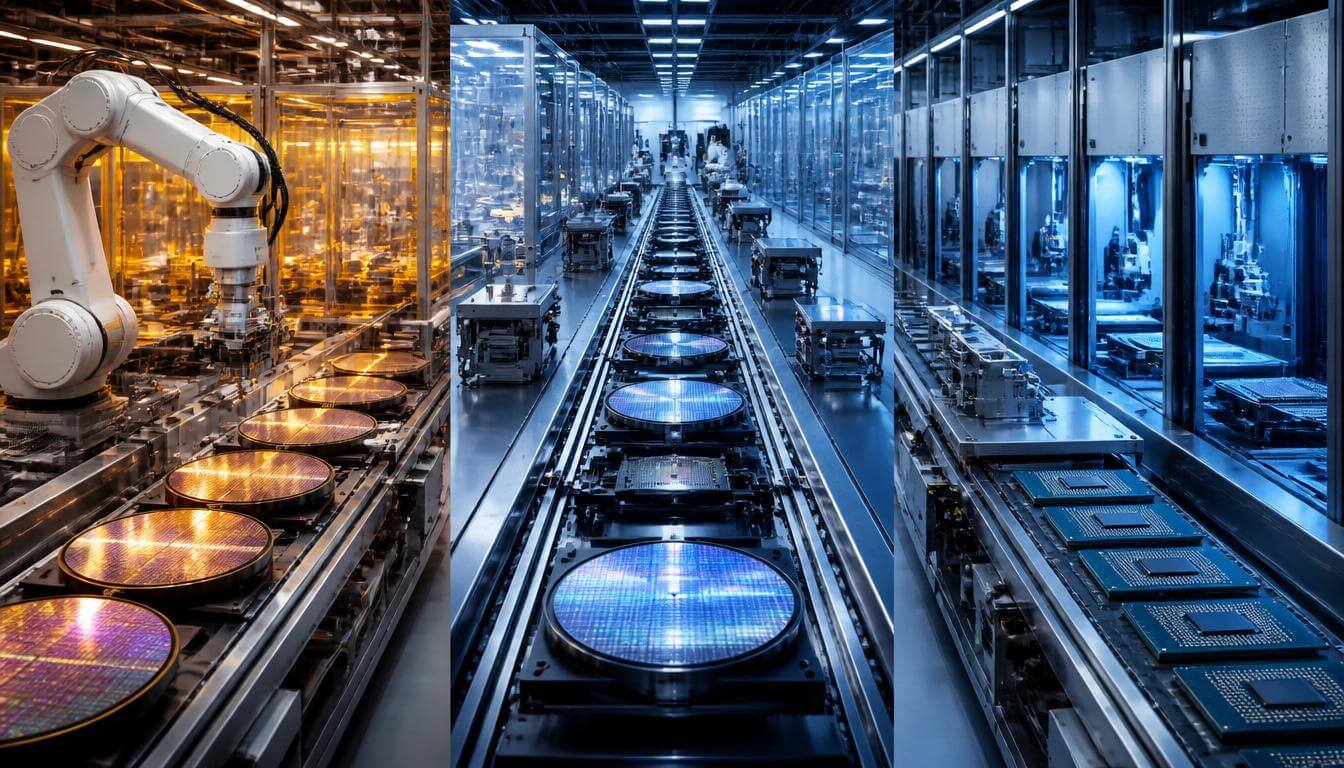
The future of semiconductor manufacturing is being shaped by three companies with significantly different industrial models: TSMC, Samsung and Intel.
All three are investing in advanced manufacturing, but their positions in the semiconductor ecosystem are not identical. TSMC has built its business around the pure-play foundry model, Samsung combines memory, logic and foundry operations within a large vertically integrated technology group, while Intel is transforming an historically integrated manufacturing model into one that increasingly includes external customers.
These differences provide a useful framework for understanding how the global semiconductor manufacturing industry is evolving.
TSMC and the Pure-Play Foundry Model
TSMC's business model is based primarily on manufacturing chips designed by other companies.
This distinction is fundamental. A foundry does not need to develop a large portfolio of its own consumer processors in order to fill its factories. Instead, it provides manufacturing capacity to customers ranging from major technology companies to specialized semiconductor designers.
The model became increasingly important as chip design and manufacturing became more specialized.
Design companies can focus resources on architecture, software integration and product development, while the foundry concentrates on process technology, manufacturing scale and yield optimization.
This structure can create powerful economies of scale. A leading foundry can spread the enormous cost of advanced manufacturing development across a large number of customers and product categories.
TSMC's strategy has consequently emphasized manufacturing excellence, process development and relationships with external customers.
Its position is also closely connected to the broader global semiconductor manufacturing race described in The Global Semiconductor Manufacturing Race.
Samsung's Integrated Approach
Samsung follows a broader model.
The company participates in memory manufacturing, logic production and foundry services. Its semiconductor operations are therefore exposed to multiple parts of the industry rather than being concentrated exclusively on external foundry customers.
This structure provides access to significant manufacturing expertise and capital resources.
Memory and logic manufacturing also have different technological and economic characteristics. Memory products are produced in extremely large volumes, while advanced logic manufacturing increasingly depends on relationships with major chip designers.
Samsung's ability to operate across both areas gives it a broad semiconductor footprint.
At the same time, maintaining leadership across multiple semiconductor categories requires substantial investment. Each market has its own technology roadmaps, production requirements and competitive dynamics.
Samsung's strategy can therefore be understood as an integrated semiconductor model rather than a pure specialization in foundry manufacturing.
Intel's Different Starting Point
Intel began from a different position.
For much of its history, Intel designed processors and manufactured them within its own production network. Manufacturing was closely integrated with the company's product development strategy.
This model had important advantages when Intel's processor architecture and manufacturing roadmap were closely synchronized. However, the semiconductor industry gradually became more fragmented, with specialized design companies and external foundries gaining greater importance.
Intel's manufacturing transformation reflects this change.
The development of Intel Foundry aims to create manufacturing capacity that can serve external customers as well as Intel's own products.
That means Intel is attempting to combine characteristics of its historical integrated model with those of the foundry industry.
This is a substantial industrial transition. External customers require manufacturing processes that can support different chip architectures, packaging technologies and design methodologies.
Three Approaches to Scale
The three companies therefore approach scale from different directions.
| Company | Source of scale | Strategic focus |
|---|---|---|
| TSMC | Large external customer base | Process leadership and foundry specialization |
| Samsung | Multiple semiconductor businesses | Diversification across memory, logic and foundry |
| Intel | Internal products plus external customers | Transition from IDM to foundry model |
These strategies lead to different investment priorities.
A pure-play foundry must continuously attract customers and maintain competitive process technologies. An integrated manufacturer can align internal product development with manufacturing investment. A diversified semiconductor company can potentially allocate resources across multiple markets.
None of these models exists in isolation from the broader semiconductor ecosystem.
Equipment suppliers, electronic design automation companies, chip designers, packaging companies and governments all influence the economics of advanced manufacturing.
The Role of Process Technology
One of the most important competitive dimensions is process technology.
As semiconductor manufacturing advances, shrinking transistor dimensions becomes increasingly difficult. New transistor structures, advanced lithography and increasingly complex manufacturing processes require substantial research and development.
But process leadership is not simply about reaching a smaller nominal node.
Commercial manufacturing also depends on yield, reliability, power efficiency, performance and production volume.
A process that works technically but cannot achieve sufficient yield or scale may have limited commercial value.
This is why manufacturing experience accumulates over time. Engineers learn how to identify defects, improve production parameters and optimize increasingly complex manufacturing processes.
The knowledge embedded in this production experience can become an important competitive asset.
Packaging Is Becoming More Important
The competition is also moving beyond wafer fabrication.
Advanced packaging is becoming increasingly important as chip architectures become more modular. Instead of placing every function on a single large piece of silicon, manufacturers can combine multiple dies or chiplets into sophisticated packages.
This approach can improve flexibility and allow different manufacturing technologies to be combined within the same system.
For companies competing in artificial intelligence and high-performance computing, packaging capacity can therefore become nearly as important as wafer fabrication capacity.
The companies that can integrate advanced process technologies with sophisticated packaging and testing capabilities may have greater flexibility in serving complex customers.
Manufacturing Footprints Are Expanding
Another important difference between the three strategies concerns geography.
Semiconductor manufacturing has historically developed around highly specialized regional clusters. Today, however, companies are expanding production footprints across multiple countries.
TSMC has invested in manufacturing facilities outside Taiwan. Samsung has developed manufacturing capacity in South Korea and the United States. Intel has pursued major investments in the United States and Europe.
The reasons are both commercial and strategic.
- Customers increasingly want geographically diversified supply chains.
- Governments want domestic or regional semiconductor capabilities.
- Companies themselves want greater flexibility in managing disruptions.
However, building factories in new locations is expensive and does not automatically reproduce the ecosystem of an established semiconductor cluster.
A factory requires suppliers, engineers, infrastructure, utilities and supporting industries. Developing all of these simultaneously is a long-term process.
The Economics of the Foundry Business
The foundry industry also faces an unusual economic challenge.
Advanced semiconductor factories require enormous upfront investment, while demand can fluctuate significantly between technology cycles.
A manufacturing company therefore needs to balance capacity expansion against the risk of underutilized facilities.
This makes customer diversification particularly important for foundries.
TSMC's model provides an example of how manufacturing capacity can serve multiple technology markets. Samsung's diversification provides another approach, while Intel is attempting to build a broader customer base around its foundry business.
The long-term outcome will depend on how successfully each model converts technological capabilities into commercially viable production.
Why the Difference Between the Three Models Matters
Comparing TSMC, Samsung and Intel illustrates that there is no single definition of semiconductor manufacturing leadership.
Leadership can involve:
- Process technology
- Manufacturing scale
- Customer relationships
- Packaging capabilities
- Geographic reach
- Consistent investment through multiple industry cycles
The three companies also operate within different corporate structures and historical contexts.
Their strategies are therefore better understood as different responses to the same structural changes affecting the semiconductor industry.
The growing importance of these differences extends beyond corporate competition. Advanced semiconductor manufacturing is increasingly connected to national infrastructure, technology policy and economic resilience.
That broader transformation is examined in Why Advanced Chip Manufacturing Is Becoming a Strategic Industry.
The comparison also demonstrates why the global semiconductor manufacturing race cannot be reduced to a simple contest over factory size. The industry depends on interconnected capabilities that include process technology, capital, engineering talent, customers, equipment, packaging and geographic infrastructure.
As semiconductor applications continue to expand, these capabilities will increasingly determine how manufacturing capacity is distributed across the global economy.