
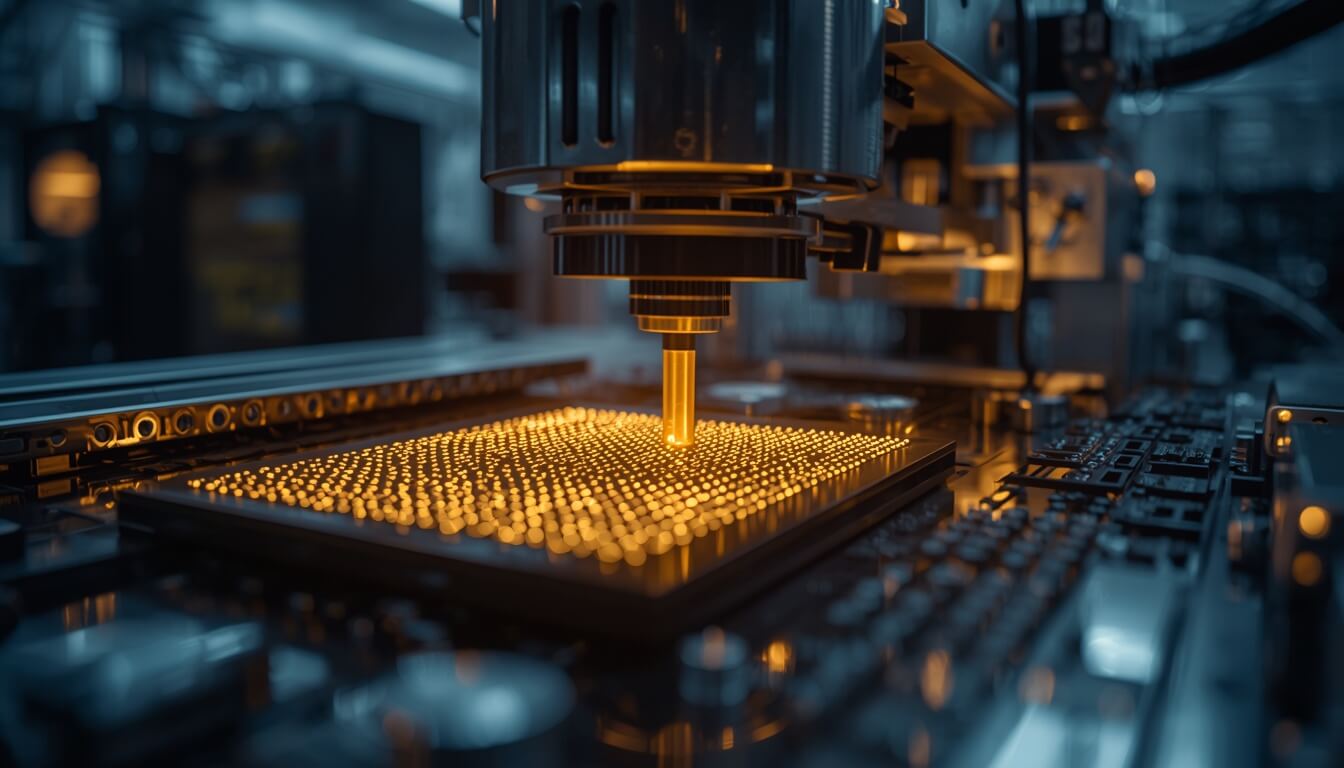
Semiconductors were once primarily viewed as components of electronic products. Today, advanced chip manufacturing has become a much broader industrial issue.
Modern economies depend on semiconductors for computing, communications, automobiles, industrial automation, artificial intelligence, telecommunications and data infrastructure. As these applications become more technologically demanding, the ability to manufacture advanced chips has acquired importance far beyond the semiconductor industry itself.
This transformation is changing the relationship between technology companies, manufacturers and governments.
Semiconductors as Industrial Infrastructure
A semiconductor factory is more than a manufacturing facility. It is the center of a complex industrial ecosystem involving equipment suppliers, chemical companies, materials producers, software developers, engineers, logistics providers and specialized service companies.
Advanced fabrication requires extremely sophisticated equipment and tightly controlled production environments.
The manufacturing process involves hundreds of steps. Small variations in temperature, contamination, materials or process parameters can affect production yields.
This complexity creates strong interdependencies.
A region capable of supporting advanced semiconductor manufacturing therefore develops capabilities that can extend into other areas of the technology economy.
The global distribution of these capabilities has become an important feature of the semiconductor manufacturing race described in The Global Semiconductor Manufacturing Race.
Why Advanced Nodes Matter
The strategic importance of semiconductor manufacturing is particularly visible at advanced process nodes.
High-performance processors used for artificial intelligence, cloud computing and advanced consumer electronics increasingly depend on sophisticated manufacturing technologies.
These chips require large investments in research, fabrication equipment and process development.
The difficulty of reproducing this capability means that advanced manufacturing is concentrated among a relatively small number of companies and regions.
This concentration creates both economic advantages and supply-chain risks.
When a critical manufacturing capability is concentrated geographically, disruptions in that region can affect industries around the world.
Consequently, governments and companies have increasingly focused on developing additional manufacturing capacity.
Economic Security and Supply Chains
The semiconductor industry illustrates how economic security can become connected to supply-chain resilience.
A company may have access to advanced chip designs but still depend on external manufacturers to produce them.
Similarly, a manufacturer may depend on equipment or materials supplied by companies located in other countries.
The semiconductor supply chain is therefore highly interconnected.
Building domestic or regional manufacturing capacity does not eliminate these dependencies. Semiconductor production requires international cooperation across many stages.
However, additional manufacturing capacity can provide greater diversification.
This explains why governments are supporting semiconductor investments even when local production may have higher costs than manufacturing in established clusters.
The objective is not necessarily to produce every type of semiconductor domestically. Instead, governments can seek to ensure that critical parts of the supply chain have sufficient capacity across multiple regions.
The Role of TSMC, Samsung and Intel
The strategies of TSMC, Samsung and Intel demonstrate different approaches to this changing environment.
- TSMC has developed a manufacturing model centered on external customers and large-scale foundry operations.
- Samsung combines memory, logic and foundry manufacturing within a diversified semiconductor business.
- Intel is attempting to transform an historically integrated manufacturing model while developing its foundry business for external customers.
These differences are important because manufacturing strategy determines how companies allocate capital, develop process technology and build relationships with customers.
A closer comparison of these models can be found in TSMC, Samsung and Intel: Three Strategies for the Future of Chip Manufacturing.
The three companies also demonstrate the scale of investment required to remain competitive.
The Capital Intensity of Semiconductor Manufacturing
Advanced chip manufacturing is one of the most capital-intensive areas of industrial production.
A fabrication facility requires expensive lithography equipment, process tools, clean-room infrastructure, power systems, water treatment and specialized materials.
The financial commitment does not end when construction is complete.
Manufacturers must continuously invest in new process generations because semiconductor technology evolves rapidly.
This creates a structural challenge.
A company must invest years before a new facility reaches full production, while the technology it is designed to manufacture may have a limited commercial window before another generation emerges.
The ability to sustain investment across multiple technology cycles is therefore an important characteristic of semiconductor manufacturing.
Electricity, Water and Infrastructure
Advanced semiconductor factories also depend on physical infrastructure.
Three resources are particularly critical:
- Electricity — fabs operate continuously and require highly reliable power. Even short interruptions can disrupt production and damage expensive manufacturing processes.
- Water — semiconductor manufacturing uses large quantities of highly purified water during production.
- Transportation — factories depend on regular deliveries of chemicals, materials, equipment and components.
This means that semiconductor manufacturing policy increasingly intersects with energy policy, infrastructure planning and regional development.
A successful semiconductor cluster requires much more than a factory.
Skilled Labor and Industrial Knowledge
Human capital is another major barrier to entry.
Advanced fabs require engineers specializing in chemistry, physics, electrical engineering, materials science, process engineering and equipment maintenance.
Manufacturing knowledge also accumulates over time.
Engineers learn from production problems, process variations and yield improvements. Companies that have operated advanced fabs for years can therefore possess extensive organizational knowledge that cannot simply be purchased with a new facility.
This is one reason why developing a semiconductor manufacturing ecosystem can take many years.
Building the physical factory is only one stage. Developing the surrounding workforce and supplier network can be equally important.
Government Policy and Industrial Investment
Governments have increasingly recognized these characteristics.
Semiconductor incentives are designed to encourage companies to construct fabs, expand capacity and establish research and development activities in specific regions.
The policy objectives vary. Some governments emphasize:
- Supply-chain resilience
- Technological competitiveness
- Employment and regional development
- National security
These policies can alter the economics of manufacturing projects by reducing the initial cost of investment or improving the infrastructure available to manufacturers.
However, public support does not remove the underlying technical and economic challenges.
A subsidized factory still needs customers, engineers, equipment, materials and competitive manufacturing processes.
The Risk of Fragmentation
Greater geographic diversification can improve resilience, but it can also increase costs.
Established semiconductor clusters benefit from dense supplier networks and specialized infrastructure. Moving production to new regions can require significant additional investment.
If manufacturing becomes increasingly fragmented, companies may face higher costs from operating multiple facilities across different jurisdictions.
The semiconductor industry therefore faces a balancing act between efficiency and resilience.
| Model | Advantage | Risk |
|---|---|---|
| Highly concentrated production | Efficient, dense supplier ecosystems | Vulnerable to regional disruption |
| Highly distributed production | Redundancy, geographic diversification | Higher costs and operational complexity |
The future industry is likely to search for a middle ground.
A Strategic Industry With Global Dependencies
The growing strategic importance of semiconductor manufacturing does not mean that globalization is disappearing.
In fact, advanced chips remain dependent on an international network of companies.
A semiconductor can involve intellectual property from one country, design software from another, manufacturing equipment from another, wafer production somewhere else and final assembly in yet another location.
This interconnected structure is unlikely to disappear.
Instead, the industry is gradually moving toward a model in which critical manufacturing capabilities are distributed across a larger number of regions while maintaining global specialization.
Looking Ahead
The future of semiconductor manufacturing will therefore be determined by more than transistor density.
Companies will need to manage capital investment, manufacturing technology, packaging, energy, water, labor, supply chains and geographic expansion simultaneously.
Governments will continue to evaluate how much semiconductor capacity should exist within their own regions and how much dependence on foreign manufacturing is acceptable.
Customers will increasingly consider not only cost and performance but also manufacturing capacity and supply-chain resilience.
The result is an industry in which technological leadership and industrial infrastructure are becoming increasingly interconnected.
Advanced chip manufacturing is consequently evolving from a specialized branch of electronics production into an important component of modern industrial capacity.
The competition between TSMC, Samsung, Intel and other manufacturers provides a clear illustration of this transition. Their different strategies show how difficult it is to combine technological innovation, manufacturing scale, capital investment and geographic diversification within a single global industry.
The semiconductor manufacturing race is therefore likely to remain a long-term process rather than a competition with a definitive endpoint. As computing requirements increase and more industries become dependent on advanced chips, manufacturing capability itself will remain an important part of the global technology landscape.