
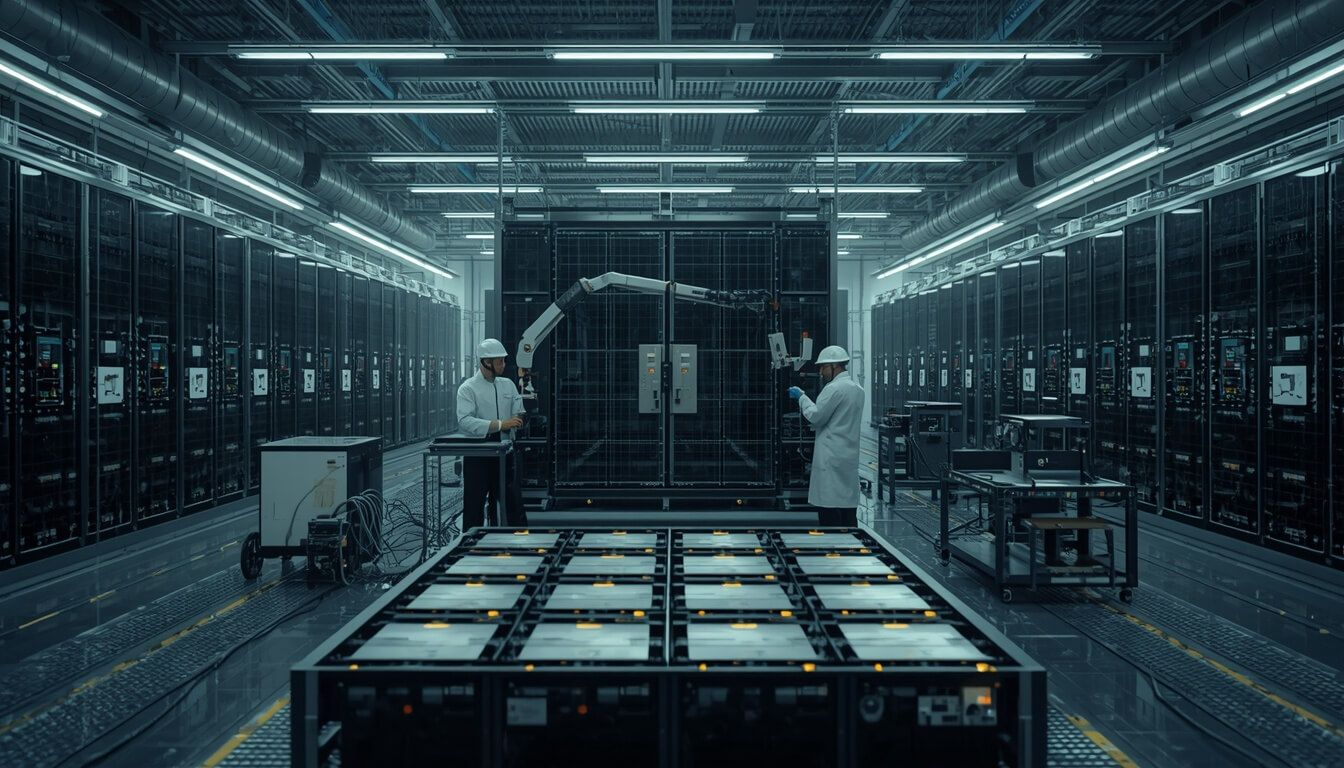
The global battery industry is increasingly shaped by a small number of companies capable of combining technological development with large-scale manufacturing. Among the most important are CATL and BYD, two Chinese companies that have developed very different business models while competing across many of the same technological and industrial dimensions.
Their rise illustrates an important change in the battery market. Competitive advantage is no longer determined only by the ability to develop a high-performing battery cell. It increasingly depends on controlling several layers of the value chain, from cell chemistry and engineering to manufacturing, battery packs, vehicle integration and production scale.
This broader industrial competition is helping reshape the global market for batteries.
CATL and the Rise of the Dedicated Battery Manufacturer
Contemporary Amperex Technology Co. Limited, better known as CATL, has become one of the world's most important battery manufacturers.
Unlike an automaker that develops batteries primarily for its own vehicles, CATL's business model is centered on supplying batteries to multiple vehicle manufacturers and other customers. This gives the company a different position within the automotive ecosystem.
A large customer base can create significant manufacturing scale. It can also expose a battery manufacturer to a wide variety of vehicle requirements, allowing it to develop different cell configurations, chemistries and technical solutions for different applications.
CATL's strategy has therefore involved more than increasing production capacity. The company has invested heavily in research and development, manufacturing technology and battery-system engineering.
This combination is important because battery technology is increasingly defined by the interaction between cell chemistry and industrial execution.
The broader technological foundations of this competition are discussed in The Global Race to Build Better Batteries.
BYD's More Integrated Model
BYD represents a different approach.
The company operates across multiple parts of the electric-vehicle ecosystem, including batteries and vehicle manufacturing. Its battery business is therefore closely connected to its own automotive operations.
One of the best-known examples of BYD's battery strategy is its Blade Battery, associated with lithium iron phosphate technology. The design emphasizes packaging efficiency, safety characteristics and integration into vehicle platforms.
BYD's position illustrates the potential advantages of vertical integration.
When a company develops the battery and the vehicle together, engineers can optimize the relationship between the battery pack, vehicle structure, electronics and manufacturing process. Decisions about cell format, pack architecture and vehicle design can consequently be made with greater coordination.
This does not automatically make vertical integration superior to a specialized supplier model. Instead, it creates a different competitive structure.
CATL can serve multiple manufacturers with battery technologies, while BYD can integrate battery development directly into its own vehicle platforms.
LFP Has Changed the Competitive Equation
One of the most important developments in the battery industry has been the growing role of lithium iron phosphate (LFP).
For years, nickel-rich lithium-ion chemistries attracted significant attention because of their higher energy-density potential. LFP batteries generally offer different trade-offs, including characteristics related to cost, durability and material availability.
The growing adoption of LFP has changed the competitive landscape because battery manufacturers can compete on a broader set of characteristics rather than simply maximizing energy density.
For vehicles where maximum range is not the primary requirement, the economics and durability of LFP can be particularly relevant.
CATL and BYD have both invested heavily in LFP-based technologies, helping make the chemistry increasingly important in the electric-vehicle market.
This illustrates a broader lesson about battery competition: the commercially successful technology is not necessarily the one with the highest performance on a single technical metric. It is the technology that provides an attractive combination of cost, performance, safety, durability and manufacturability.
Cell Design Is Becoming a Competitive Tool
Battery manufacturers are also competing through cell architecture.
Traditional battery packs contain many individual cells assembled into modules before being integrated into a larger battery pack. Advances in cell-to-pack and related approaches can reduce some of the structural components between the cells and the vehicle.
Reducing unnecessary packaging can potentially improve the proportion of the battery system dedicated to active energy storage.
This has important implications for electric vehicles.
If manufacturers can fit more usable energy into the same physical space, they can potentially increase range without proportionally increasing battery size. Alternatively, they can reduce battery material while maintaining similar vehicle performance.
CATL and BYD have both developed approaches designed to improve the relationship between cells, packs and vehicles.
The competition therefore extends beyond chemistry. Battery architecture itself has become an important area of engineering differentiation.
Manufacturing Scale Creates a Feedback Loop
One of the strongest advantages available to major battery manufacturers is production scale.
Large-scale factories allow companies to spread fixed costs across enormous production volumes. They also provide an environment in which manufacturing processes can be continuously refined.
Battery production involves thousands of individual process steps and extremely demanding quality-control requirements. Small improvements in production yield, material efficiency or manufacturing speed can become economically significant when multiplied across millions of cells.
Scale can also generate technological knowledge.
A company producing batteries at high volume receives continuous information about manufacturing performance, reliability and real-world use. That experience can be fed back into the design of future cells and production lines.
This creates a feedback loop between manufacturing and research.
Higher production creates more operational experience. More experience can improve manufacturing. Better manufacturing can reduce costs and make new products more competitive, potentially supporting additional production.
For this reason, battery manufacturing capacity has become an important part of technological competition rather than simply a measure of industrial size.
Battery Technology Is Moving Closer to the Vehicle
The relationship between battery manufacturers and automakers is also changing.
Historically, an automaker could purchase major components from specialized suppliers while concentrating primarily on vehicle design and assembly. Electric vehicles have increased the strategic importance of batteries because the battery influences range, weight, acceleration, charging and a significant portion of vehicle cost.
As a result, automakers have increasingly sought greater control over battery technology.
Some are developing their own battery cells or joint ventures. Others are building dedicated battery factories or forming long-term relationships with specialist manufacturers.
This creates a complex competitive environment for CATL and BYD.
CATL's position as a major independent battery supplier gives it relationships with numerous automakers, while BYD's vertically integrated structure connects battery development directly to its own vehicles.
At the same time, established automakers and other battery manufacturers are attempting to strengthen their own positions.
Research and Development Are Becoming More Important
Battery technology is still evolving rapidly.
Companies are researching improvements to existing lithium-ion technologies while also investigating alternatives such as sodium-ion and solid-state batteries.
For CATL and BYD, the challenge is therefore not simply to defend today's technology. They also need to maintain research capabilities that can adapt to future changes in chemistry, manufacturing and vehicle architecture.
This creates uncertainty around the eventual technological structure of the industry.
A chemistry that appears commercially dominant today may face competition from a different technology if manufacturing costs fall or performance improves sufficiently. Conversely, an emerging technology may struggle to become commercially significant if it cannot achieve reliable high-volume production.
The companies with the strongest positions may therefore be those capable of managing technological transitions rather than simply maximizing the performance of one current battery platform.
Global Expansion Is Part of the Competition
Battery technology is also becoming increasingly international.
Major manufacturers are expanding production beyond their domestic markets, establishing factories and partnerships closer to major automotive production centers.
Local production can reduce transportation requirements, improve relationships with automakers and help manufacturers respond to regional industrial policies. It can also provide a degree of resilience against disruptions affecting international trade.
However, international expansion introduces new challenges. Battery factories require substantial capital investment, specialized labor, reliable electricity and access to materials and components. Regulatory requirements can also vary significantly between countries.
The ability to reproduce manufacturing expertise in different locations is therefore becoming an important industrial capability.
The Competition Is Broader Than CATL and BYD
Although CATL and BYD are central examples, the global battery industry is not a two-company market.
Other Asian manufacturers, established automotive suppliers, automakers and emerging battery companies are developing competing technologies and production capacity.
Companies in South Korea and Japan remain important participants in the battery ecosystem, while European and North American manufacturers are attempting to expand domestic battery production.
Governments are also influencing the structure of the market through industrial policies, investment incentives, trade measures and efforts to establish domestic supply chains.
As a result, the competition involves companies, technologies and industrial systems simultaneously.
From Battery Technology to Supply-Chain Control
The evolution of CATL and BYD demonstrates why battery competition cannot be separated from supply-chain strategy.
A battery manufacturer needs access to raw materials, chemical processing, specialized equipment, manufacturing facilities and logistics networks. Control over these elements can influence the cost and reliability of battery production.
This creates a second layer of competition beyond the design of the battery itself.
Companies that can secure materials, manufacture cells efficiently and integrate those cells into vehicles have the potential to build stronger industrial positions.
The importance of these connections is explored in Why Battery Supply Chains Are Becoming a Strategic Industrial Battleground.
A Competition Over the Entire Battery System
The rivalry surrounding CATL and BYD ultimately illustrates how the battery industry is changing.
Battery technology is becoming a system-level competition involving chemistry, cell architecture, software, manufacturing processes, pack design and vehicle integration.
CATL's position demonstrates the potential power of specialization combined with enormous production scale and relationships with multiple automakers. BYD illustrates the potential advantages of integrating battery technology with vehicle manufacturing.
Neither model exists in isolation.
Both companies operate within a wider ecosystem involving material suppliers, equipment manufacturers, automakers, governments and research institutions.
The next stage of the battery industry will therefore depend on how these different capabilities develop together. Improvements in chemistry may create new opportunities, but manufacturing scale and supply-chain access will determine how quickly those technologies can reach the global market.
The competition is consequently moving beyond the question of who can build the best battery cell. Increasingly, it is about who can develop, manufacture, integrate and supply battery technology at global scale.