
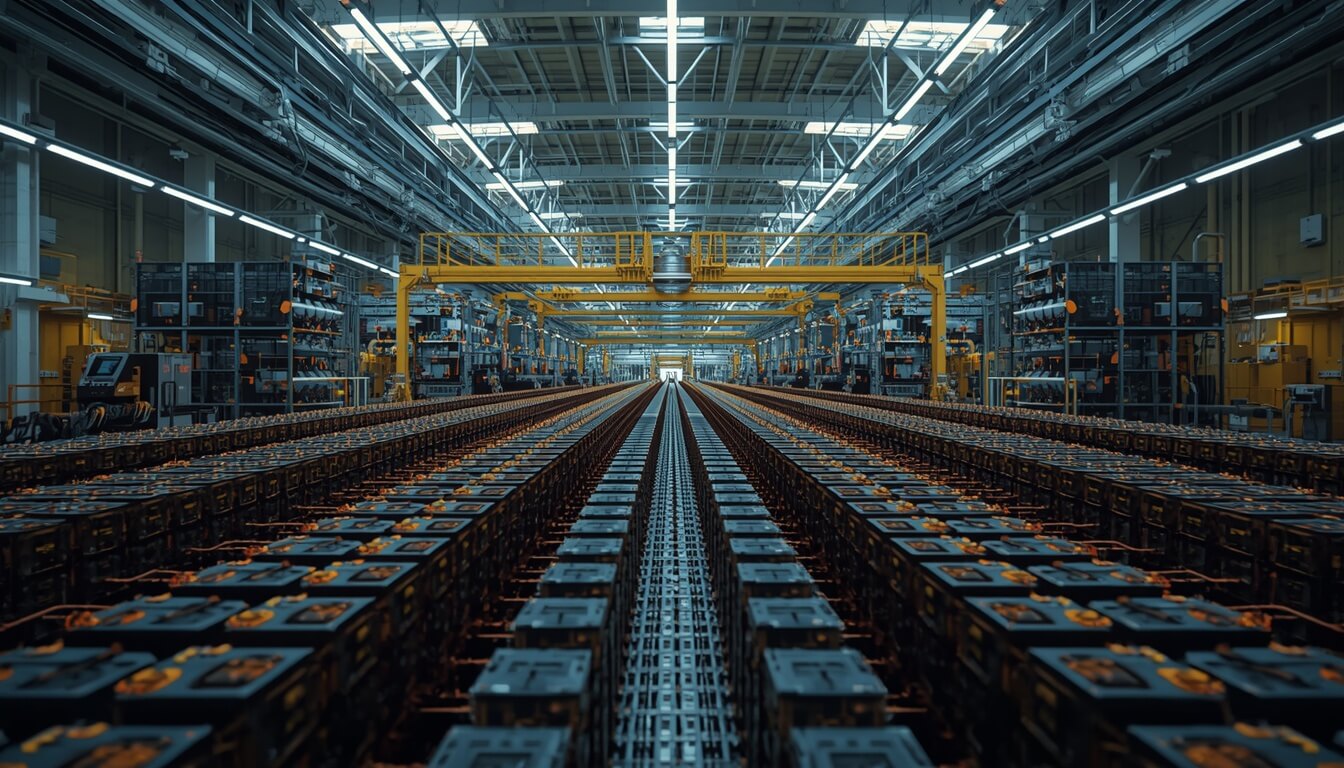
Batteries have become one of the most important technologies in the global industrial economy. They are no longer limited to consumer electronics or conventional electric vehicles. Advances in battery technology are increasingly connected to transportation, renewable energy, electricity grids, industrial equipment and the broader transition toward electrification.
This has created a global race to develop batteries that can store more energy, charge faster, last longer, operate safely and remain economically competitive. The challenge is not simply to invent a better battery chemistry. Companies and countries also need to manufacture batteries at enormous scale, secure raw materials, improve production processes and develop supply chains capable of supporting increasingly large volumes.
The result is a competition that combines scientific research with industrial capacity.
Battery Technology Is Becoming a Strategic Industry
For decades, improvements in battery technology were largely driven by the needs of portable electronics. The rapid expansion of smartphones, laptops and other consumer devices helped establish lithium-ion batteries as the dominant rechargeable technology.
Electric vehicles changed the scale of the problem.
A vehicle requires a much larger battery pack than a smartphone, while automotive manufacturers also demand predictable performance, long operating life, high safety standards and competitive costs. As electric vehicle production has expanded, battery manufacturing has consequently become one of the most important components of the automotive value chain.
The technology is also evolving.
Lithium-ion batteries can use different combinations of cathode, anode, electrolyte and other materials. Lithium iron phosphate (LFP) has become increasingly important because of its cost and durability characteristics, while nickel-based chemistries remain relevant where higher energy density is a priority.
At the same time, companies and research institutions are investigating technologies that could eventually complement or replace today's dominant configurations. These include sodium-ion batteries, solid-state batteries and other approaches designed to improve energy density, safety, charging performance or raw-material requirements.
The global race therefore involves multiple technological paths rather than a single competition over one battery design.
Energy Density Is Only One Part of the Equation
Battery development is often described in terms of energy density: how much energy a battery can store relative to its weight or volume.
Energy density is important, particularly for electric vehicles. A lighter battery capable of storing the same amount of energy can potentially increase vehicle efficiency, range or usable cargo capacity.
But higher energy density does not automatically make a battery commercially superior.
Manufacturers must also consider cost, cycle life, charging speed, thermal management, safety and availability of raw materials. A battery that performs exceptionally well in a laboratory may not be attractive if it is too expensive or difficult to manufacture at scale.
This distinction between technological performance and industrial viability is becoming increasingly important. The next generation of batteries will be judged not only by laboratory specifications but by how effectively the technology can move from research facilities into millions of commercially produced cells.
Manufacturing Scale Is Becoming a Competitive Advantage
Battery manufacturing is an unusually scale-intensive business.
Large factories require significant investment in equipment, materials, quality-control systems and specialized production processes. Manufacturing yields also matter because even small inefficiencies can become economically significant when production reaches millions of cells.
Companies that manufacture large volumes can accumulate operational knowledge that is difficult to reproduce quickly. They can refine production equipment, improve quality control, optimize material usage and reduce manufacturing costs through experience.
This creates an important feedback loop.
Higher production volumes can lead to lower costs and better manufacturing expertise, which can support further production growth. As a result, the battery industry is not simply a contest between different chemistries. It is also a contest between industrial systems.
The relationship between technology and manufacturing capacity becomes particularly visible when comparing major battery producers. Companies such as CATL and BYD have built extensive manufacturing capabilities while continuing to invest in battery research and development. Their position illustrates how technological innovation and production scale increasingly reinforce one another.
The competitive landscape surrounding these companies is examined in greater detail in CATL, BYD and the Competition to Control Battery Technology.
The Importance of Battery Architecture
Battery innovation is not limited to chemistry.
The physical design of battery cells and packs is also changing. Manufacturers are experimenting with different cell formats, structural designs and methods of integrating batteries into vehicles.
One important objective is to reduce the amount of material and hardware required around the cells themselves. If battery packs can become structurally simpler, manufacturers may reduce weight, improve packaging efficiency and potentially lower costs.
This is particularly relevant for electric vehicles because the battery represents a major share of the vehicle's overall cost and weight.
Manufacturers are therefore competing across several layers simultaneously: cell chemistry, cell design, battery management systems, thermal management, pack architecture and manufacturing processes.
This makes battery technology increasingly similar to other complex industrial technologies in which competitive advantage comes from integrating many components rather than optimizing a single specification.
Charging Speed Could Reshape the Competitive Landscape
Another major area of development is charging.
Range remains important to electric vehicle adoption, but charging time can influence how consumers perceive the practicality of electric transportation. Faster charging could reduce the importance of very large battery packs by making it easier to replenish energy during longer journeys.
Achieving faster charging, however, requires more than simply increasing electrical power.
Battery chemistry, thermal management, charging infrastructure and battery-management software all have to work together. Extremely rapid charging can also increase thermal stress and influence battery degradation if the system is not properly designed.
Consequently, fast charging is becoming another area in which battery manufacturers can differentiate their technologies.
The companies capable of combining charging performance with long battery life, safety and manageable costs could have an important role in the next phase of the market.
Alternative Chemistries Are Expanding the Field
Lithium-ion technology currently dominates rechargeable batteries, but the industry's future is unlikely to depend on a single chemistry.
Sodium-ion batteries have attracted attention because sodium is more abundant than lithium and can potentially reduce dependence on some constrained materials. Their characteristics may make them particularly relevant for applications where cost and resource availability are more important than maximum energy density.
Solid-state batteries represent another major research direction. By replacing conventional liquid or gel electrolytes with solid materials, researchers hope to improve safety and potentially increase energy density.
However, commercializing a new battery technology at large scale is difficult.
A promising chemistry must pass extensive testing, integrate with existing manufacturing infrastructure and achieve competitive economics. The transition from laboratory prototype to mass production can therefore take years.
This is one reason why established battery manufacturers have an important role in the technology race: they already possess factories, supply relationships, engineering teams and experience with high-volume production.
Raw Materials Remain Part of the Technology Race
Battery technology cannot be separated from the materials required to produce batteries.
Lithium, nickel, cobalt, graphite, manganese and other materials are important across different battery chemistries. The quantities required and the relative importance of each material vary depending on the cell design.
As battery production expands, manufacturers must secure reliable access to these inputs while managing price volatility, geographical concentration and processing capacity.
This creates a connection between technological choices and supply-chain strategy.
A chemistry that reduces reliance on a particular scarce or expensive material may offer manufacturers an industrial advantage even if its theoretical performance is not the highest available.
The resulting competition increasingly extends beyond factories and laboratories into mining, refining, processing, recycling and logistics. The broader supply-chain dimension is explored in Why Battery Supply Chains Are Becoming a Strategic Industrial Battleground.
Recycling Could Become More Important
Battery recycling is another emerging component of the industry.
As the number of electric vehicles and large-scale energy-storage systems increases, more batteries will eventually reach the end of their initial operating lives. Recovering valuable materials could reduce the need for some new raw-material extraction and create an additional source of supply.
Recycling technology is still developing, and the economics vary depending on battery chemistry, collection systems and processing costs.
Nevertheless, recycling could become increasingly important as the installed base of batteries grows.
In the long term, the battery industry may therefore develop a more circular structure in which materials move between mining, manufacturing, use, collection and recycling rather than following a predominantly linear path.
A Competition Between Technology and Industrial Execution
The global battery race is ultimately about more than finding a superior chemical formula.
The most important advances may come from the combination of chemistry, engineering, manufacturing scale, supply-chain management and cost control.
A company may develop a technically impressive battery, but commercial success requires the ability to produce it reliably and economically. Conversely, a manufacturer with enormous production capacity can face challenges if its technology falls behind competing solutions.
This makes the battery industry particularly interesting from an industrial perspective. Technological progress and manufacturing capability are becoming increasingly interconnected.
CATL, BYD and other major manufacturers are competing not only to develop new cells but also to improve production systems, secure materials and establish relationships across the broader battery ecosystem.
The next phase of the industry will therefore depend on how these different capabilities interact.
As electric vehicles, grid storage and other electrified applications expand, batteries are becoming a foundational industrial technology. The companies and regions capable of combining technological development with large-scale manufacturing and resilient supply chains will play an increasingly important role in determining how the global battery industry evolves.