
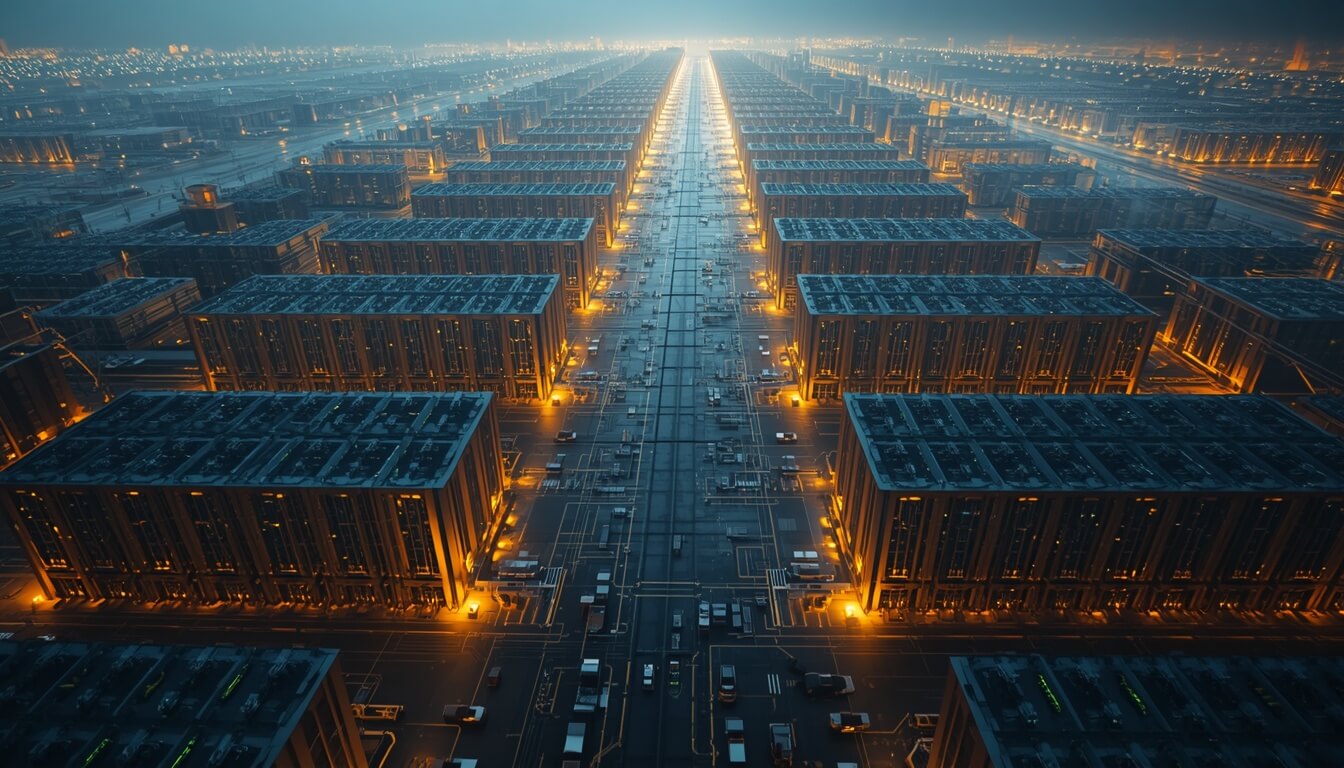
Artificial intelligence is changing the scale and economics of data center construction. For years, cloud computing infrastructure expanded through networks of large facilities distributed across regions and availability zones. AI is introducing a different requirement: enormous concentrations of computing power capable of supporting increasingly demanding training and inference workloads.
This is creating a new race to build some of the largest data centers ever conceived.
The competition is not simply about installing more servers. AI facilities require advanced accelerators, high-density networking, sophisticated cooling systems and enormous amounts of electricity. They also need suitable land, grid connections and access to infrastructure capable of supporting construction at unprecedented scale.
As a result, the companies building AI infrastructure are increasingly competing across several layers of the physical economy.
From data centers to AI factories
Traditional cloud data centers were designed around a relatively broad range of workloads. Enterprise applications, databases, storage and conventional computing could be distributed across large numbers of machines.
AI workloads can be substantially different.
Training a large model may require thousands or even tens of thousands of specialized accelerators operating together. These systems must communicate at extremely high speeds, which means that the architecture of the facility becomes closely connected to the architecture of the computing cluster.
The result is a concept increasingly described as an AI factory: a facility designed primarily to transform electricity, computing hardware and data into AI models and inference capacity.
Scale therefore becomes important for more than simple economies of size. A sufficiently large facility can support a much larger computing cluster and potentially reduce some of the logistical complexity associated with operating many smaller sites.
The physical requirements, however, are substantial.
The new generation of hyperscale facilities
The world's largest cloud companies are already accustomed to building hyperscale infrastructure. Companies such as Microsoft, Amazon, Google and Meta have invested heavily in data center campuses capable of supporting massive cloud workloads.
The emergence of generative AI is increasing the scale of those investments.
At the same time, specialized AI companies and their infrastructure partners are becoming important participants in the market. Partnerships between technology companies, cloud providers, chip manufacturers, utilities and infrastructure developers are creating increasingly complex investment structures.
The objective is not necessarily to construct a single building containing the largest number of servers. Instead, companies are developing campuses that can expand over multiple phases.
A large site can therefore become a strategic asset because it may provide room for several generations of computing infrastructure.
This changes the importance of location.
Location is becoming part of computing strategy
In the early cloud era, a data center's location was often evaluated according to factors such as:
- Network connectivity
- Proximity to customers
- Taxes
- Climate
- Reliability
AI adds another variable: the availability of electricity at sufficient scale.
A company may identify a site with excellent fiber connectivity and inexpensive land, but if the local electricity grid cannot provide hundreds of megawatts of additional capacity, the location may have limited value for a large AI campus.
This is one reason why the competition for AI infrastructure increasingly extends beyond technology companies.
Developers are competing for suitable land. Utilities are evaluating new generation and transmission projects. Governments are considering how new data centers fit into regional infrastructure planning.
The interaction between these factors is examined in more detail in How Data Center Companies Are Competing for Power, Land and Capacity.
Why size matters for AI
AI computing has a strong relationship between scale and performance.
Large model training can involve enormous datasets and sophisticated distributed computing systems. Accelerators must exchange information rapidly, requiring high-performance networking infrastructure.
A facility designed for AI therefore has to consider the entire computing system rather than treating servers as independent machines.
This can favor large, purpose-built campuses.
However, larger does not automatically mean more efficient. Very large facilities introduce significant engineering challenges:
- Power distribution becomes more complicated.
- Cooling requirements increase.
- Construction schedules become more difficult to coordinate.
The economics also depend on the utilization of the installed infrastructure.
Expensive accelerators that remain idle represent a significant capital cost. Consequently, the competitive advantage of a large AI campus depends not only on how much computing capacity it can install, but also on whether that capacity can be used effectively.
The importance of cooling
Electricity is not consumed only by computing chips.
AI accelerators generate substantial heat, particularly when deployed at high density. Traditional air cooling can become less practical as rack power increases, encouraging the adoption of liquid cooling and other advanced thermal-management technologies.
This means that AI data center design increasingly resembles an industrial engineering problem.
Power arrives at the facility, is distributed to high-density computing equipment, converted into computational output and ultimately released as heat. Every stage requires infrastructure.
The ability to deploy advanced cooling systems can therefore affect how much computing power a building can accommodate.
In some cases, the limiting factor may not be the physical size of the building but the amount of power and heat that the facility can manage.
The race is becoming multi-dimensional
The phrase "largest AI data center" can therefore mean several different things.
A facility can be large in terms of:
| Dimension | What it measures |
|---|---|
| Physical area | Land and building footprint |
| Electrical capacity | Megawatts available for computing |
| Number of accelerators | Total GPU/TPU/custom silicon deployed |
| Computing performance | FLOPS or effective throughput |
| Future expansion potential | Room for additional phases |
These measurements do not necessarily produce the same ranking.
A smaller site with a highly concentrated AI cluster could potentially provide more computing power than a much larger conventional facility. Conversely, a huge campus with substantial planned expansion may have greater long-term capacity even if much of the site is not yet operational.
This makes comparisons between projects increasingly complicated.
It also explains why companies are announcing enormous infrastructure plans years before all the associated computing capacity is operational.
Capital is moving upstream
AI infrastructure investment is increasingly extending beyond the purchase of servers.
Companies need to secure:
- Land
- Electricity
- Substations and transmission infrastructure
- Cooling equipment
- Construction capacity
- Networking
The capital requirements can therefore be enormous.
This creates opportunities for a broad ecosystem of infrastructure companies, including construction firms, electrical equipment manufacturers, power developers, cooling specialists and network providers.
It also creates potential bottlenecks.
If the supply of advanced accelerators grows faster than the availability of electricity or data center capacity, hardware cannot simply be deployed immediately. Conversely, building electrical infrastructure without sufficient computing demand creates a different economic risk.
The entire system has to expand in coordination.
Electricity as a strategic resource
Among all these constraints, electricity is increasingly central.
An AI data center can require dramatically more power than a conventional enterprise computing facility. As clusters become larger, the availability of reliable electricity can determine whether a proposed project can actually be built.
This is why electricity is becoming a strategic component of AI infrastructure rather than simply an operating expense.
The relationship between power availability and competitive positioning is explored in Why Electricity Is Becoming a Competitive Advantage in AI Infrastructure.
A new infrastructure competition
The AI data center race is ultimately a competition to build an interconnected physical system.
The companies involved are not competing only over processors or software platforms. They are competing over the ability to transform capital, land, electricity and engineering capacity into usable computing infrastructure.
The largest facilities will therefore depend on much more than technological ambition.
They will require access to:
- Power
- Suitable locations
- Advanced cooling
- High-speed networks
- Construction expertise
- Long-term financing
As AI adoption expands, the ability to assemble these resources at scale may become one of the defining characteristics of the next generation of technology infrastructure.
The race to build larger AI data centers is consequently becoming a race to control the physical foundations on which AI computing depends.