
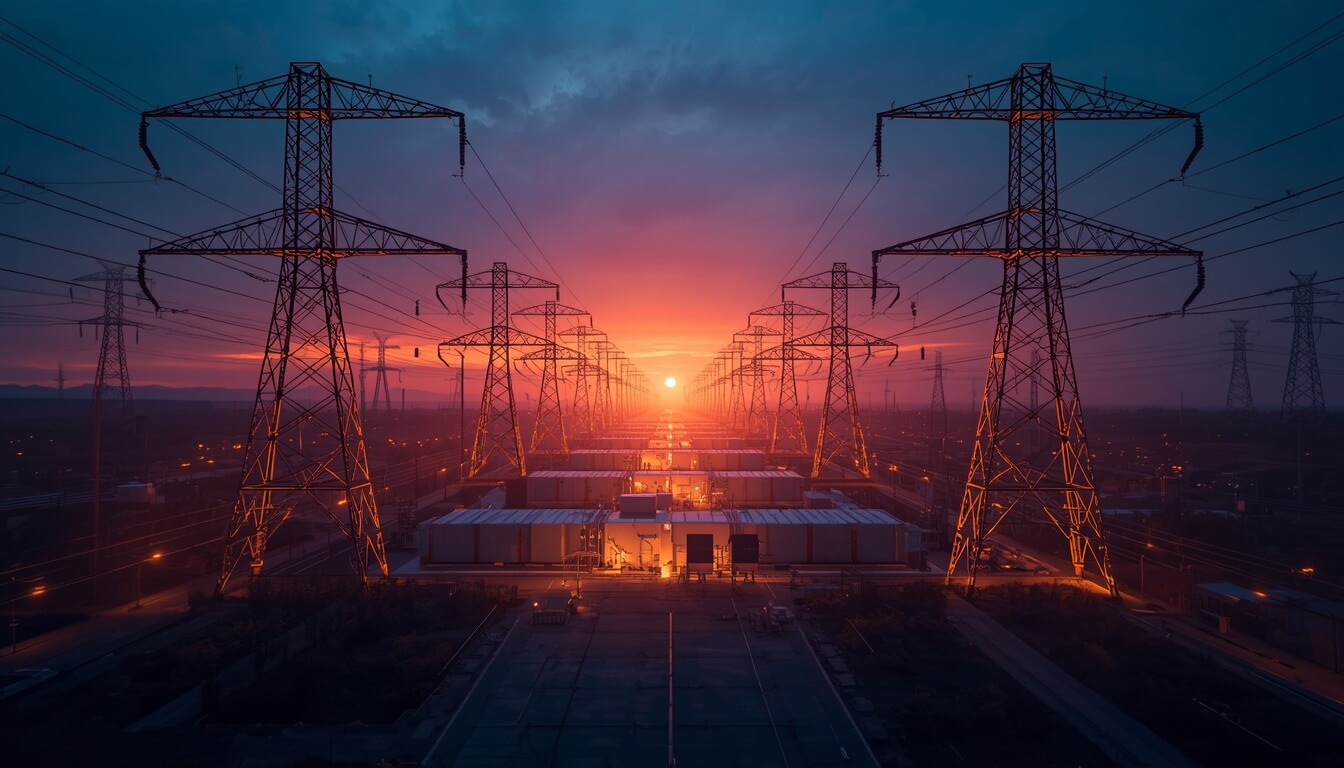
Artificial intelligence is creating a new relationship between computing and electricity.
For much of the history of the technology industry, electricity was treated primarily as an operating requirement. Data centers needed reliable power, but competition between technology companies was generally associated with processors, software, networks and services.
The expansion of AI is changing that relationship.
Modern AI systems can require extremely large concentrations of computing power, particularly during the training of advanced models and the operation of large inference systems. As a result, access to electricity is becoming increasingly important when companies plan new computing infrastructure.
Power is no longer simply something a data center consumes.
It can influence where a facility is built, how quickly it can become operational and how much computing capacity it can ultimately support.
AI changes the power equation
Traditional data center workloads can be distributed across many servers and facilities.
AI workloads can be considerably more concentrated.
A large training cluster may contain thousands of accelerators operating simultaneously. These systems also require high-speed networking and advanced cooling, creating additional electrical demand beyond the computing chips themselves.
The result is a much larger power requirement per facility.
This creates an important infrastructure challenge.
If demand for AI computing grows faster than available electricity infrastructure, data center development can become constrained even when companies have sufficient access to capital and computing hardware.
The competition for electricity therefore becomes part of the competition to build AI infrastructure.
Electricity availability can determine location
A company considering a new AI data center has to evaluate several variables.
Land is necessary, but land alone is insufficient.
The site must have access to electrical infrastructure capable of supporting the planned load. In many cases, this means evaluating transmission lines, substations and the potential for future grid expansion.
This can dramatically change the relative attractiveness of different locations.
A site with inexpensive land but limited grid capacity may be difficult to develop.
A site with established electrical infrastructure and potential access to additional generation may command a higher economic value even if the underlying land is more expensive.
The broader competition for these resources is discussed in How Data Center Companies Are Competing for Power, Land and Capacity.
The importance of reliability
The quantity of electricity is only one part of the equation.
AI data centers also require reliable power.
Interruptions can disrupt computing workloads, reduce utilization and potentially affect large distributed training processes.
This makes power reliability an important consideration when selecting infrastructure.
Data center operators traditionally use redundant electrical systems, backup generators, batteries and other technologies to reduce the consequences of outages.
As facilities become larger, however, the scale of the supporting infrastructure also increases.
Reliability therefore has both technical and economic dimensions.
Power density is changing
One of the most important characteristics of AI infrastructure is power density.
A conventional server rack may consume significantly less power than a rack filled with high-performance AI accelerators.
As accelerator performance increases, the amount of electricity required within a relatively small physical area can also increase.
This affects data center design.
Electrical distribution systems must handle larger loads. Cooling systems must remove more heat. Buildings may require different rack layouts and liquid cooling technologies.
The result is that power density can become a limiting factor even when there is sufficient total floor space.
A data center may have room for additional equipment but not enough electrical or thermal capacity to operate it.
Cooling turns electricity into another infrastructure problem
Almost all the electricity consumed by computing equipment eventually becomes heat.
AI therefore creates a close relationship between power infrastructure and cooling infrastructure.
A facility capable of supplying additional electricity must also be capable of removing the resulting heat.
This can require liquid cooling, specialized heat exchangers and redesigned data center architectures.
Consequently, the electricity requirement of AI cannot be analyzed independently from thermal management.
More computing power means more electrical demand, which generally means more heat that must be managed.
This interdependence can affect both construction costs and operational efficiency.
Generation and transmission matter
The growth of AI data centers is also bringing greater attention to electricity generation and transmission.
A region may have substantial generating capacity but still face constraints in delivering that electricity to a specific location.
Transmission networks have physical limits.
Adding a major new data center load can therefore require investment in substations and transmission infrastructure.
This creates a time problem.
A technology company may be able to plan a new computing campus relatively quickly, while large electricity infrastructure projects can require lengthy planning, permitting and construction processes.
The ability to coordinate these timelines can become important for data center developers.
Long-term power visibility
AI infrastructure is typically designed with a long operating horizon.
Companies investing billions in a large campus need some degree of visibility into future operating conditions.
Electricity prices and availability therefore become important financial variables.
Long-term electricity contracts can potentially provide greater predictability. In some markets, companies may also pursue direct arrangements with power producers or invest in new generation capacity.
The objective is not necessarily to obtain the lowest possible electricity price at every moment.
For a large AI facility, predictability and scalability can be equally important.
A stable power supply that can expand as the campus grows may be more valuable than an initially inexpensive supply that cannot accommodate additional demand.
Why power can influence computing strategy
Electricity availability can also influence how companies deploy computing resources.
If a company operates multiple data centers across different regions, workloads can potentially be distributed according to capacity, network conditions and operational requirements.
This creates an interaction between physical infrastructure and cloud architecture.
Computing capacity is no longer completely independent of geography.
The physical location of electricity can influence the location of computing capacity, while the location of computing capacity can influence how AI services are delivered.
This relationship becomes increasingly important as AI workloads scale.
The emerging value of energy-rich locations
Historically, technology companies often concentrated infrastructure near major population centers or established internet hubs.
AI may encourage greater interest in locations with abundant electricity and suitable infrastructure.
Such regions can potentially offer a combination of:
- Land availability
- Generation capacity
- Room for expansion
However, moving data centers to new regions also introduces trade-offs.
Network connectivity, latency, workforce availability, water resources, permitting and local infrastructure must all be considered.
Electricity is therefore not the only determinant of location.
It is becoming one of several strategic variables that must be optimized simultaneously.
Electricity as a competitive infrastructure asset
The growing importance of power changes the competitive structure of the AI industry.
Companies that secure suitable electricity infrastructure may be able to deploy computing capacity more rapidly.
Those that have to wait for grid upgrades may face longer development timelines.
This does not necessarily mean that access to electricity determines the success of an AI company. Software quality, hardware availability, capital, customers and operational execution remain important.
But electricity availability can increasingly determine how quickly physical computing capacity can be added.
That makes energy infrastructure an important component of competitive positioning.
The race for massive AI facilities
The broader transformation can be seen in the scale of new AI data center projects.
The industry is moving toward campuses designed to accommodate very large computing clusters and multiple expansion phases.
These projects require coordination between technology companies, data center developers, utilities, construction firms and equipment suppliers.
The scale of this transformation is examined in The Race to Build the World's Largest AI Data Centers.
The important change is that AI infrastructure is becoming increasingly dependent on physical systems that historically received less attention in technology discussions.
A new infrastructure bottleneck
The AI industry has demonstrated how quickly demand for computing can grow.
Electricity infrastructure generally cannot expand at the same speed.
Generation assets, transmission networks and substations require physical construction and regulatory processes. Their development follows longer investment cycles than software deployment.
This creates the possibility of an infrastructure bottleneck.
If electricity becomes the limiting factor, access to advanced processors alone will not determine how quickly new AI computing capacity can be deployed.
The limiting resource may instead be the electrical infrastructure required to operate those processors.
From computing competition to energy competition
The AI infrastructure race is therefore expanding beyond chips and software.
Companies are increasingly competing for access to the physical resources required to operate large computing systems:
- Electricity
- Land
- Cooling
- Network connectivity
- Construction capacity
Among these resources, electricity has a particularly central role because it connects almost every other part of the system.
More computing requires more power.
More power requires stronger electrical infrastructure.
More computing also produces more heat, requiring more cooling.
And larger facilities require more land and supporting infrastructure.
The result is an interconnected industrial system in which energy availability can influence the pace and scale of AI infrastructure deployment.
The next phase of AI competition will therefore not take place entirely inside laboratories or software platforms. It will also take place across power grids, industrial sites and data center campuses.
As AI computing continues to scale, electricity is becoming not just an input to the technology industry, but an increasingly important part of the infrastructure on which its expansion depends.