
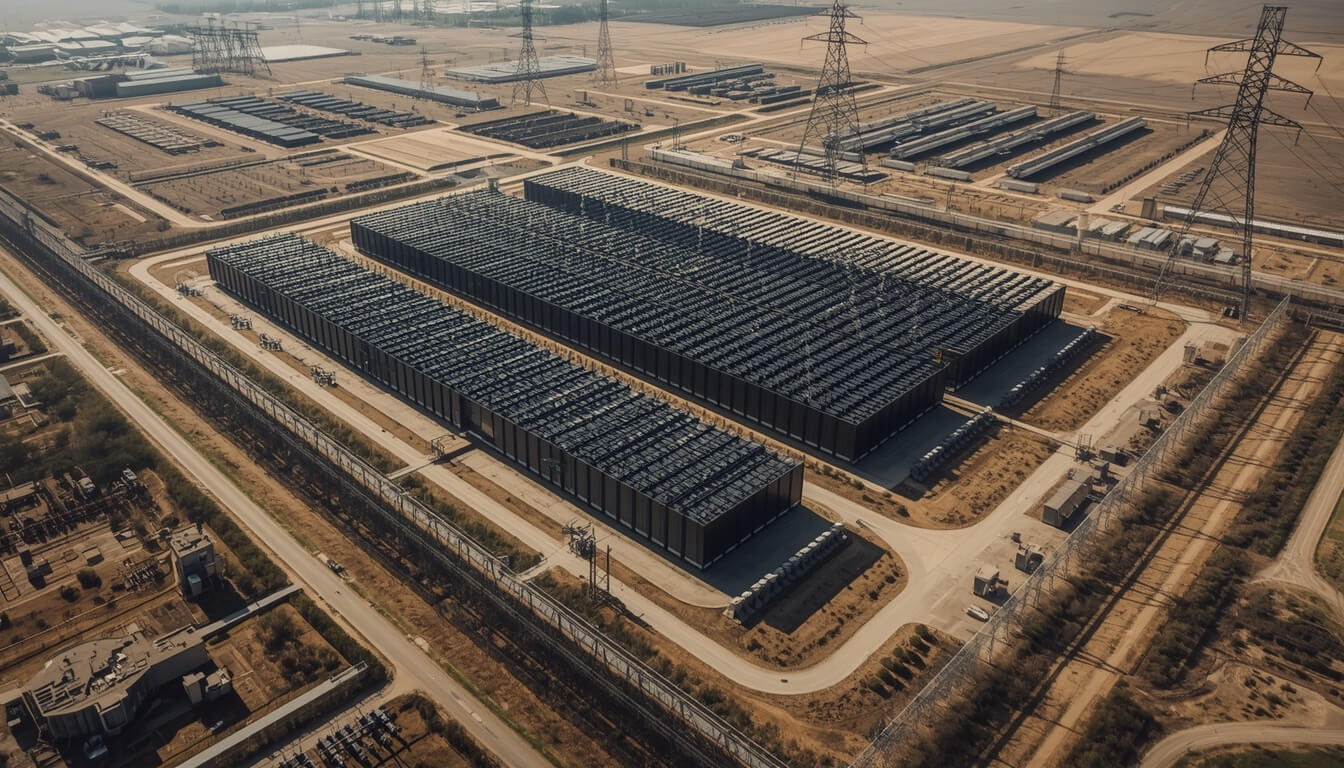
The rapid expansion of artificial intelligence is creating a new challenge for the data center industry: finding enough physical infrastructure to support the computing capacity required by modern AI workloads.
For decades, data center development focused heavily on connectivity, proximity to customers, operating costs and access to reliable infrastructure. AI is changing the equation.
A large AI cluster can require enormous amounts of electricity and specialized cooling infrastructure. At the same time, developers need sufficiently large sites, transmission connections and construction capacity.
This means that competition between data center companies increasingly takes place before a server is installed.
The critical question is often not simply whether a company can buy enough computing hardware, but whether it can find a location where that hardware can actually operate at scale.
Power is becoming a development constraint
Electricity is one of the most important resources in data center development.
A conventional facility may have relatively predictable power requirements. AI infrastructure can create much larger and more concentrated loads because thousands of accelerators may operate simultaneously.
This creates challenges for utilities and developers.
A data center operator may identify a suitable site and have sufficient capital to construct a facility, yet still face a long wait before the local grid can provide the required electricity.
Transmission lines, substations and generation capacity cannot always be expanded as quickly as computing demand.
Consequently, access to power can influence which projects are built first.
The growing importance of electricity is examined separately in Why Electricity Is Becoming a Competitive Advantage in AI Infrastructure.
Land is more than physical space
Land availability is another increasingly important factor.
Large AI campuses require space for:
- Buildings
- Substations
- Cooling equipment
- Backup systems
- Roads and supporting infrastructure
The ideal site may also need to accommodate future expansion.
This creates a difference between land that is technically available and land that is strategically useful.
A large parcel in a remote location may appear inexpensive, but if it lacks transmission infrastructure or fiber connectivity, development can be difficult.
Conversely, land near a major power corridor may command a significant premium because it can potentially support faster infrastructure deployment.
The economic value of a data center site is therefore increasingly determined by the infrastructure surrounding it.
The race for suitable locations
Data center developers are examining a growing range of locations.
Traditional technology hubs remain important because they provide established fiber networks, skilled labor and existing data center ecosystems.
However, the enormous electricity requirements of AI are encouraging companies to consider regions where power availability may be more favorable.
This can lead to a geographic shift in data center development.
Locations with large industrial power infrastructure, available land and access to generation can become attractive even if they are far from traditional technology centers.
The result is a more distributed infrastructure map.
AI computing does not necessarily need to be located directly beside the end user. Many workloads can be processed remotely, provided that connectivity and latency requirements are satisfied.
This creates more flexibility for developers, although not every AI application has identical networking requirements.
Capacity has several meanings
The word "capacity" is often used broadly in discussions about data centers.
It can refer to different things, and these are related but distinct:
| Type of capacity | What it refers to |
|---|---|
| Physical building capacity | Floor space and structural footprint |
| Electrical capacity | Megawatts available for computing and cooling |
| Rack capacity | Number and density of equipment racks |
| Computing capacity | Total accelerator performance available |
| Network capacity | Bandwidth and latency between nodes |
A building may have sufficient floor space for thousands of servers but lack enough electricity to operate them.
A site may have a power connection but insufficient cooling infrastructure.
A facility may have power and cooling but lack the high-speed networking required by a large AI cluster.
This means that developing AI infrastructure requires coordination across multiple systems.
The most valuable sites are therefore those where several constraints can be solved simultaneously.
Speed can become an advantage
The timing of infrastructure development is increasingly important.
AI hardware evolves rapidly. A project that takes several years to complete may begin with one generation of accelerators and become operational when a newer generation is available.
This creates pressure to shorten construction and deployment cycles.
Companies that already control suitable land and infrastructure may have an advantage in terms of deployment speed because they do not have to begin every project from scratch.
Existing campuses can potentially be expanded, while sites with established grid connections can avoid some of the delays associated with obtaining new connections.
This creates an important distinction between owning a data center and controlling a pipeline of future capacity.
The role of power contracts
Developers also need to consider how electricity will be sourced.
Long-term power purchase agreements, utility contracts and other arrangements can provide greater visibility over future electricity costs and availability.
For large AI projects, this visibility can become particularly important because power consumption may represent a substantial portion of operating expenses.
The structure of electricity procurement can therefore influence the economics of a facility.
Companies may evaluate not only the nominal price of electricity but also:
- Reliability
- Scalability
- The ability to increase supply over time
In this environment, an inexpensive power source that cannot support future expansion may be less useful than a somewhat more expensive source with predictable long-term availability.
The grid connection bottleneck
One of the most difficult constraints can occur between the data center and the electricity grid.
Adding a large industrial customer can require new substations, transmission upgrades or other network investments.
These projects can take years to plan, permit and construct.
This creates a potential mismatch between the speed of AI investment and the speed of electricity infrastructure development.
Technology companies can deploy capital quickly, but physical infrastructure operates on longer cycles.
That difference is becoming increasingly important for the AI industry.
Competition for construction capacity
The physical expansion of data centers also creates competition for construction resources.
Large projects require electrical engineers, construction workers, equipment manufacturers, cooling specialists and other contractors.
If multiple companies attempt to build enormous facilities simultaneously, bottlenecks can emerge across the supply chain.
This includes:
- Transformers
- Switchgear
- Backup power equipment
- Cooling systems
- Other specialized components
The data center industry therefore depends on a broader industrial ecosystem than the technology sector alone.
The companies capable of coordinating this ecosystem may be able to bring new capacity online more quickly.
AI infrastructure is becoming an industrial market
This shift is changing the identity of the data center industry.
Data centers were once viewed primarily as specialized real estate combined with computing equipment.
AI is pushing the sector closer to industrial infrastructure.
The core questions increasingly involve electricity, engineering, construction, logistics and long-term asset utilization.
The scale of the investment reinforces this transformation.
When a single campus requires enormous amounts of power and supporting infrastructure, decisions about its location can have consequences for local utilities, municipalities and regional development.
From individual facilities to infrastructure networks
The biggest AI projects are unlikely to operate as isolated buildings.
Companies are developing networks of facilities connected through high-speed communications infrastructure and coordinated cloud platforms.
This creates another layer of competition.
An operator with several geographically distributed sites can potentially manage workloads across locations depending on power availability, network requirements and computing demand.
Geographic diversification can also provide greater resilience.
However, building such networks requires substantial capital and long-term planning.
The first step remains securing the physical resources needed to construct each individual facility.
The broader race to build enormous AI campuses is described in The Race to Build the World's Largest AI Data Centers.
A different definition of location advantage
The traditional definition of a good data center location is changing.
Historically, proximity to population centers and network connectivity were central considerations.
For AI infrastructure, the equation increasingly includes:
- Electricity availability
- Land
- Cooling conditions
- Transmission access
- Expansion potential
This does not make connectivity irrelevant. Instead, it adds new constraints.
A site that combines several of these characteristics can become strategically valuable because solving them independently may be expensive or time-consuming.
The infrastructure race ahead
The AI data center industry is entering a period in which physical resources may become as important as computing hardware.
Companies will compete for sites, grid connections, construction capacity and long-term electricity supply.
Some projects will be able to expand quickly because the necessary infrastructure is already available. Others may face years of development before they can support significant AI workloads.
This creates a new infrastructure race beneath the visible competition between AI models and cloud platforms.
The winners of individual projects will ultimately depend on economics, execution, technology and infrastructure availability. What is increasingly clear, however, is that AI capacity cannot be created solely by purchasing more chips.
It requires a physical environment capable of powering, cooling, connecting and expanding those chips.
That makes power, land and capacity central components of the next phase of the data center industry.